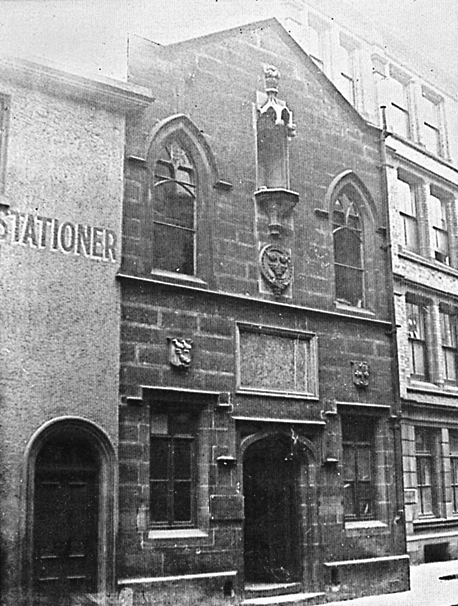
Let’s finish this series of High School puzzles with a third, and final, enigma. So let’s look at that photograph of the Stoney Street school again:
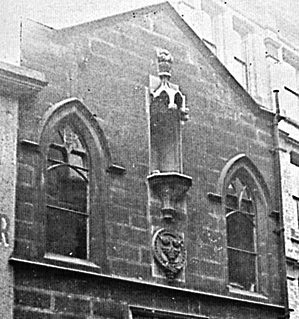
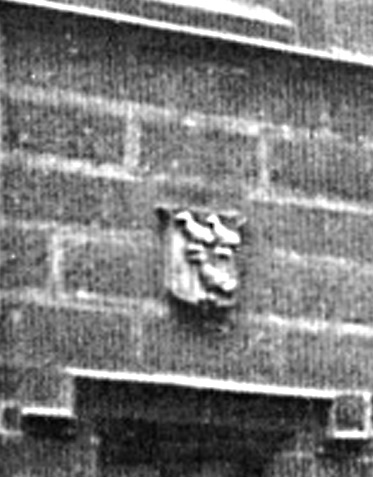
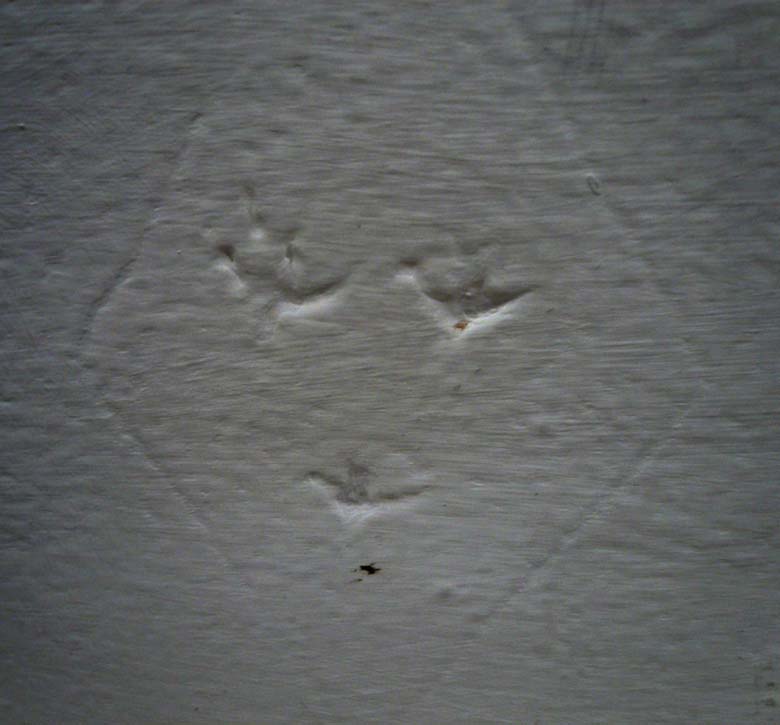
We already know where the pesky little merlettes are hiding, (four o’clock down from the word “stationer”) but what exactly is in the niche near the top of the building? Here is a photograph of nothing, this time seen in close up:
And I’ll ask the same question a second time. What exactly is in the niche near the top of the building? Well, here’s that photograph of nothing again…
Do you remember what a “vowess” was? Of course you do. It’s:
“a woman who has vowed chastity or devotion to a religious life; a nun”.
It’s what Dame Agnes Mellers became after her husband died.
But do you remember Mr. F. J. Snell’s words about a “vowess” in his book “The Customs of Old England” ? Why certainly! He said that:
“a “vowess” would never willingly forgo any opportunity of showing reverence to the Blessed Virgin”.
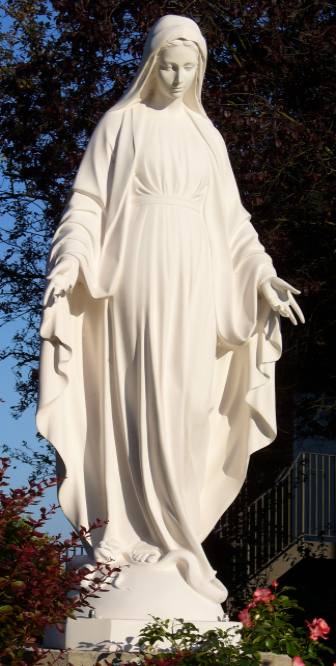
I would guess that, perhaps in the very small print, in Clause 42, sub-clause 69, of Dame Agnes’ bequest, acting as a staunch vowess, she had stipulated that this type of Roman Catholic statue should be on prominent display in her new, or perhaps, merely refreshed, school. After all, her school had started its life in a church dedicated to St Mary:
But then, twenty years later, once Henry VIII had decided that Roman Catholicism should no longer be the state religion, to have a statue of Mary, Mother of God, on display above the door of the school, must have become just “a statue too far”. It would have made the place look anti-Protestant. Anti-Church of England. It might even have reminded ordinary people of the fact that the Glorious King Henry VIII had taken advantage of the Reformation to steal billions of pounds worth of assets and land from the suddenly unwanted Roman Catholic Church. So one day, the statue of Mary, Mother of God, just wasn’t there any more. And few people noticed and those who did notice, knew that the best thing to do for their own safety was to keep their mouths firmly shut. And nobody ever mentioned the statue again.
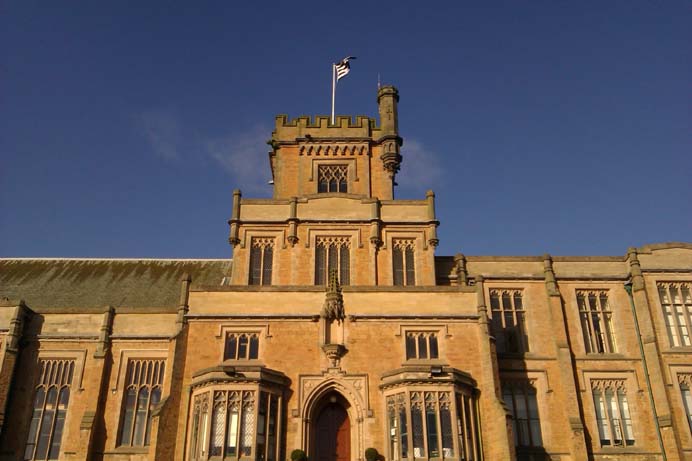
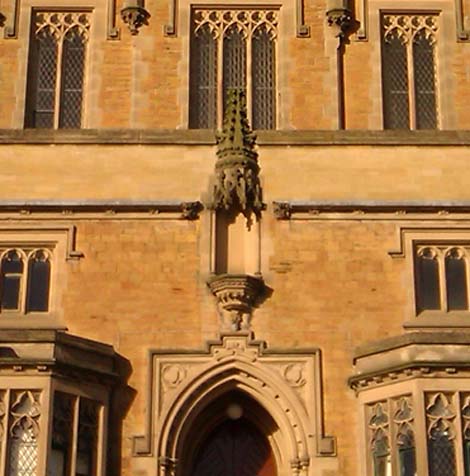
Presumably, this centuries old exclusion from the school’s premises of statues of the beatified members of the fairer sex will come to an end very soon. When the first girl crosses the threshold of her new, co-educational school, she will surely walk into the building under a statue of the Virgin Mary, just as Dame Agnes would have wanted. Surely we will not have to wait for the High School’s first Headmistress to put the matter straight?
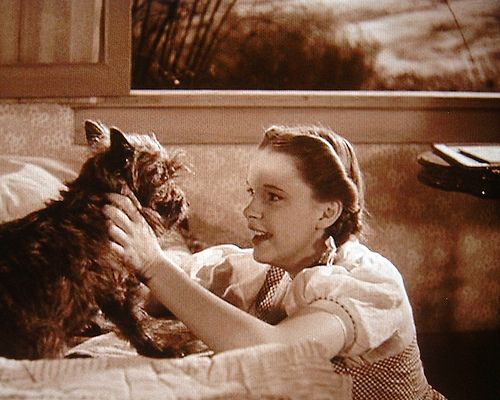
So far I have looked at how Nottingham has been affected by too much water, not enough water, weather that was too cold and weather that was too hot. There have never been any earthquakes or tsunamis here, thank goodness. That is not to say, though, that Nottingham has never been troubled by high winds. All right, it cannot rival Texas or Oklahoma. Neither Dorothy nor Toto ever lived here, and we just cannot compete with things like this:
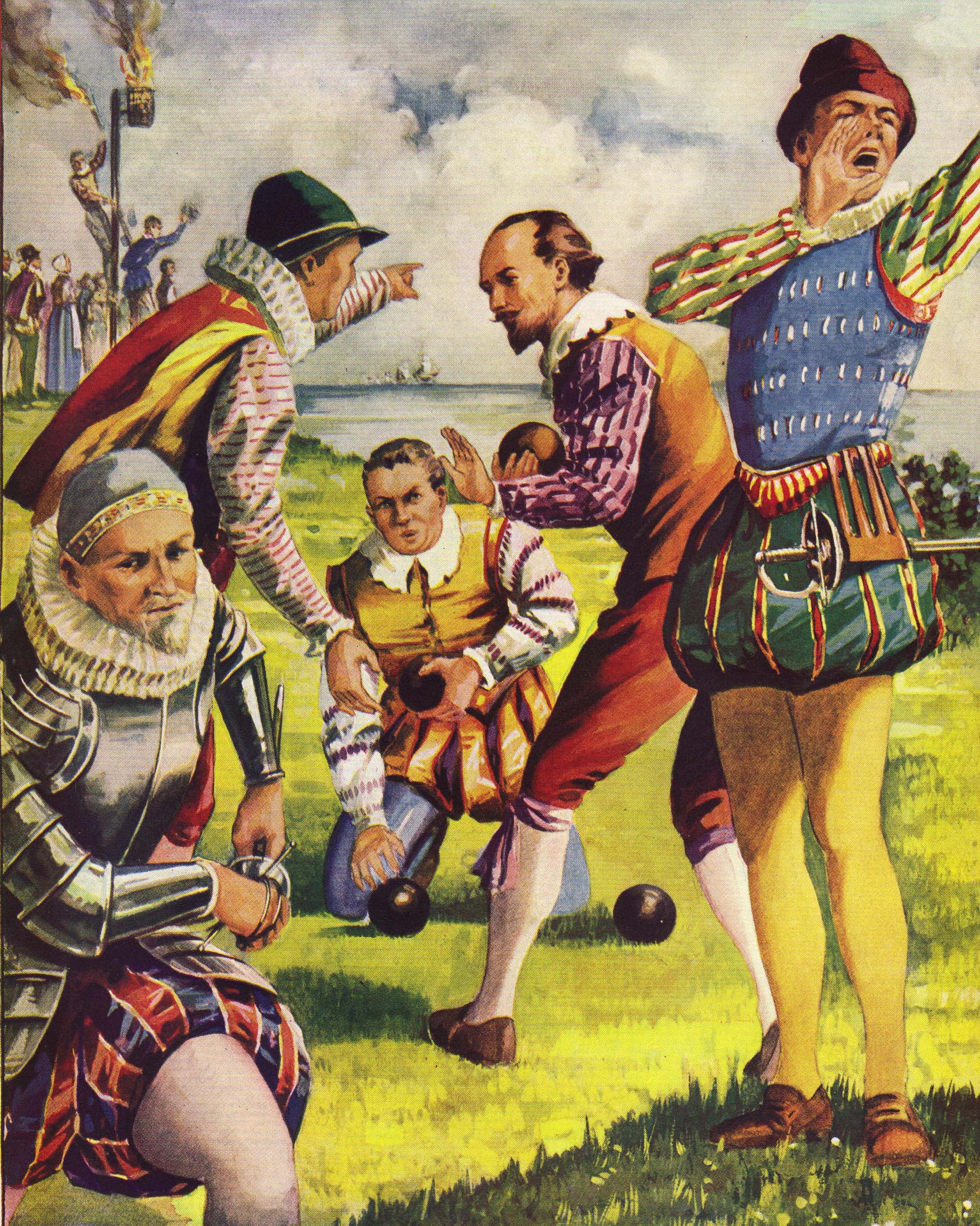
But we do try our hardest. We do our bit. Or at least we did do, way back in the sixteenth century. Just to continue with our policy of showing you the clothes and the costumes, so that you can work out what time period we are talking about, here are some of my favourite people from the era in question, having a game of bowls while they wait for a decision about the Armada from the European Court of Justice:
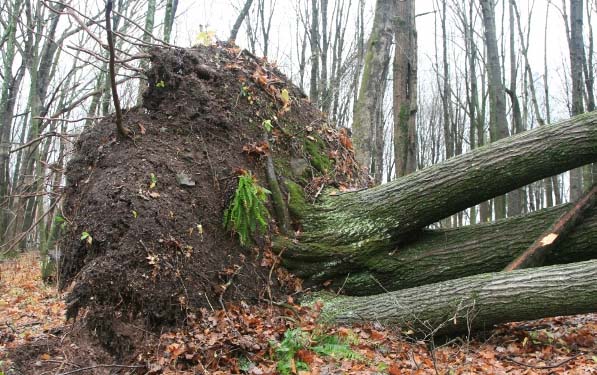
“On the 7th of July, this year, within a mile of Nottingham was a grievous tempest with thunder, which, as it came through beat down all the houses and churches, cast the bells to the outside of the church-yards, and twisted the sheets of lead like a pair of leather gloves and threw them four hundred foot into the field. The River Trent, running between the two towns, the water, with the mud in the bottom, was carried a quarter of a mile, and thrown against trees, with the violence whereof the trees were torn up by the roots, and cast twelve score yards off:
A child was taken out of a woman’s arms, and carried up into the air then let fall, had its arm broke and died. Also, a child was taken forth of a man’s hand and carried two spear’s length high, and then let fall two hundred feet off, of which fall it died.
Five or six men thereabouts were killed yet had neither flesh nor skin hurt. They were slain by the storm, during which, hailstones fell measuring fifteen inches in circumference.”
The “two towns” are thought to have been the villages of Wilford and Lenton which at the time were rural, agricultural villages of roughly similarly size, separated from the main town of Nottingham.
Elsewhere in the East Midlands, on an unknown date in July 1558, in Northamptonshire, there was a storm with immense hailstones some fifteen inches around:
I do not know if these two events were connected or not. Overall in England, it was a very hot summer in 1558 with long periods of drought throughout the whole year. In March of 1558 the country had already seen the “most destructive hurricane in England”, although I have been unable to locate the precise whereabouts of this occurrence, and Nottingham seems to have been unaffected.
Eighty or so years later, on Wednesday, October 13th 1666, there was a similarly violent storm just a little further north. Called a whirlwind at the time, it actually seems to have done enough damage to warrant being called a tornado. How fashion tastes change in only a hundred years:
“In Lincolnshire, there was a dreadful storm of thunder, accompanied with hail, the stones as large as pigeon or even pullet eggs, followed by a storm or tempest, attended with a strange noise. It came with such violence and force, that at Welbourn, it levelled most of the houses to the ground. It broke down some trees and tore up other trees by the roots. It scattered abroad much corn and hay. One boy only was killed. It went on to Willingmore (Wellingore?) , where it overthrew some houses and killed two children in them. Thence it passed on and touched the skirts of Nanby (Navenby?) and ruined a few houses. Keeping its course to the next town, where it dashed the church steeple in pieces, furiously damaging the church itself, both stone and timber work. It left little of either standing, only the body of the steeple. It threw down many trees and houses. It moved in a channel, not a great breadth. Otherwise it would have ruined a great part of the country. It moved in a circle and looked like fire. It went through Nottinghamshire, where the hailstones were nine inches about. The whirlwind was about 60 yards broad. On Nottingham Forest, it broke down and tore up at least 1,000 trees, overthrew many windmills, overturned boats on the River Trent. In a village of fifty houses, it left only seven standing.”
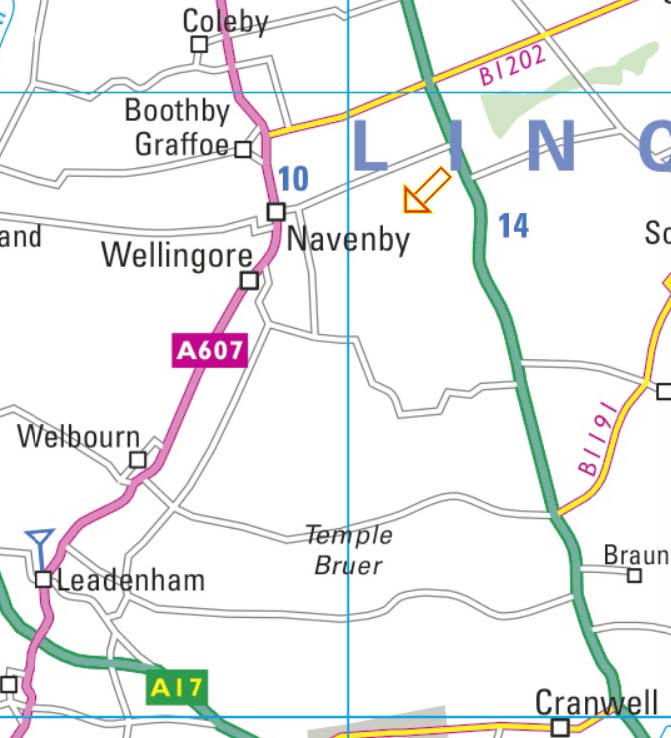
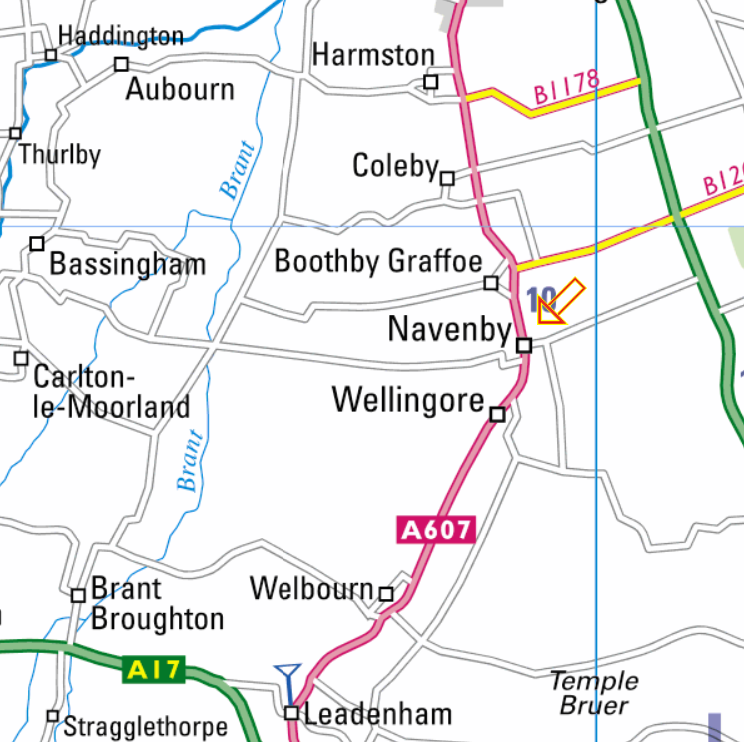
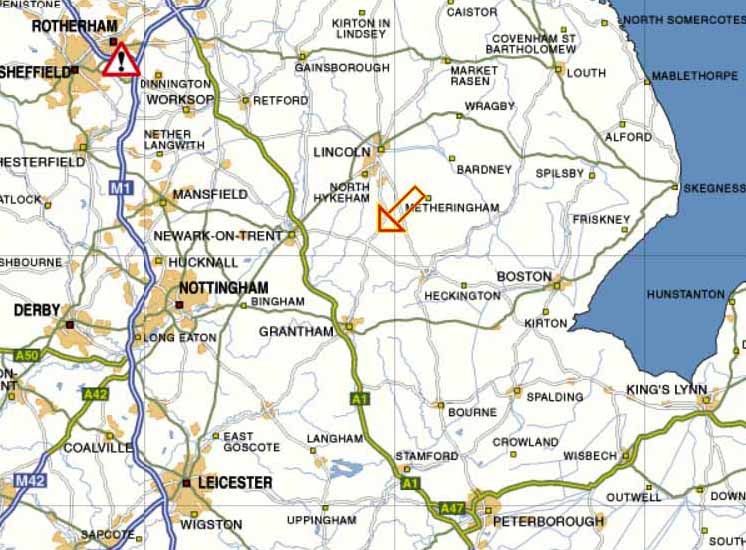
The original place names are given as Welbourn, Willingmore and Nanby. I have taken a quick look at the map and I think that Thomas was writing down the names of the places from a person who was talking to him. I can just imagine a local peasant of the time calling Wellingore, Willingmore and another slack jawed local pronouncing Navenby as Na’nby. As always, look for the orange arrow:
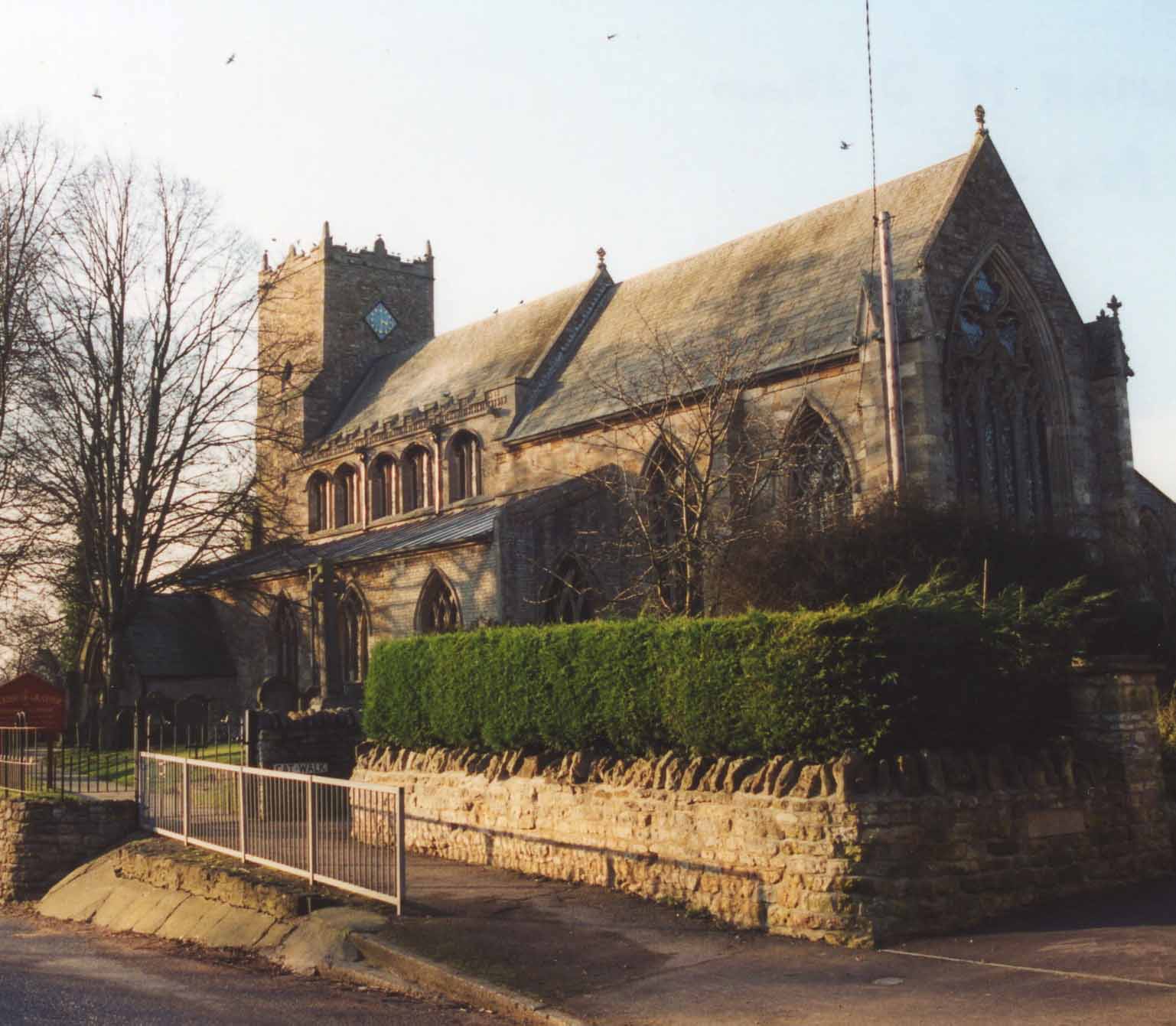
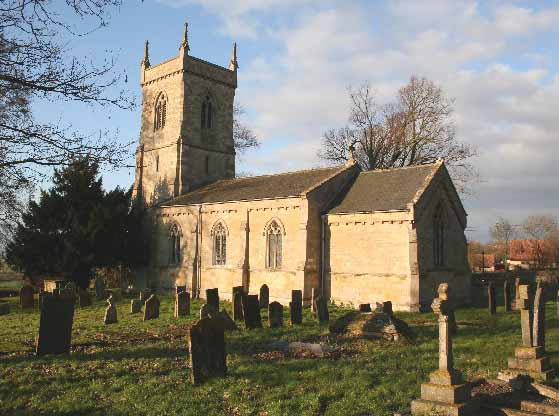
Here is St Chad’s Church in Welbourn, which survived the tornado more or less intact:
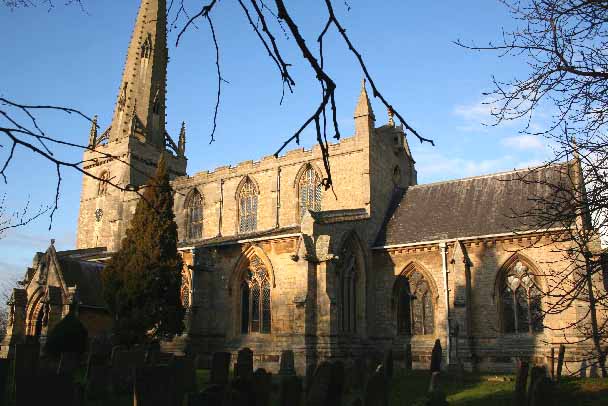
….and a church which over the course of the last 350 years seems to have recovered from what must have been, judging by Thomas’ account, a very bad hair day:
Here is a slightly better overview of the area to refresh your memory. All of my three best guess place names of Welbourn, Willingmore, and Navenby are in a nice, more or less straight line, as the tornado flies. It would be possible to argue that, if the fourth location is a genuine town sized town, then it might be Waddington, or even (less likely perhaps), the county capital of Lincoln. Boothby Graffoe, though, is a lovely village name. Perhaps not as striking as Norton Disney, but cute nevertheless.
Just take a look at this second map, showing clearly the path of the tornado through the three villages. I rest my case, as they say:
From my point of view, of course, the most interesting detail is the fact that:
“On Nottingham Forest, it broke down and tore up at least 1,000 trees.”
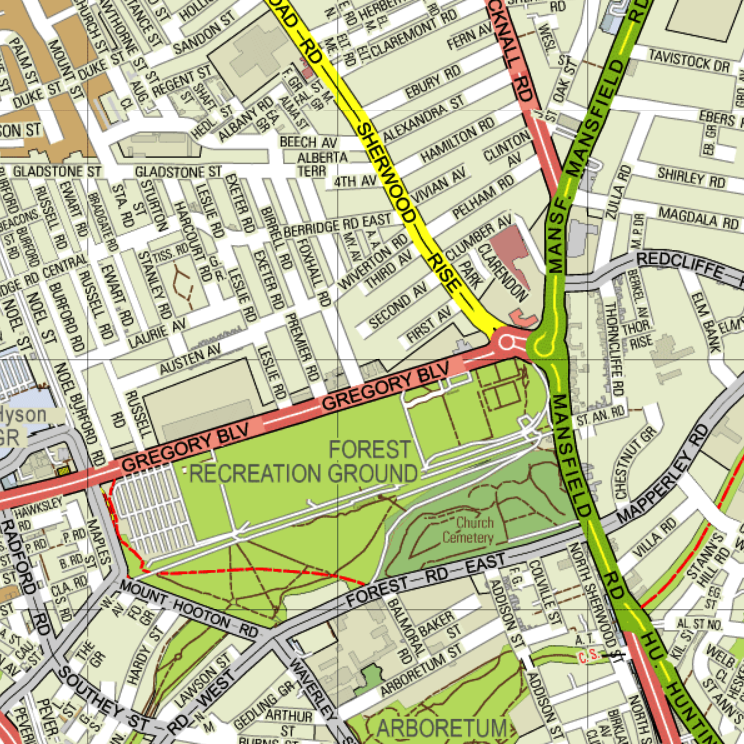
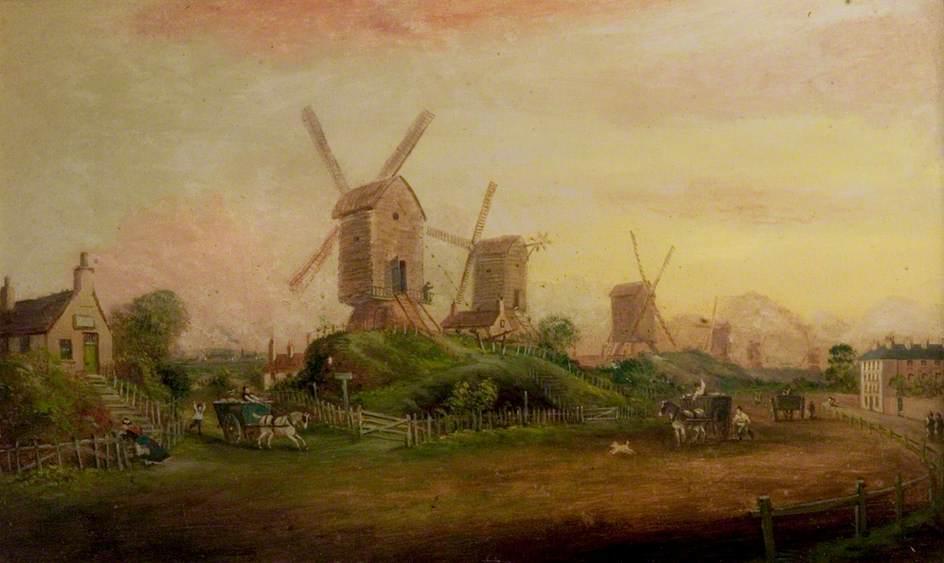
How do I know that this is the same place as Nottingham Forest? I know because of what used to be situated on Forest Road East, to the south of the green area marked “Forest Recreation Ground”. Here is an old, and no doubt, valuable oil painting of them. These are clearly what Richard was talking about when he mentioned that the whirlwind “overthrew many windmills”:
Enormous damage was occasioned in Nottingham:
“On Nottingham Forest, it broke down and tore up at least 1,000 trees, overthrew many windmills, overturned boats on the River Trent. In a village of fifty houses, it left only seven standing.”
In my opinion, this was because the tornado came from the south west, travelled, broadly speaking, to the north east, and was therefore much stronger in Nottingham than it was in Lincolnshire. This weather event may even be the reason that the Forest Recreation Ground was initially created. Having so many trees cut down together in what was then a heavily wooded part of Sherwood Forest itself, may have been the first step towards the vast open space that we all enjoy today. This map shows the general north easterly path of the tornado. The orange arrow points towards the Lincolnshire Three:
It is always difficult to prove a negative, but this map shows why mention of the tornado came only from Nottingham and the three small villages in Lincolnshire. Even now, 350 years later, there are comparatively few people living between the two localities to tell the story. And equally, there would have been, centuries ago, virtually nobody to tell it to.
Could somebody in England have recognised a tornado in 1666? Well, yes, he could, if he described the storm he saw as “attended with a strange noise”, as well as being “in a channel, not a great breadth”, “about 60 yards broad” and, most convincing of all, “It moved in a circle and looked like fire.” And don’t forget, it is always very difficult for a human being to describe something which is not within his terms of reference or his own personal experience.
Just compare those three hundred and fifty year old descriptions with this:
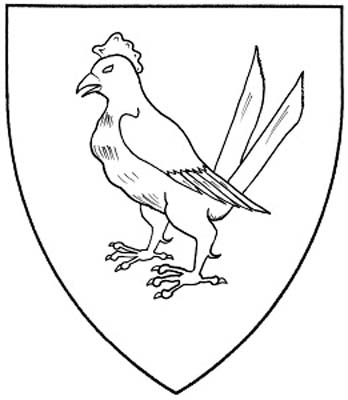
Last time, we had left Sir John More, the pious and God fearing father of England’s second Catholic martyr, making his choice about what coat of arms to have, now that he had come up in the world, and become first a lawyer and then a judge. He was offered a completely free choice of design. He had no doubt been told of the possibility of having a visual pun on his shield. There is an heraldic bird called a moorcock, which is based on the male black grouse, a bird of the moors, and is characterized in heraldry by its two projecting tail feathers. Eventually, Sir John made his decision:
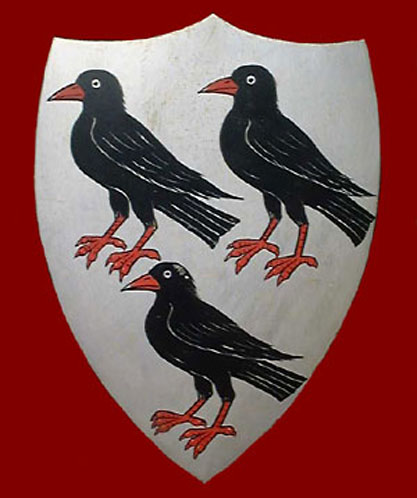
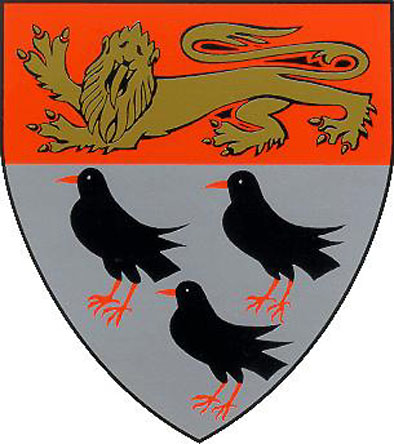
A quite amazing result. Clearly, a direct hommage to Thomas à Becket, better known as Saint Thomas of Canterbury. There is no way that pious Sir John would have been ignorant of the Becket arms. He may even have been on a pilgrimage there himself. Here is the coat of arms of the first Saint Thomas:
Clearly, Dame Agnes too had felt the same attraction to those three black birds. For some still unknown reason, three black birds were beginning to have very strong connections with Catholic piety and Catholic saints.
Hanging Thomas à Becket’s choughs over the mantelpiece would not have been a problem in the early days of the sixteenth century when England was Roman Catholic, and owed its ultimate allegiance to the Pope in Rome. With the coming of the Reformation, however, things suddenly became very different. The Head of the now Protestant Church was now the King himself.
Henry VIII would not have wanted any reminders whatsoever about a prominent member of the now hated Catholic Church, who was murdered at the behest of a king called Henry, but who, eventually, was destined to triumph over him. Only three and a half years after the dirty deed, on July 12th 1174, the other Henry, Henry II, had had to carry out a public penance at Becket’s tomb and at the nearby church of St. Dunstan’s. The two churches became the most popular sites for pilgrims in the whole of England. King Henry VIII would have wanted absolutely nothing like this in his own reign.
And, clearly, he must have been scared stiff of exactly the same thing happening. And with good reason after the amazing coincidence of Sir Thomas More, a second prominent and pious Catholic done to death by a wilful monster of a king called Henry. The last thing Henry VIII would have wanted would have been the beginning of a new martyr cult among the overwhelmingly Catholic population of England:
Dame Agnes’ favourite coat of arms would now have become much more of a problem, not for Dame Agnes herself, because she had died well before 1527, the year when Henry first asked Pope Clement VII for an annulment of his marriage to Catherine of Aragon. Instead, it would have been the fledgling school which might have faced problems. After all, those three black birds are a bit of a giveaway. Nobody was ever going to be mistaken about whose coat of arms they really were.
Over the years, I think that the red legs and red beaks of Becket’s three choughs would probably have been allowed slowly and gradually to be forgotten, most likely once Dame Agnes herself had passed away, in probably April or possibly May, of 1514. In an area where choughs have probably never nested, namely the East Midlands, local people may not have considered their bright red legs and beak to be particularly important. Furthermore, in many cases, the birds would have been seen in a grayscale context where bright colours were totally absent, such as a carving in stone on a wall, or a drawing in pen and ink on a manuscript.
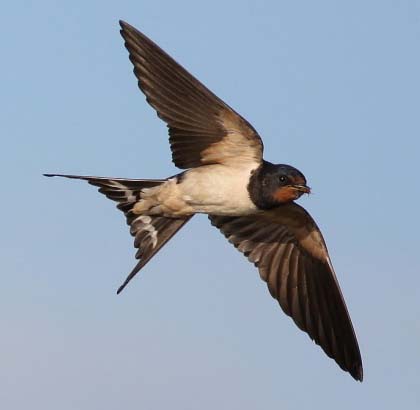
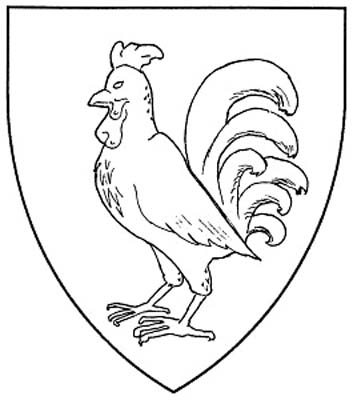
Certainly, in Heraldry, it has never been particularly difficult for birds’ legs to disappear. In actual fact, there has always been a black bird which has no feet or lower legs. It is called a “martlet” and is, more or less, the heraldic version of the barn swallow. And here is a barn swallow:
It is never represented with feet, the legs terminating in the feathers which cover the upper parts of the leg. Furthermore, many heraldry books also state that the “martlet” has no obvious beak, a useful detail if you are trying to tone down a large long bright red one.
Interestingly, some experts in Heraldry see a family tree which fits in quite neatly with my argument. In French heraldry, therefore, a blackbird may be a “merle” because that is the ordinary French word, even nowadays, for a blackbird. When the bird on the shield loses various bits of its body, it is called by a diminutive form, namely “merlette” and this then becomes the “martlet” of English heraldry. The martlet in fact became commoner and commoner as it was used to indicate the arms of the fourth son of any particular nobleman.
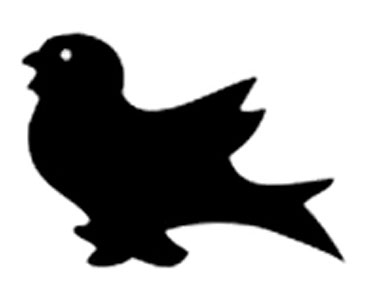
Here is just one “martlet”:
And here is a small flock of them:
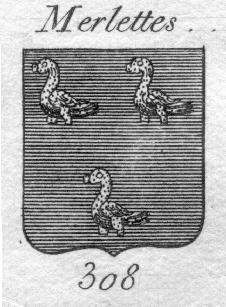
In French Heraldry the “merlette” has become an even stranger bird. Although closely connected to the English martlet, it is always depicted with a swan-neck but without a beak, wings, feet or forked tail. It looks, in fact, worryingly like a duck in a car crash:
For me, this may be where the confusion between “Mellers” and “merles” has
arisen. The choughs of Thomas à Becket have, over hundreds of years on a wall a long way from Canterbury, gradually lost their bright beaks and legs and people have thought that they must be “martlets”.
As a word, of course, “martlet” is not a million miles from “merlette”, and “merlette” is not a million miles from “merle”. “Merle” is not a million miles from Mellers. It is this pure and total coincidence which has led people, always looking for logical explanations, to invent the story about the “merles” representing Mrs Mellers, creating an explanation that is historically and heraldically impossible. There have never been any “merles” in English Heraldry, either in this century or in the sixteenth.
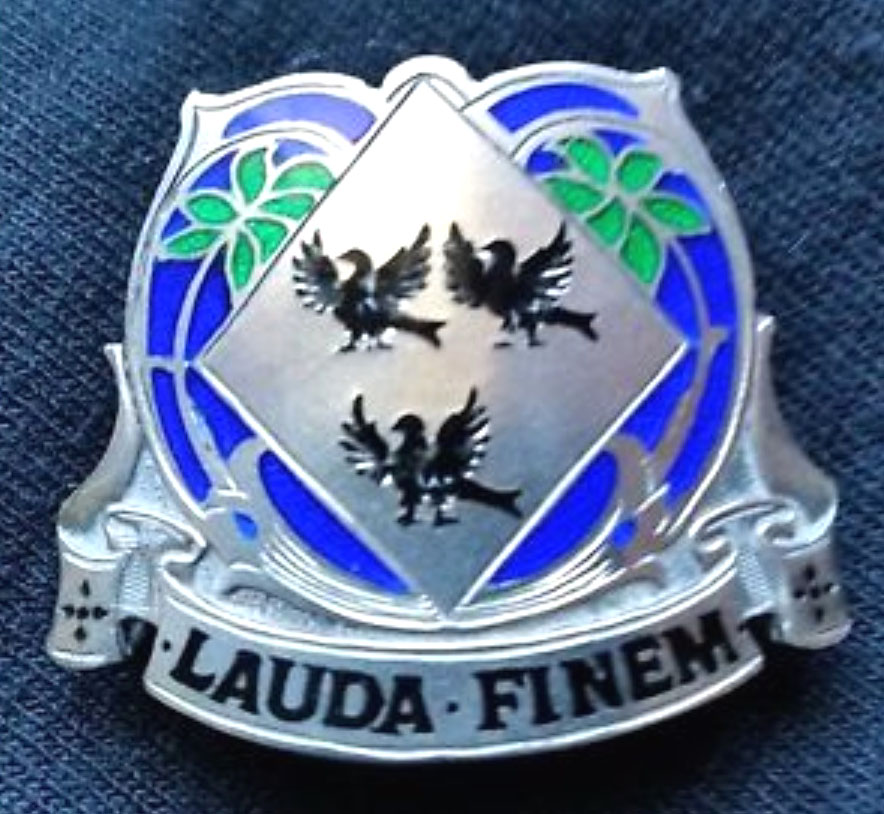
Months and months after I wrote these words, I found an online auction where a High School “Silver and Enamel Badge”, dating from 1935 was for sale. Interestingly enough, the three so-called “merles” on the badge have all been depicted with forked tails. In other words, they are not blackbirds, but black birds. And these black birds are clearly, because of their tails, martlets. This motorists’ badge must hark back to a mid-way period in the heraldic evolution from Becket’s chough to the erroneous, “merle”:
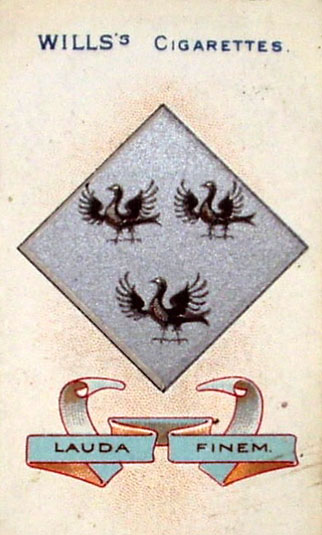
A very similar badge is in evidence in the Wills Cigarette card series of 1906, which depicts the coats of arms of England’s top public schools. I have always had visions of eleven and twelve year olds all smoking forty cigarettes a day just to get the complete set of cards. Anyway, here is the High School card, with the requisite “three Blackbirds rising proper”. Again, they have a forked tail:
Finally, here is a photograph of the old Stoney Street school, possibly the only one still extant:
Look at the coat of arms (four o’clock from the word “stationer”). It doesn’t look very much like the present day badge. It is perhaps closer to being the missing link between Thomas à Becket’s choughs, martlets, merlettes and merles:
The beauty about my ramblings is that they do explain away, quite effectively, a completely unrelated incident which has puzzled an admittedly tiny and fairly sad group of people over the last few decades.
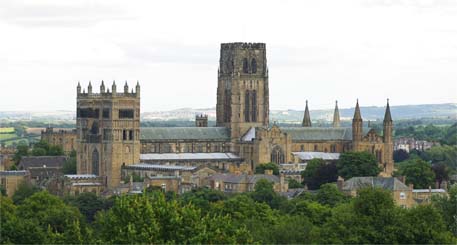
This was the only coat of arms in the whole cathedral which the local experts in the north east had failed to identify. The only link of any kind which could be established between Durham Cathedral and Nottingham was the fact that Richard Barnes, Bishop-Suffragen of Nottingham in 1537, eventually became the Bishop of Durham. No connection whatsoever was discovered though, between Richard Barnes and Dame Agnes Mellers.
My supposition is that whoever carved the mystery coat of arms in the late twelfth century when the cloisters at Durham Cathedral were being constructed, was displaying his own allegiance to St Thomas à Becket. Certainly, from a historical viewpoint, the timing is just about right. Thomas à Becket was martyred in Canterbury Cathedral on December 20th 1170. Precisely the time when the cloisters were being built, namely the latter part of the twelfth century. Perhaps the coat of arms was carved as an act of ecclesiastical defiance against King Henry II, rather like the people who chalked letter “V”s on walls in Nazi-occupied Europe. I couldn’t find a picture of that, so here is the next best thing:
And as a conclusion, let me add that, during their investigations on behalf of Durham Cathedral, the Heralds’ College could not find any indication whatsoever that either Richard or Agnes Mellers had ever used those particular arms with the three birds, the ones which the Old Boy had immediately recognised as those on his blazer pocket all those years ago.. The ones he had himself seen, carved on that stone fireplace, by someone, another lifetime before that:
Surely this coat of arms is the easy and direct link with the “merles” of Dame Agnes Mellers?
If you were scared stiff that your husband was on his way to Hell, then what better saint to recruit to your aid than the Numero Uno of English saints, the Head Honcho of martyrdom in England? As one expert TV commentator recently said, in that original programme (to which, by now, I was giving my fullest attention):
“The most important English saint, by a wide margin.”
I think that Dame Agnes, like so many ordinary football supporters nowadays, did not have her own coat of arms or badge, but instead she was very attached to those of her hero. Not Nottingham Forest or Notts County for her, of course, but Thomas à Becket.
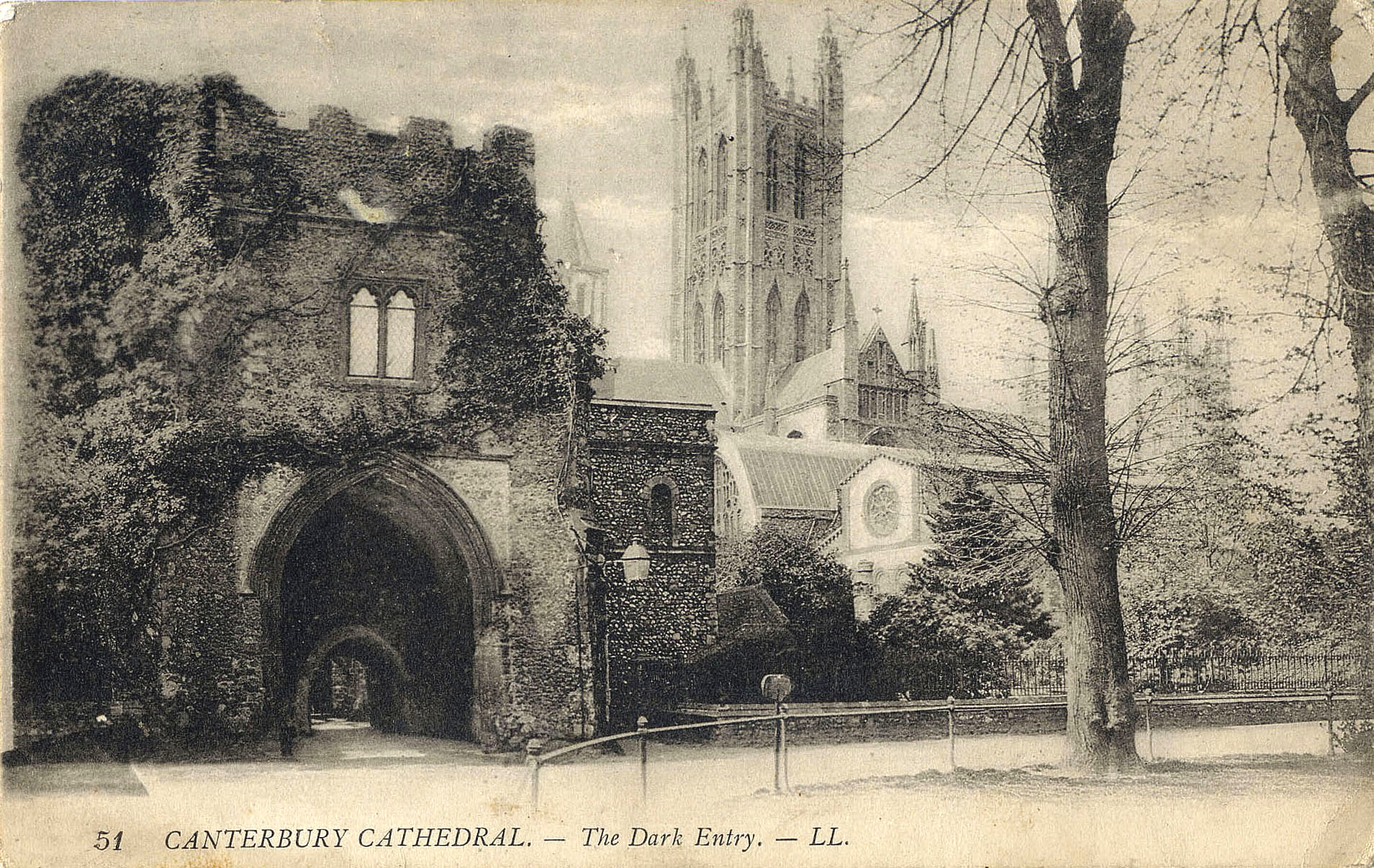
Perhaps Dame Agnes used to display Thomas à Becket’s coat of arms because, as a very pious and religious person, a vowess of the future indeed, she had already been on a pilgrimage to see the saint’s tomb in Canterbury Cathedral:
Dame Agnes may have done this on her husband’s behalf or she may have done it because it was what thousands and thousands of English Christians had always done over the centuries. Perhaps in the three hundred and fifty years since Becket’s death, a tacky tourist trade had built up, and Dame Agnes was able to buy her very own copy of the great saint’s shield, which she had then hung up over her mantelpiece for all her friends to see. We will never know, but for me, the visual coincidence between the two coats of arms is quite stunning. Black birds, of course, are not particularly common on heraldic shields. Eagles, yes, but not a great deal beyond that. Everybody preferred lions.
Game set and match for my theory is the coat of arms of Sir Thomas More (1478-1535), the Lord Chancellor of Henry VIII but more significantly perhaps, the second most important English saint, venerated by all English Catholics as Saint Thomas More. When King Henry wanted to divorce the barren Queen Catherine of Aragon in the hope of fathering a male heir with Anne Boleyn as his new, younger, sexier, more fertile and six fingered Queen, Sir Thomas More “steadfastly refused to take the oath of supremacy of the Crown in the relationship between the kingdom and the church in England.”
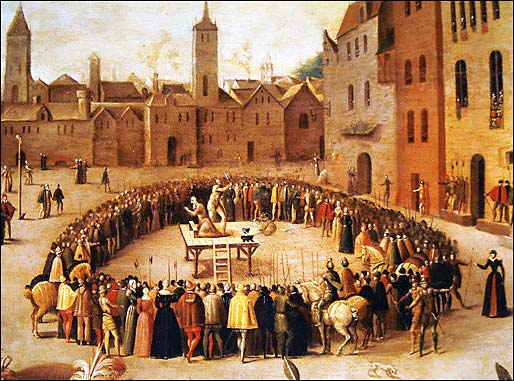
More would not retreat from his belief in the supremacy of the Pope over the King. He was beheaded on July 6th 1535. Before he died, More proclaimed to the watching crowd, that he was:
“the king’s good servant, but God’s first.”:
As a young man Thomas had thought seriously more than once of giving up his legal career to become a monk. And now he was a martyr, and well on his way to becoming a saint.
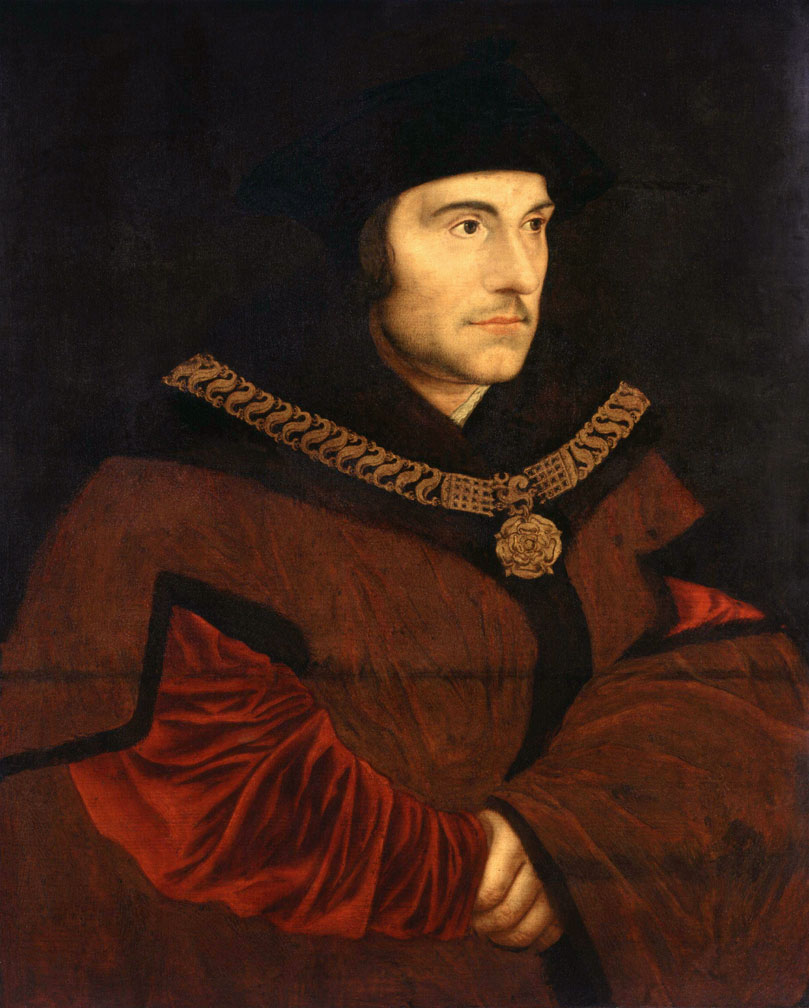
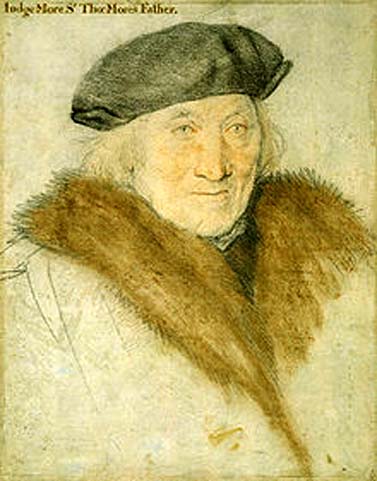
It would be amazing, of course, if his father had had no influence on his growing son. How could the young Saint Thomas have been so pious and so spiritual had his father not influenced him at any point? Clearly, Sir John must have been a very staunch Catholic to have produced a son like Thomas. Here is the only known depiction of Sir John:
That pious father of the saint, Sir John More, was born around 1451 and died in 1530. He was a lawyer and eventually became a judge. As he rose in society, he was offered the chance of a coat of arms of his own. He may have been told of the possibility of having a shield with a striking visual pun. There is an heraldic bird called a moorcock, which is based on the male black grouse, a bird of the high moors, and is characterized in heraldry by its two projecting tail feathers:
Last time, I posed a number of questions about the three black birds on the school crest, the so-called “merles”, and the coats of arms of a number of different families with the surname Meller, Mellers, Mellor and even Mellors:
If you remember, I was far from convinced that there was any connection between Dame Agnes and any of these families, the closest of them a minimum of a week’s journey away in Manchester. I was equally doubtful about the existence of “merles” as a bird in English heraldry. Indeed, overall, in English, the word “merle” does not really seem to relate particularly strongly to birds at all.
Wikipedia, for example, states that “merle” is a first name used by both men and women, a surname of French origin, a rather beautiful pattern in dogs’ coats, another name for the wine grape Merlot, a German glider originally built in 1938 for the 1940 Olympics gliding competition, a Crusader fort near Tantura on the coast of Israel and finally mentions the fact that the MS Phocine, a ferry, was originally named MS Merle.
In the bird world, Wikipedia states that it is a name for the “Icterid varieties of which the male is predominantly black, especially the Common Blackbird, Turdus merula.” The first word is the Latin for thrush, and “merula” means Blackbird.
I need to say here that “Icterids” are exclusively American birds such as grackles, orioles, cowbirds, meadowlarks and bobolinks:
This slideshow requires JavaScript.
Back to Wikipedia, which continues with the fact that “merula” gives the French their word “merle” and also gives the Scots their word “merl”. According to Wiktionary, it is also an “English 19th century bird name from merle, blackbird, possibly also a variant of Muriel”. That is in itself quite interesting as many common birds in Merrye Olde Englande had their own human names. Jack Daw. Mag Pie. Jenny Wren, Robin Redbreast. Sparrows were called Philip because of their chirping call. A modern equivalent would be the Soviet ruler, Joe Starling.
Very tenuous links between Dame Agnes and merles therefore, made all the more tenuous by another, etymological, dictionary, which states that “merle” is a late fifteenth century word which nowadays “owes its survival in modern times to its use by Scottish poets.” And how many fifteenth century Scottish poets can you name? Or any living, modern ones come to that?
Scotland, of course, is even further away from Dame Agnes than Manchester. And just in case you see a possible link between Dame Agnes and the “late fifteenth century”, don’t forget that the alleged Mellers’ coat of arms wasn’t ever used by her, and first appeared only in 1808.
Sooooo, where did that coat of arms come from?
Well, just for a moment, let’s go back to that idea that Dame Agnes was a lifelong staunch Roman Catholic with a very real fear of Hell for wrongdoers, especially those who might have cheated their customers a bit, perhaps when they were flogging them very large and very expensive bells.
The city was, of course, Canterbury. But where did the City of Canterbury find those striking and exciting black birds? Well, it’s not a huge surprise:
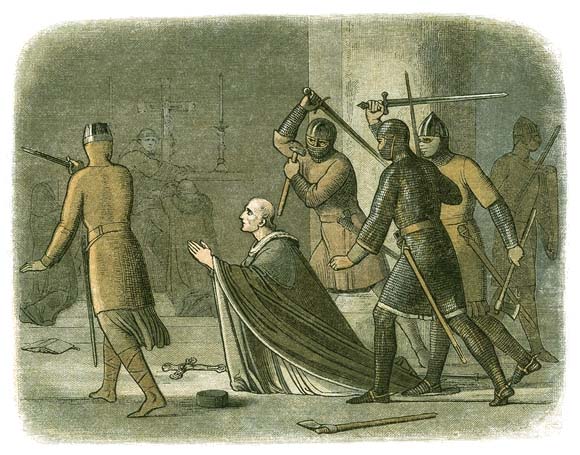
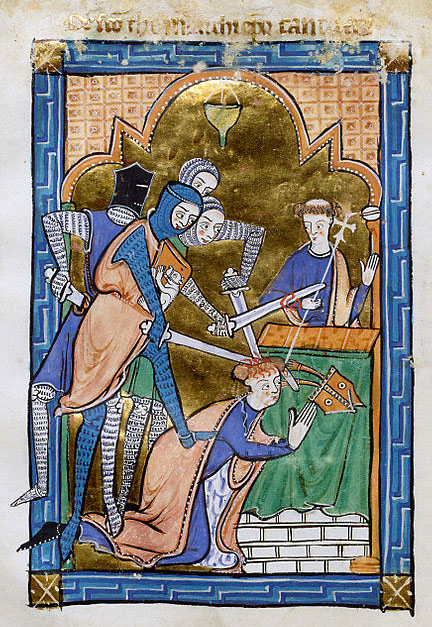
“The wicked knight leapt suddenly upon him, cutting off the top of the crown of his head. Next he received a second blow on the head, but still he stood firm and immovable. At the third blow he fell on his knees and elbows, offering himself a living sacrifice, and saying in a low voice, “For the name of Jesus and the protection of the Church, I am ready to embrace death.” But the third knight inflicted a terrible wound as he lay prostrate. By this stroke, the crown of his head was separated from the head in such a way that the blood white with the brain, and the brain no less red from the blood, dyed the floor of the cathedral:
The same clerk who had entered with the knights (not Edward Grim) placed his foot on the neck of the holy priest and precious martyr, and, horrible to relate, scattered the brains and blood about the pavements, crying to the others, ‘Let us away, knights; this fellow will arise no more.”
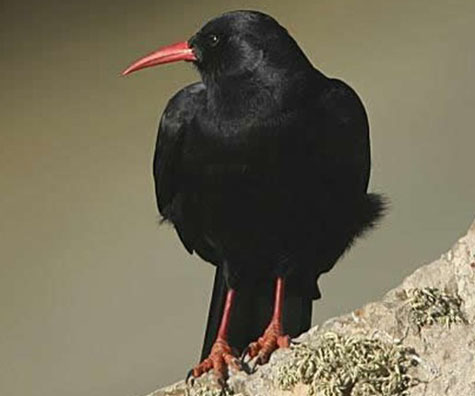
The birds on Thomas à Becket’s shield have red feet and red beaks and they are nowadays called “choughs”, although apparently in medieval times, they were often referred to by pilgrims as “beckitts”.
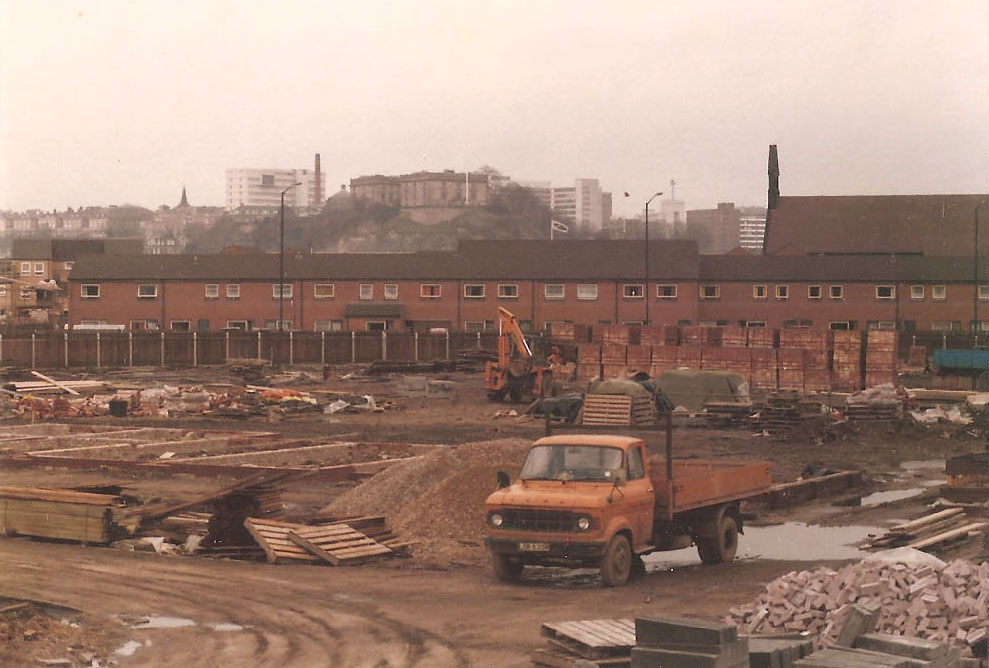
When we were first married, my wife and I bought a house in the Meadows area of Nottingham. This was traditionally a place of slums, crime and general unpleasantness, but at the time, the early 1980s, huge numbers of unhealthy hovels were being demolished to be replaced by newly built, better quality, council houses, as they were then called. Mixed in with all the rented accommodation though, was a small estate of private houses, and we bought one of those. When we first moved in, we were surrounded by a vast building site:
And now, it must be nine minutes past four and the teaching day is ended and I have driven home at top speed:
“Home is the sailor, home from the sea,
And the hunter home from the hill.”
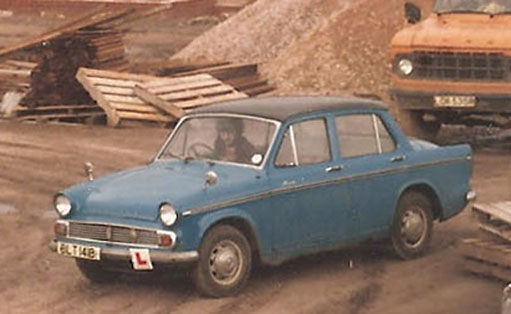
I used to have an old 1964 Hillman Minx De Luxe, with the registration plate BLT 141B. It was my first car, and I loved it dearly. I wish I could have it back again. It had previously belonged to my Dad, Fred, who loved it even more than I did. When the seventeen-year-old car failed its last roadworthiness test, he was so glad that I took the trouble to drive it, fairly illegally, the 35 miles to his house, just so that he could then drive it himself on its last ever journey down to the scrapyard.
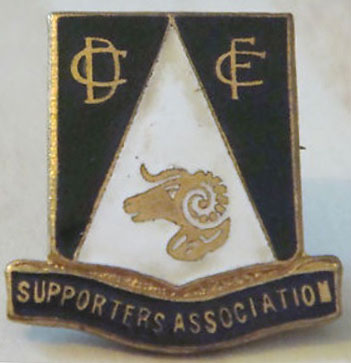
This beautiful blue car was “the one” as far as Fred’s motoring career was concerned. One day in 1966, he took me with him to nearby Derby and we visited Peveril Garage, on Friar Gate, up near the headquarters of the Derby County Supporters’ Club:
Fred told me not to mention anything whatsoever about the day to my mother, not under any circumstances. Without any consultation with her at all, therefore, he bought this marvellous car, which was priced at £510. In those days, that was a princely sum indeed. If truth be told, it was actually a total sufficiently royal, that when my mother did eventually find out what he had done, she would have had Fred beheaded if she could have organised it.
The car was a rich blue, half way between sky blue and navy blue, with a black side stripe picked out in metallic chrome. In later years, when he had problems with rust on one of the wings, Fred was to opt for a total re-spray, which allowed him to retain the same colour blue for the body, but to incorporate a black roof which added that extra, unique, little detail to his beloved car:
At this time, I had only recently passed my driving test, so, while I waited for the green “Provisional” plates to be invented, I retained my Learner plates, with the Big Red Ell on them. That was enough to be pulled over by a young policeman, apparently tired of arresting burglars, drug dealers, terrorists, murderers and bank robbers. Still, no hard feelings.
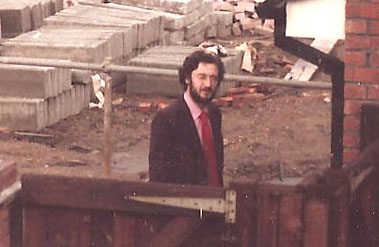
And here I am, looking like the man who designs the stage costumes for a 1970s pop group:
I am wearing my favourite wide lapel purple jacket which had a wonderful Polyester feel to it. My shirt was short sleeved and chequered in pink and white. My extra wide tie was scarlet, and again, made of Polyester for easy cleaning. My glasses were gold-rimmed and my hair was a deep delicious dark brown without the slightest trace of grey:
I had probably been wearing a pair of trousers throughout my day as a teacher, but they are not visible in this photograph. They may well have been my favourite pair ever, which were generously flared and mid-grey with an emphatic large black check design all over them. This created a whole series of huge squares perhaps four or five inches in size. I eventually gave these show stealers to a charity for the homeless in Africa. I often wonder who got them and what he made of them. Conceivably, some kind of shelter.
I have written a good deal, some would say too much, about the monsters which terrorized France between 1500 and the end of the nineteenth century. The most conservative zoologists say that the so-called monsters were just wolves behaving badly. Other more daring individuals say they were cave hyenas or dire wolves or waheelas or whatever:
This slideshow requires JavaScript.
I personally think that they were some kind of Superwolf which was like generally pretty much like an ordinary wolf in appearance, but with enough differences in behaviour to stand out from the rest. Just enough for the French peasant of 1764-1767 to think to himself, “C’était comme un loup, mais ce n’était pas un loup.”
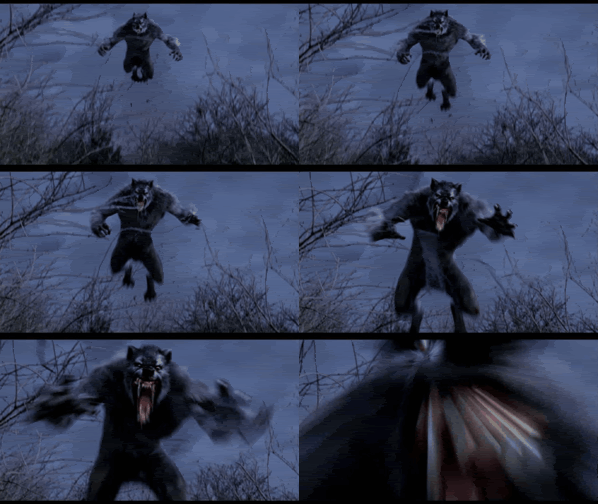
What I have never imagined as the solution to this blood spattered conundrum is the werewolf. In French, it is the Loup-garou:
The Americans in those areas of the USA which have a French heritage call it the Rougarou, rather as if somebody in 1700 had slightly misheard the word. Given that the Rougarou allegedly lives in the bayou and perhaps makes a “Wooo-hooo” call, I have always been somewhat surprised that no aspiring songwriter has ever taken up this subject.
In two cases, back in the day, they were unknown creatures that attacked livestock and left a trail of blood and gore. That could have been anything, of course, perhaps even the first Alien Big Cats in the country but much more likely to have been just feral dogs, which regularly kill both people and livestock in far larger numbers than either wolves or werewolves:
There was mention of a genuine werewolf near Ripon, Yorkshire, in the 1920s and then another in Edale, Lancashire, in 1925. It was described by the forum contributor, Jerry_B as “some large animal…tearing sheep to bits”. Sounds like it’s back to those feral dogs to me.
A bloodsucking equivalent of these two werewolves, allegedly, was the monster “on the prowl in 1905, at Badminton (Gloucester)”.
All of these seem extremely far-fetched in my humble opinion, but there is one interesting English werewolf tale which features very widely on the Internet. For me though, it is a superb example of putting a couple of interesting facts together, and then using them to come to a fairly ridiculous conclusion. After that, everybody is more than happy to view this iffy conclusion as completely sensible and to consider it henceforth as hard fact. No need to bother about questioning the reasoning process. If you still don’t understand what I’m getting at, then treat yourself to the finest example I know of, namely any episode whatsoever in the “Ancient Aliens” TV series.
.
First of all, though, for the sake of argument, I am willing to accept the supposition, for the moment, that wolves in England, centuries ago, were capable of behaviour that, nowadays, would be dismissed as being highly unlikely. That behaviour, of course, would be to treat human beings as a prey item and to attack them as a matter of ordinary routine:
Whatever you may think about that as a supposition, the author, John Harries, in his book “A Ghost Hunter’s Road Book”, states that things were so bad in Saxon times that, presumably at the behest of King Aethelstan:
“ about the year 940 AD a hostel was built in the village of Flixton to shelter wayfarers in wintertime from attacks by wolves. At that period packs of the animals were not uncommon in the north of the country, and they were regarded with particular loathing because in times of severe weather they scavenged in graveyards.”
That statement is by no means outrageous, although it would be nice to know where the story originally came from. After all, there cannot be too many sources available to be cited when it comes to events more than a thousand years ago in 940 AD.
What tips it over the edge, though, is the next piece of rather iffy logic:
“Their cunning in discovering unprotected cattle, their boldness in attacking travellers, and their habit of suddenly descending in large numbers on an area where they had previously been unknown, all helped to give rise to the belief that the animals were not ordinary wolves but human beings who adopted a travesty of wolf shape by night.”
Wolves capable of finding “unprotected cattle”? How unusual! How unprecedented! I’m sure that has never happened in the northern states of the USA.
“Descending in large numbers” to a source of easy food? How extraordinary for a pack predator to be any good at doing that!
The wolf is one of the most widespread and successful predators on the planet. So why do we need to explain his achievements as the work of werewolves? And not even ordinary werewolves at that…
“Their nocturnal exploits were supposed to be organised by a wizard whose innocent appearance enabled him to gather information about cattle, sheep and human wayfarers in taverns and market places.”
Look out! There’s a wizard about!! Careless talk costs lives!!
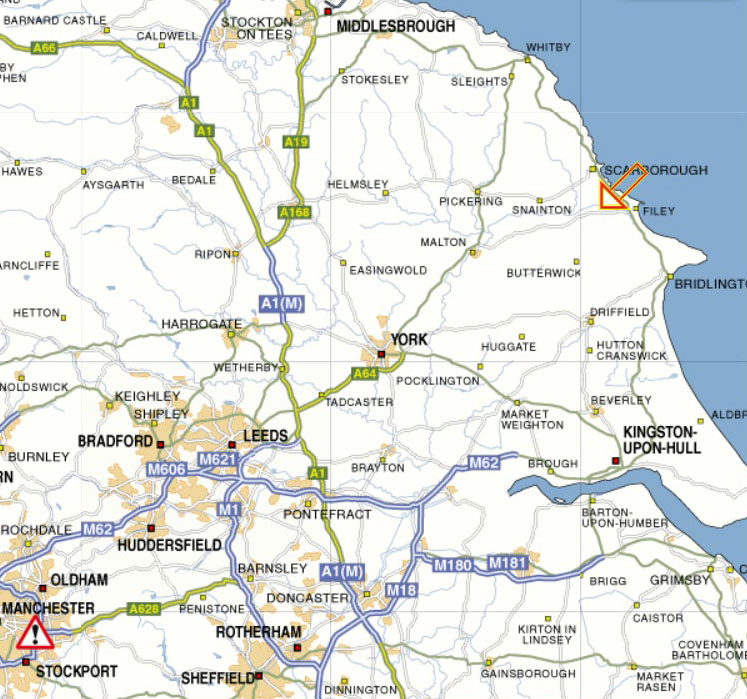
Flixton, by the way, is in Yorkshire, in the north of England, near Scarborough. Look for the orange arrow:
Here is a more detailed map:
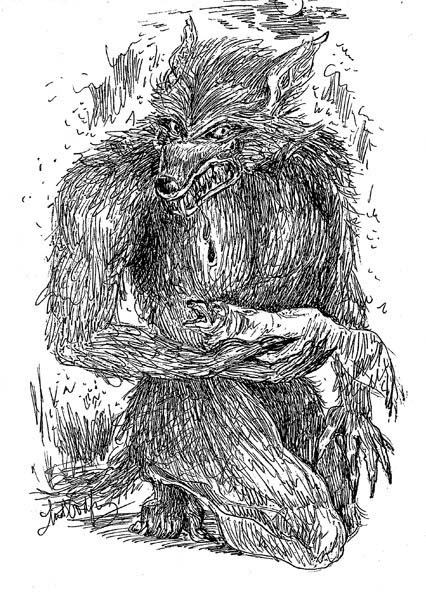
Further details about the Flixton Werewolf were that he has glowing red eyes and a particularly bad body odour. (Don’t say it!) Reports supposedly began all over again in 1150, although by now he had grown a very long tail. In 1800 a stagecoach making its way to York was supposedly attacked by an apparent werewolf. In 1970, the Flixton Werewolf made an unsuccessful attempt at attacking a long distance lorry. Easy prey, of course:
All these additional details, and a succession of precise dates, all help to give the story of a werewolf in Yorkshire veracity and credence, of course.
I was able to find mention on the Internet of just a two other werewolves in England, both of them in Devon (in the Valley of the Rocks in Lynton and the Valley of the Doones on Exmoor). On the latter occasion, a Victorian lady walking home in the dark saw a grey man with a wolf’s head, apparently stalking a large rabbit. The grey man disappeared when he was disturbed by a stag emerging suddenly from some nearby woodland.
Funnily enough, this apparently bizarre tale of the grey man with a wolf’s head sounds a lot more probable to me. If you have read my articles about Shuck and then the Wolfmen in the USA, you may recall that the almost cute behaviour of this grey man with a wolf’s head is much more typical of these cryptocanids:
“Nick Duffy, of the West Midlands Ghost Club, reported that “The first person to contact us was a postman, who told us he had seen what he thought was a werewolf. He saw what he believed was a large dog, but when he got closer, the creature got on his hind legs and ran away.”
“A local scout-leader reported that: “It just looked like a huge dog. But when I slammed the door of my car it reared up on its back legs and ran into the trees. It must have been about six to seven feet tall.”
Both of these pieces of behaviour come much, much closer to the Dogmen and Werewolves of the USA. If you read Linda S.Godfrey, you will see that the majority of these monsters prefer not to attack but to run away:
Let’s finish with two things. Firstly a question. Why do you always have to shoot a werewolf with a silver bullet to kill it?
It’s because back in the days of muskets and similar hit-and-miss weapons, accuracy was way below today’s standards, as was killing power. One, albeit expensive, way to improve both was to discard the third rate bullets of the day, and make your own, rock hard, bullets from…you’ve guessed it! Silver.
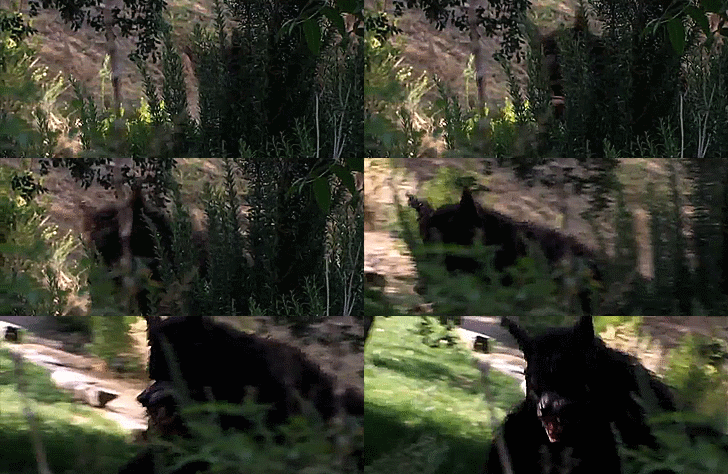
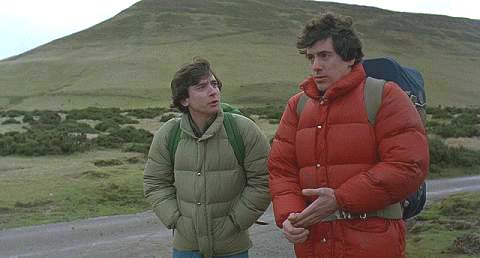
And secondly I was unaware that when they were filming that classic tale “An American Werewolf In London”, the opening scenes on the Yorkshire moors were all filmed in Wales because “Yorkshire didn’t look Yorkshire enough”:
Not many people would be able to answer this question.
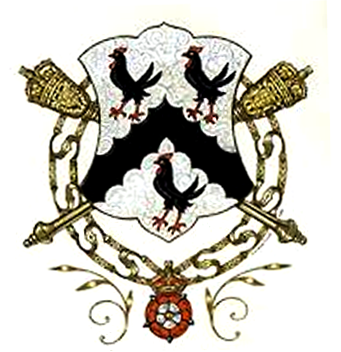
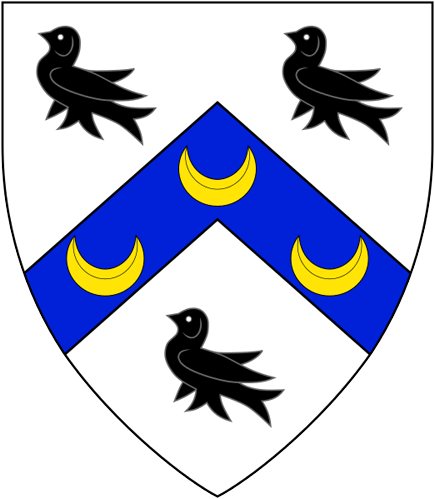
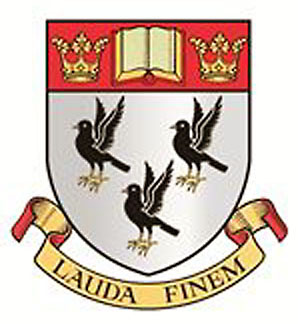
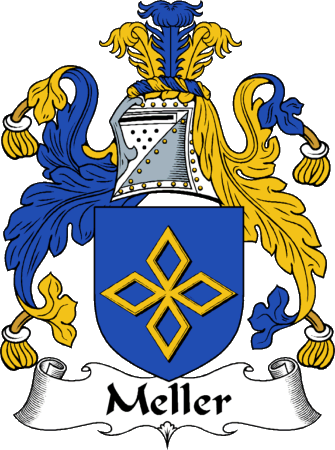
What exactly is “Ermine a Lozenge Argent charged with three Blackbirds rising proper on a Chief Gules an open Book also proper garnished Or between two Ducal Coronets of the last.” ?
Well, it’s one of these, more or less. What’s a lozenge between friends?:
The origin of the High School’s coat of arms has always been, to me, a major enigma. Apparently, there has always supposed to have been a connection between the arms of Dame Agnes’ family, namely “Mellers” and another family called Mellor, who lived in Mellor, a village between Stockport and Glossop.
(Where?)
(Well, let’s put it this way. in either town you can easily get a bus to Manchester. It’s a distance of some seven miles and twelve miles respectively)
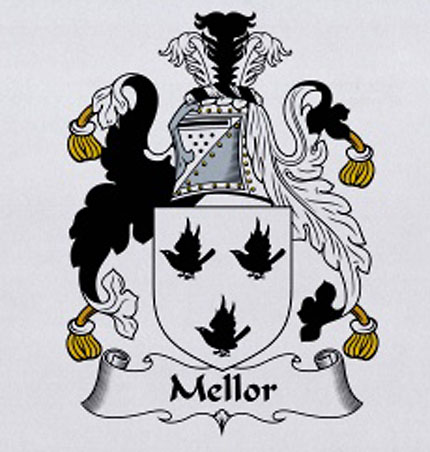
Here is their coat of arms:
To me though there is quite a difference in spelling between Mellor and Mellers, although the Mellor coat of arms is obviously a reasonable fit with the school’s crest.
This theory, though, does rely almost totally on the supposition that Richard Mellers was related to this “Family in the North” whose coat of arms displayed three black birds. In actual fact, there is no reason to suppose any proven link whatsoever between the two families. After all, it’s a very long way between Nottingham and Stockport in late medieval times. More than ninety miles, in fact. The best part of a week on foot, not counting any unexpected meetings with Robin Hood and his Merrie Men.
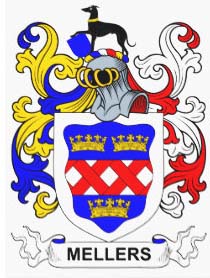
Let’s look at a small number of other likely coats of arms. Let’s start with Mellers. It should be said that Dame Agnes herself always spelt her name as “Mellers” (but never as “Mellor”):
For “Mellers”, we find very few coats of arms, but there is this one:
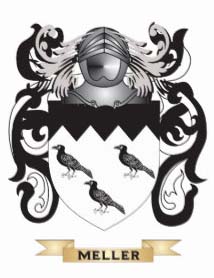
Let’s try “Meller”. We do find this one, and furthermore, the very same shield is listed elsewhere as “Mellers” :
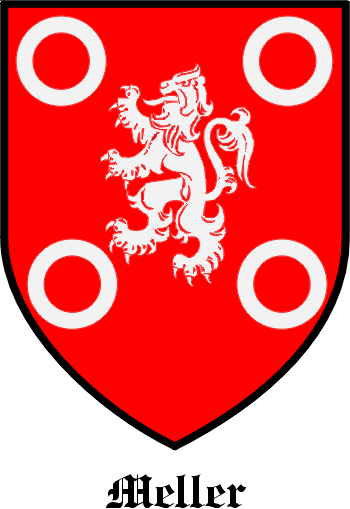
That’s not the answer, though,, because we also find this shield for Meller, as well:
And this one:
And this one:
Clearly, something, somewhere, is not quite right. It may even be very wrong. There are problems here, and the first major one may well be connected with the simple issue of the spelling of Dame Agnes’ surname. Despite her own insistence on Mellers, mentioned above, a quick look at “Google Images” will reveal that Mellers, Mellor, Meller and probably Mellors, appear to be disturbingly interchangeable.Coats of arms just seem to come and go. They are different every tine you look at Google. This is because, I suspect, they are connected less with accurate heraldry than the desire to sell tee-shirts, mugs, key rings, ties and even underpants with your family crest on them.
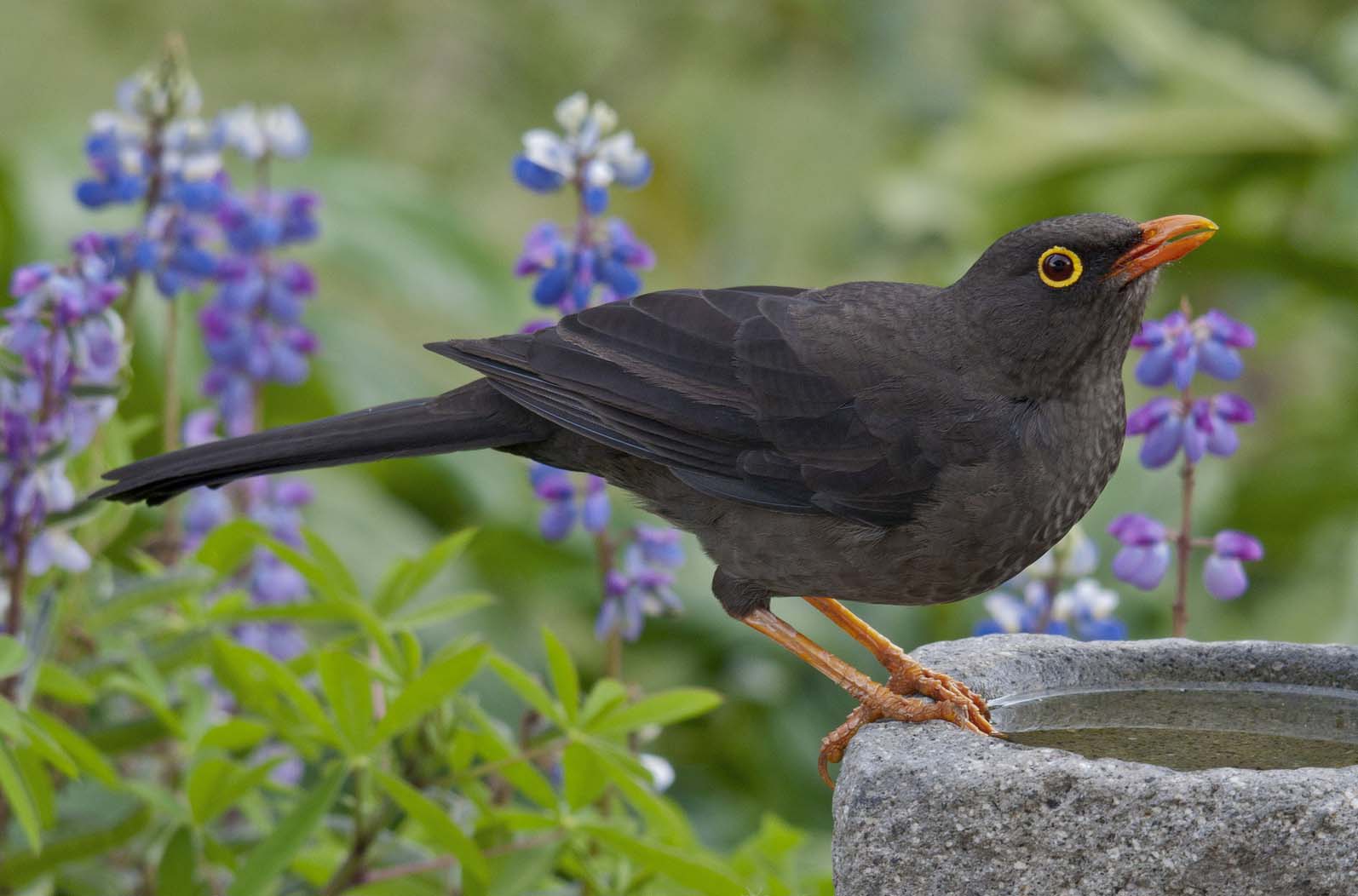
Those black birds on the High School shield have always been regarded as Blackbirds, an everyday bird species in England:
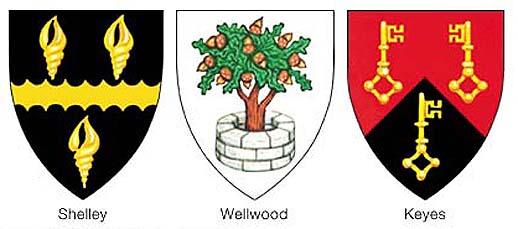
The theory is that the heraldic word for a blackbird is “merle”, taken from the French, and this gives us a devilishly funny pun for the surname “Mellers”. Such side splitters are called “Canting Arms”. They are used to establish a visual pun, as in the following examples:
I am just not sure about this word “merle”. Just because a coat of arms contains a number of black birds (as opposed to green ones), that does not automatically mean that we are dealing with canting arms, even if the French word “merle” refers to our familiar back garden bird, the Blackbird, aka turdus merula, and the name “Mellers” sounds perhaps, possibly, maybe, slightly, conceivably, like it.
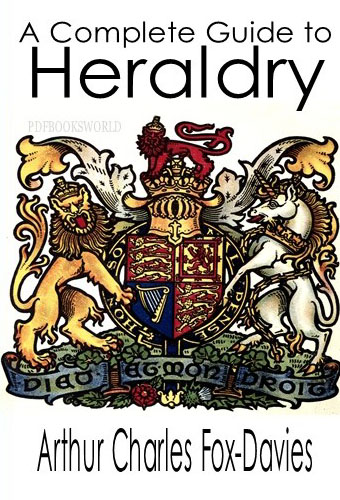
This rather old book is the standard work on English Heraldry and has been for quite a considerable time. It is a book of some 645 pages, but there is not a single “merle” on any one of them. And more important still, if merles did actually exist in Heraldry, then why did the Heralds’ College, known also as the College of Arms, call these birds “blackbirds” when they made that formal grant-of-arms to the school as recently as 1949? Why didn’t they call them “merles” and thereby preserve the “Laugh, I nearly died” visual pun?
And don’t think that the College of Arms are just a bunch of fly-by-night door-to-door sellers of heraldic key rings and underwear. They were founded well before Dame Agnes Mellers, in fact as far back as 1484. To quote the definition on the Heraldry Society website:
“The College of Arms is the only official English authority for confirming the correctness of armorial ensigns — Arms, Crests, Supporters and Badges — claimed by descent from an armigerous ancestor, or for granting new ones to those who qualify for them.”
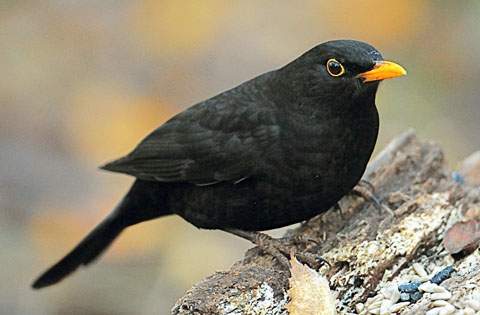
In other words, if they say it’s a blackbird it’s a blackbird. You can’t just decide to call it a “merle” because you feel like it, or because it seemed like a good idea at the time. It’s just not allowed. Here is another blackbird, just to refresh your memory:
In 1920 at least, nobody called it a “merle”. In June of that year, the new school magazine, “The Highvite” contained a “Sports Chorus”, including appropriately vigorous music. The words were…
“Score our High School / ye Highvites now score for victory.
Our High School / For Highvites, never, never, never shall be beaten
By any Worksop / Newark & c. team
At the Sign of the Blackbirds three.”
No “merles” there then. It is equally interesting to note that in “The Nottinghamian” of December 1921, the school’s emblem is again referred to as containing blackbirds, rather than merles. This overturning of tradition, however, does not mean that the use of three black birds does not connect us directly with Dame Agnes. Let’s look at it from a different angle, just for a moment.
Many people have believed over the years that it was only when the school changed its site from Stoney Street to Arboretum Street in 1867 that the three black birds were first adapted. But this was definitely not the case since photographs from the mid-nineteenth century show quite clearly that a badge with three birds was displayed on the wall of the Free School building. In this case, though, their wings were folded rather than the modern version, flapping and ready for immediate and dynamic intellectual and sporting take-off:
Indeed, it is thought that the three black birds were in evidence as an unofficial badge for the school from at least June 16th 1808 onwards. On this date, an unknown but apparently very bored clerk has decorated the title page of the funky new volume of the Schoolwardens’ Annual Balance Sheets with the traditional three black birds, so it has clearly been known as a symbol connected with the school for a very long time.
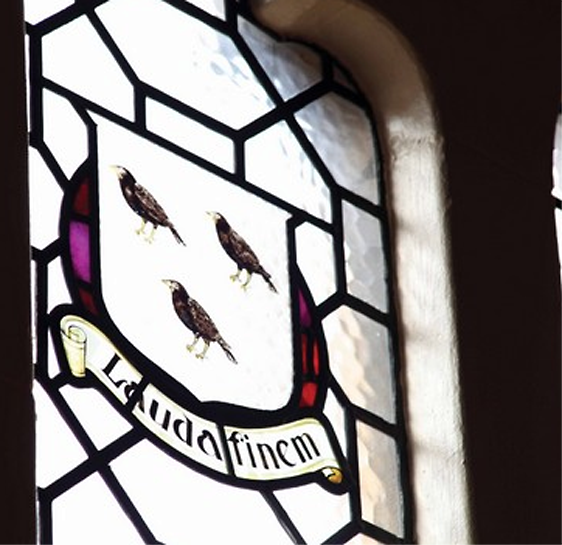
Interestingly enough, another slightly more modern place where the birds’ wings can be seen as folded dates from 1936, when some new stained glass sections were put into the windows at the back of the recently built Assembly Hall:
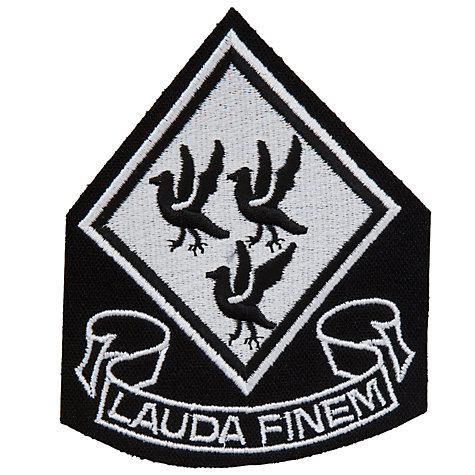
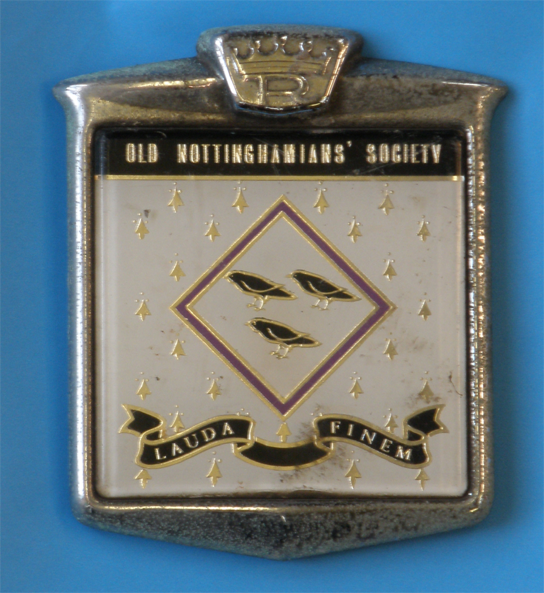
And nowadays, of course, this folded wings version forms the badge of the Old Nottinghamians’ Society. Presumably, that is why they appear in this guise on a car badge being sold off on ebay:
Next time, I will attempt to answer the question of where did those black birds come from? In the meantime here’s a clue. Not all black birds are Blackbirds:
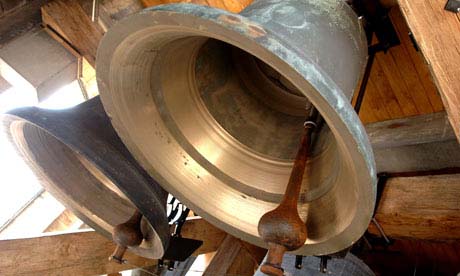
In the first part of this article, I demonstrated how Richard Mellers, the husband of Dame Agnes, was, at best, a fairly unscrupulous businessman. I ended by relating how, in 1507, Richard had received a pardon for having committed offenses against the statutes of weights and measures. This charge related to problems with the purity of his bells. The metal, apparently, was just not as valuable as he said it was. Richard’s pardon would have been granted because of his previous position as Mayor of Nottingham. A less prestigious person would have been in very, very, serious trouble:
Dame Agnes, of course, may well have known absolutely nothing whatsoever about any of this rather serious matter. Like many, many husbands over the centuries, Richard may have decided, quite simply, to tell her nothing at all about it. And if she did know about her husband’s cheating and double dealing, then, like many, many wives over the centuries, she may perhaps have turned a blind eye to it, hoping that one day her errant husband would rejoin the forces of light.
He didn’t though. At least not for long, because on or about Sunday, June 16th 1507, Richard Mellers died, with the ink on the pardon if not still wet, then certainly recognisably damp. I think Dame Agnes would have seen his sudden demise as a direct consequence of his previous wrongdoing. She must have thought that her husband’s death so soon after receiving a pardon was the true verdict from on high.
In more modern, medical, terms, Richard may well just have hastened a natural death by continually feeling guilty or by worrying too much about the outcome of the affair. He may, quite simply, have been a victim of early sixteenth century stress. Irrespective of the clinical truth, though, for a devout woman in Tudor times, these events must have seemed like a clear judgement from Heaven.
At the beginning of the sixteenth century, it would have been completely impossible for a sincere and devout Roman Catholic to be in any conceivable way ignorant of the rôle played by Hell in the scheme of things. How can Dame Agnes have possibly thought back about her husband’s life, misdemeanours and sudden death, and not have seen him as the proud possessor of a “Go straight to Hell, Do not pass Go, Do not collect a ticket to Heaven” card?
That must have been a very, very real fear in her mind.
Here’s how the Rock Combo “AC/DC” saw the situation, firstly on an album cover:
And then on stage:
More or less straightway after his death, therefore, Dame Agnes, the grieving widow, became a “vowess”. She resolved never to remarry, and instead to devote herself to the service of the church.
“a woman who has vowed chastity or devotion to a religious life; a nun”.
Other dictionaries tell pretty much the same tale. One other interesting detail about vowesses is given in “The Customs of Old England” by F. J. Snell. Writing about how a vowess would view her obligations, he states that:
“Whatever fasts a vowess might neglect as non-obligatory, it seems probable that she would not willingly forgo any opportunity of showing reverence to the Blessed Virgin.”
More of this later.
Immediately after her husband’s death, Dame Agnes tried to repay many of his victims. She literally gave them back the exact sums of money which she was worried they had lost to her husband.
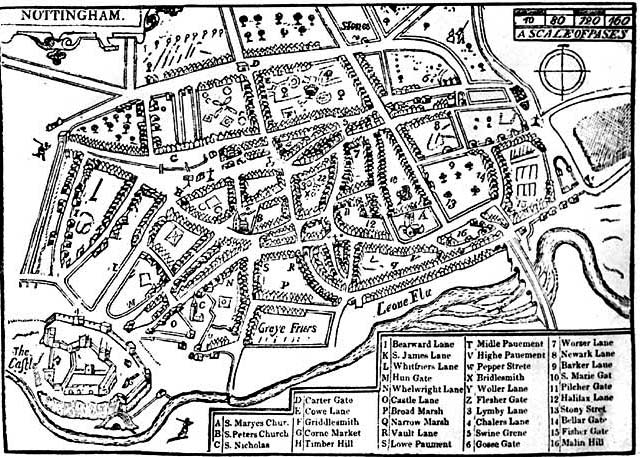
She then decided to spend the rest of Richard’s money on charitable causes. Most important of all, she decided to found a school. Or alternatively, she decided to fund a school which was already in existence and was clearly in need of financial assistance. She must have known that this one simple act would benefit the citizens of Nottingham in the long term, and make up for the occasions when, for short term gain, her late husband had cheated them. Here is the grateful city in 1610. St Mary’s church is marked with the letter “A”. Keep looking. It is there:
Before the official first day of her school, February 2nd 1513, there had already been eleven apparent references to a “Nottingham Grammar School” between 1289 and 1513. At this point in time, of course, it is impossible to tell what connection, if any, there is, with Dame Agnes’ school. Indeed, we do not even know if the eleven schools mentioned before 1513 have a continuous history, or whether they were all short lived affairs.
Having said that, though, Dame Agnes may well have decided to develop an ancient original grammar school into her own school. This original establishment may have depended solely on fees paid by the pupils. Dame Agnes perhaps thought it would be a good idea to establish a foundation, which would then ensure a much better financial future for the school. Equally, she may well have wished to take personal dcontrol of an older school, and then, as a loyal Catholic, to bring it under the control of St Mary’s Church.
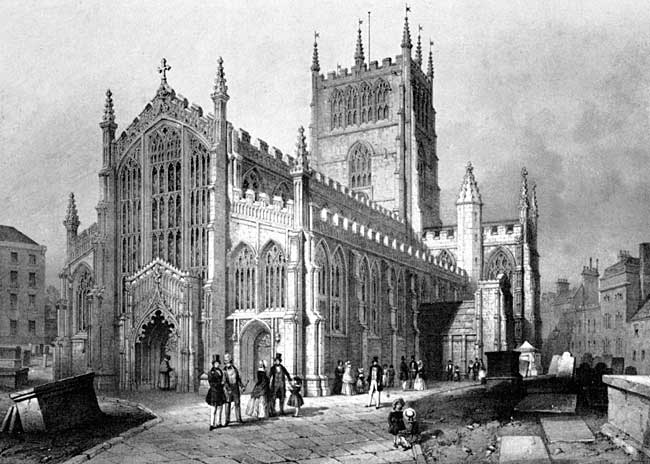
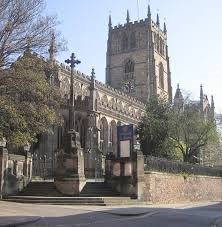
Whatever the details of founding, funding, refounding or whatever, from Dame Agnes’ point of view, the most important thing was that the school should remain closely linked to St Mary’s Church. This, of course, carries out the words of F. J. Snell. Her efforts with this school clearly showed that Dame Agnes would “not willingly forgo any opportunity of showing reverence to the Blessed Virgin”. Here is St Mary’s Church nowadays:
All this sounds like heresy now, of course, after a whole series of celebrations have commemorated the 500th Anniversary of the school, and books have been published, but these ideas are not actually mine own. In “The Nottinghamian” for 1924, for example, there was a clear connection stated in the school magazine between the older schools from before 1513 and the then Nottingham High School. Dr James Gow, the school’s greatest Headmaster, had died this particular year:
In his obituary, it was said that:
“he was appointed Headmaster of the Nottingham High School, an ancient Grammar School, already existing in the thirteenth century, and refounded and endowed by Dame Agnes Mellers, under a Charter of King Henry VIII, in 1513.”
These words are anonymous, but were most probably written by Mr “Sammy” Corner who had been the school’s Deputy Headmaster until his retirement in 1914. Mr Corner had spent much of his spare time researching school history and had become a great expert. Much of this knowledge was to appear in the school magazine which he edited for many years, and which at one point had contained a serialised history of the school. After his retirement, the plan was that Mr Corner would finish writing his history of the High School.
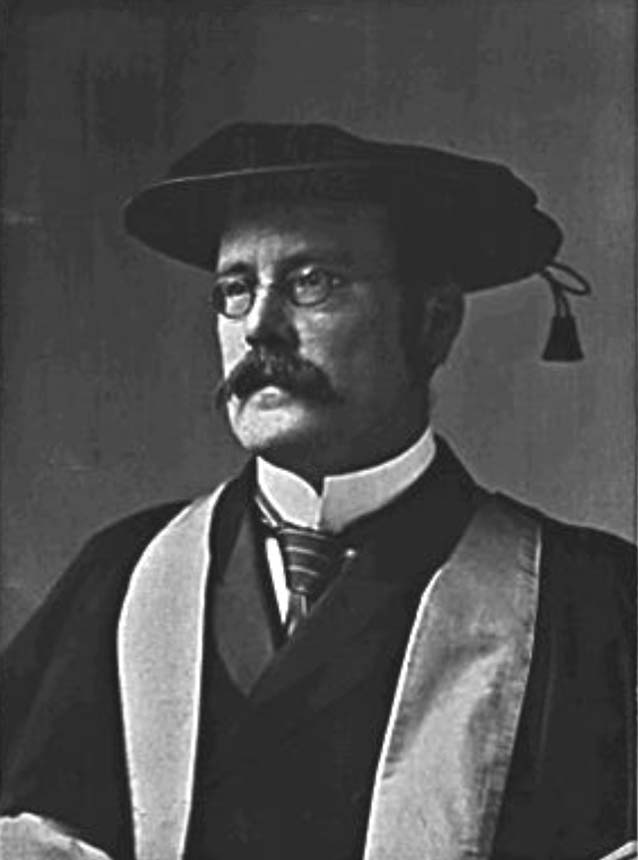
Alas, this popular member of staff was destined never to write his book, as the Great War broke out only a month after he was due to start work, and, despite his advanced age, Mr Corner went off to do his bit for the war effort. At the end of the conflict, Mr Corner moved from Nottingham to Croydon, but his life’s work was to remain forever uncompleted, a source of great regret, as he later told Mr Reynolds, the Headmaster, in a letter. This is the great Sammy Corner in 1913, showing off the school’s charter in the 400th anniversary celebrations in 1913:
On the afternoon of Monday, November 13th, 1933, similar ideas about the school’s history to those in Dr Gow’s obituary were being expressed by the Duke of Portland, when he performed the formal opening ceremony for two new High School buildings, the Gymnasium and the newly converted Library.
This very same interpretation was obviously still current around this time, when Mr.C.L.Reynolds, the Headmaster, wrote his own brief history of “The Buildings of Nottingham High School”. He described the events of 1513 as “…the re-foundation or endowment of the School by Dame Agnes Mellers.” Here is Mr Reynolds, seen with the prefects, in an unknown year, probably in the 1930s:
Furthermore, a document more contemporary to Dame Agnes’ time said that what Dame Agnes was doing was to “…unite, create and establishe a Free Scole” as if there were some definite connection between her school and the Nottingham schools of previous centuries. Similarly, she is referred to in a number of other early documents not as a “foundress” but as a “fundress”, as if she were building and strengthening what was already there.
How that fear of the “Go straight to Hell, Do not pass Go, Do not collect a ticket to Heaven” card must have haunted Dame Agnes. As well as her wonderful achievements with the school, she also laid down that a service of commemoration for her deceased husband should be held every year on June 16th. This latter date is thought to have been chosen because it was the Feast Day of St Richard of Gloucester. Interestingly enough, St Richard’s shrine in Chichester Cathedral, at this time, was a magnificently decorated and popular destination for the Tudor Pilgrim. Perhaps Dame Agnes had been there herself as a dedicated vowess:
The ceremony which Dame Agnes had requested was, of course, a solemn Roman Catholic mass for the soul of her dear departed husband. It is thought that this mass was probably celebrated for about thirty five years, until such services were abolished by order of the then king, Edward VI. This same type of mass may then possibly have been revived under the Catholic Queen Mary, but it certainly would have disappeared for ever when the Protestant Queen Elizabeth I came to the throne in 1558.
Even in the 1660s though, some hundred and fifty years after Dame Agnes, the students still went every Friday during the period of Lent, with their teachers, to visit St.Mary’s church, and kneel in front of the tombs of Richard and Agnes Mellers, and say prayers for their souls, and the souls of all their relatives. And even nowadays, every year on Founder’s Day, the congregation still says prayers for the souls of Dame Agnes, and more importantly perhaps, her husband, Richard. This is Founder’s Day in 1957, a beautiful backlit day:
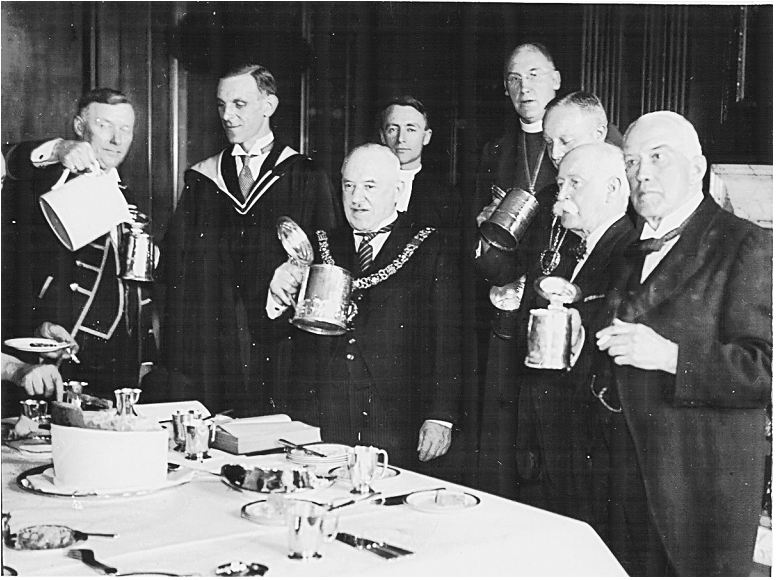
This is the Cheese and Ale Ceremony in the same year:
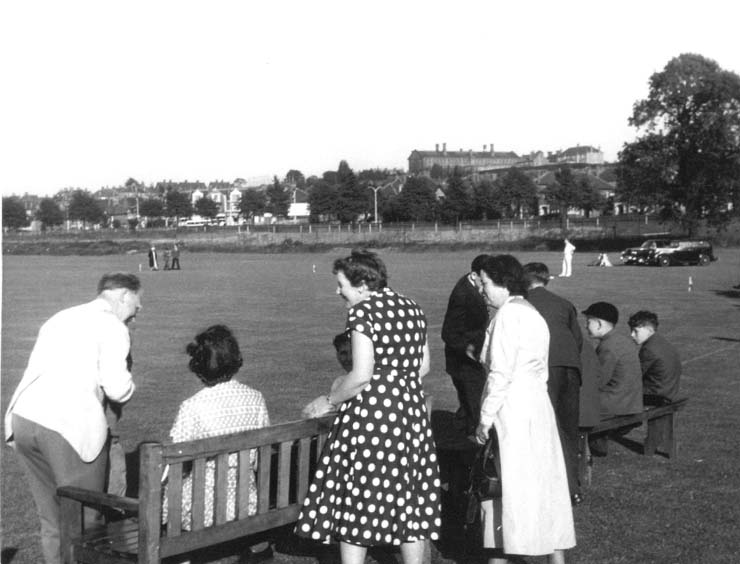
They’re going to get very drunk very quickly if they fill those tankards too frequently. Here is the traditional Cricket Match on that sunlit afternoon in 1957:




















 John Knifton