Sir Jesse Boot, later the First Baron Trent, was, of course, a very famous figure in the history of Nottingham. In the High School, however, far more famous was Bill Boot, the school caretaker during the middle period of the twentieth century.
The school looked roughly the same in those days as it does now, except it was black and white.
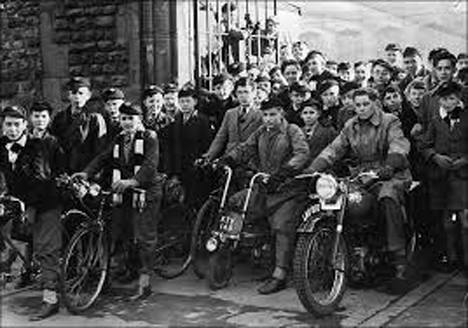
This photo shows the boys leaving school around this time. Look at the great variety of means of transport compared to today…
Bill Boot was a much loved figure as the school caretaker, and in December 1949, the following poem appeared in the school magazine. It was a much modified version of the original, which was written by Lewis Carroll and appeared in his book “Alice’s Adventures in Wonderland”, published in 1865.
This slideshow requires JavaScript.
It was written by F.Martin Hall and John G.Golds, and was dedicated to Mr.Boot…
“To Bill Boot on his 70th birthday
You are old, Father William, the schoolboy said,
And your tooth is of marvellous length,
Yet your tap on the door makes the whole building rock,
Where on earth do you find all that strength ?
In my youth, said the Sage, when I fought for the Queen,
Frequent exercise, Generals demanded,
I chased Kruger each morning around Spion Kop,
Do you wonder my muscles expanded ?
You are old, Father William, the schoolboy said,
And your hair has long since turned quite grey,
Yet your voice like a clarion round the School rings,
How d’you manage such volume, I pray ?
In my youth, said the Sage, when I served with Lord “Bobs,”
His commands could not travel by wireless
So I bawled them (in code) right across the Transvaal,
And my throat, by this means, became tireless.
You are old, Father William, yet your eagle eye
Seems as bright as the stars high in heaven,
Pray, how does your eyesight thus function so well,
With no help from Aneurin Bevan ?
I have answered your questions, the wrathful Sage said,
And as sure as my name’s William B.,
If you pester me further, my patience will go,
So be off, or I’ll put you in D.
(With apologies to Lewis Carroll. In the last verse it was considered impolite to suggest that Mr. Boot would actually threaten to kick anyone downstairs.) ”
Bill Boot retired as school caretaker only a year later in 1950, after twenty-eight years’ service. He was replaced by Mr.T.H.Briggs, who had previously worked as a policeman in the city.
Bill Boot had been in the British Army and had fought bravely in the Boer War of 1899-1902. He was famous among the boys for his rapid, shuffling gait, and his extremely rapid speech, which, with his accent, frequently became almost unintelligible.
Bill’s hobby was fishing, and he travelled widely at weekends. When he retired, he received a small pension, but, alas, he did not live very long to enjoy it, as, tragically, he was killed as he was crossing the road on December 7th 1952. As far as I know, no photographs of Bill Boot have survived, and only Old Boys in their seventies would now be able to remember this fine gentleman “of the old school”, as they say.
Boots are one of the most familiar names in High Streets across the United Kingdom and beyond. Very few people, however, would realise that this gigantic pharmaceutical corporation started from just one tiny shop in Nottingham.
The founder of this vast retail empire, Jesse Boot, was born in the city on June 2nd 1850. His father was a farm labourer called John, and his mother was originally named Mary Wells. The family lived in an area of the town called Hockley, which at that time was extremely poor and overcrowded. John Boot opened a herbal remedy shop locally in 1849, but unfortunately he passed away in early 1860. His mother, by now the Widow Mary Boot, decided to enrol their son, Jesse, in the Nottingham Free School. On Thursday, July 19th, of that year, at the age of eleven years and one month, Jessy (sic) Boot was included on the register as a pupil at the Free School.
He first attended the School in July of 1861, and was to remain in Mr Field’s English Department until his departure in August 1863, a period of just over two years.
While her son learnt high standards of reading, writing and arithmetic, Mrs Boot continued with the shop, helped out by her family and friends, and, from 1863, when he left the Free School, by her son Jesse. By 1871, Jesse was a co-partner with his mother in the imaginatively named “M & J Boot”.
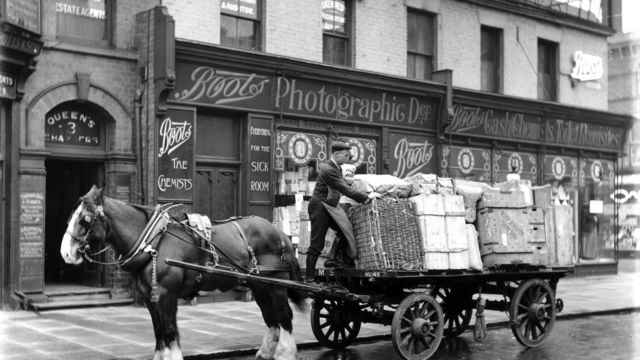
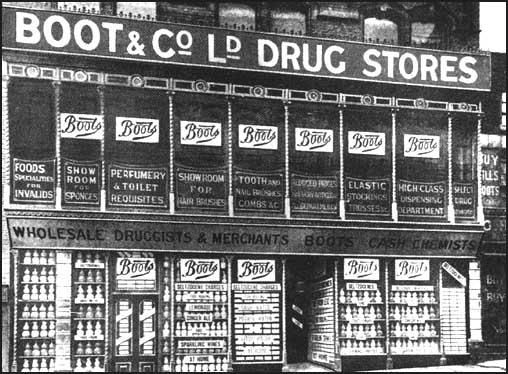
In 1883 the shop became “Boot and Company Limited”. The horse was delighted…
The business then expanded to Sheffield in 1884.
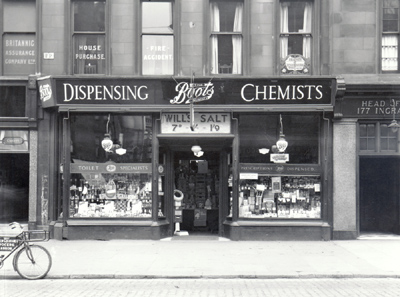
By 1900 there were Boots’ shops over the whole country, reaching their peak with 560 branches in 1913. This particular one was in Glasgow.
The business was eventually sold by Sir Jesse Boot, who became 1st Baron Trent in 1917. It was bought by the Americans for £2.25 million,
In 1933, however, during the Great Depression, the company was re-acquired by a British syndicate. Its head was the grandson of the founder, John Boot, who had inherited the title of Baron Trent from his father, who had recently died in Jersey in 1931.
Nowadays, Boots is a familiar High Street brand name…
Their staff are deliberately clad in quasi-medical uniforms to look more professional
Last night I once again sat down to watch my heroes, the Hillbilly Hunters, set off in quest of monsters, this time to Hocking Hills, Ohio, in search of the legendary Hogzilla.
This thousand pound porker is a hybrid of two closely related animals. His fierceness comes from the introduced feral pig that the Americans call by many different epithets, including the Russian Boar, the Razorback, or the enchanting “Pineywoods Rooter”. His size comes from the huge, overfed and genetically modified farm pigs, such as we see in the fields as we drive north of Nottingham on the A614. The American equivalent is the beautifully deep red coloured “Duroc pig”.
Given his enormous size, his sharp, twelve inch long tusks and his desperately aggressive temperament, Hogzilla is a genuinely fearsome beast who will kill you if he can, and eat you if he is hungry.
The task is defined here…
Here are the first stages of the final night hunt…
And, for the first time ever, SUCCESS!!!!!
“Hogzilla” is suddenly “Trapzilla”.
Within a couple of days, he will make 500lb of sausages. Hurrah!!!
On a more serious note though, towards the end of the third video, Trapper make some very pertinent comments about the accuracy of the evidence given by even the most honest of eyewitnesses, especially when they are frightened.
(An extract from my old birdwatching diary “Crippling Views”)
As I mentioned in a previous blogpost, I used to be a “twitcher”, the sort of birdwatcher who might travel hundreds of miles to see a species which is rare in whichever country he lives. A hardcore British twitcher, therefore, would travel vast distances without any hesitation to see a Common Grackle or a Red-bellied Woodpecker in Great Britain.
An American twitcher would react equally strongly to news of a Northern Lapwing or a Eurasian Siskin in his own country.
Twenty five years ago, I kept a diary of where I went in search of unusual birds. So, on Sunday, August 21st 1988, I know exactly where I was, and what I was doing…
“A minibus trip to North Norfolk this time.”
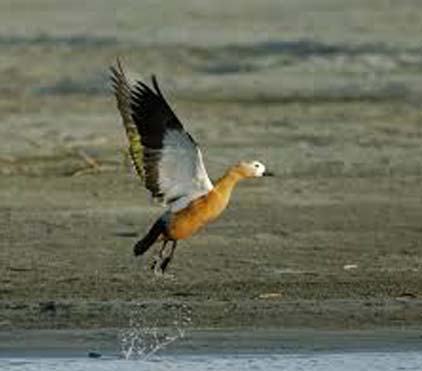
“Not a lot on Birdline to chase, but one half decent bird is a Ruddy Shelduck.”
Here’s a short, but lovely, film taken by “paulboyish”
“This beautifully plumaged waterbird will be, hopefully, still at Lynn Point, just a few miles north of north of King’s Lynn.”
“I try to persuade the minibus driver to hotfoot it out there straightaway but he’s very reluctant. He thinks the bird must be one of those from a zoo that you can never hope to count, one of those wonderfully colourful birds that is almost by definition an escape. Something along the lines of Golden Pheasant, Mandarin or Carolina Wood Duck. Or Red-breasted Goose.”
This slideshow requires JavaScript.
“O Ye of Little Faith. The mood of the passengers is one of optimistic keenness to go and see a new bird. When the minibus driver poses the hoary old question of how many people would actually like to go and see the Ruddy Shelduck, in an effort to prove once and for all that there will not be enough to fill a minibus, and therefore, we ought not to bother going, his effort at token democracy turns out all wrong. Absolutely everybody wants to go to Lynn Point to see this stunning bird, no matter how dubious the tick might be.”
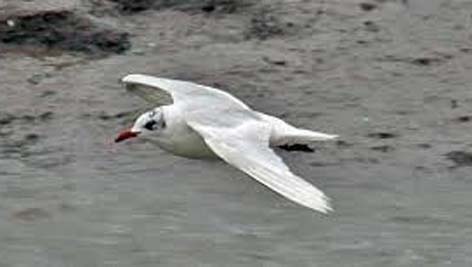
“I navigate for the first bus, and Alan navigates for the second. We have a short diversion around the docks at Fisher Fleet, which was the scene of my first ever Mediterranean Gull, only a year or so previously, watched at close range as it fed from the wagons full of steaming hot shellfish waste which emerged at regular intervals from the factory.”
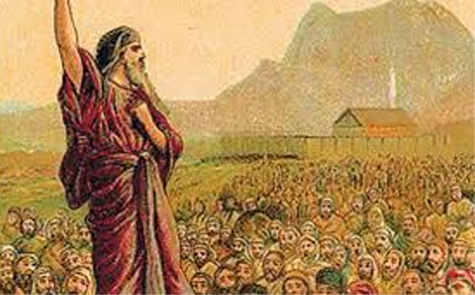
“We eventually find the mud-bath that rejoices in the flattering title of car park and set off along the seawall, out towards Lynn Point. It is throwing it down with heavy rain, and I begin to get very nervous indeed at the mood of the other birdwatchers, as we gradually get wetter and wetter. They seem to walk terribly slowly and not at all to like the idea of leaving the car-park. One woman actually says within earshot, “We’re a very, very long way from the bus.”, obviously racked with terror at the prospect being any distance whatsoever from her preferred method of vehicular transport. I begin to understand what Moses must have felt like.”
“Things are not helped one little bit by having to make a gigantic detour inland to the concrete bridge which allows you to cross one of the many enormous drainage ditches that are met with so frequently in this sodden landscape.
To be honest, it isn’t pleasant marching into driving rain, but on the other hand, for a new bird it’s obviously worth it. Suddenly catastrophe strikes. We are faced with a bright green electrified fence that the farmer has erected across the path. We all stand there like a flock of lost sheep, milling around, not knowing what to do. Several people wring their hands and talk seriously of turning back. No chance. In for a penny, in for a pound. With a loud cry of “Twenty years in an SAS Suicide Squad taught me this one”, I step over the fence, followed by Alan, and then, with his trousers at their usual go-faster low-slung crutch height, Paul. The fun really starts when Paul’s wife makes the attempt to get over the fence, and gets electrocuted. Not badly, but just enough to make her squeal loudly with surprise. It’s all Alan’s fault of course. As always, it’s the husband who gets the blame. We all want to dissolve into unsympathetic howls of laughter, mostly at Alan’s attempts to smooth things over, but none of us dare.”
“Off we go again, into the hurricane and the sleet and the slight rain of volcanic ash and the radioactive nuclear fallout that has just started to come down. Eventually, we decide to walk to a certain spot in the distance, stop there and then take a good look around the saltings. If there is no Ruddy Shelduck on view, we will all come back and not pursue the quest any further. We do this, and, sure enough, Alan, who has a wonderful talent for finding specific targets, locates the Ruddy Shelduck within less than thirty seconds. It’s with a flock of twenty or so ordinary shelducks, swimming about thirty yards off shore, slowly making its way towards the opposite side of the estuary, then finally reaching the muddy bank and striding ashore. It’s at fairly long range, but would seem to me to be a female. A prime candidate for genuine vagrancy I would say, particularly as it’s in the correct part of Britain, at the right time of year, with exactly the required winds, namely, gentle warm south easterlies. Indeed, Paul reckons that there are several other birds from roughly the same part of Europe and the Middle East, present in Britain at the same time.”
“On the other hand, we are also in exactly the right place for one of the Dutch feral population to have made landfall across the North Sea. King’s Lynn may not be exactly Amsterdam, but it’s not that different for a Ruddy Shelduck in a storm. Soooo… overall, it’s not a complete tick, well, only if you’re either unscrupulous or plain desperate. Still, at least, it’s a moral victory.”
This short film is by Peiselkopp
“On the Long March back, we see a Marsh Harrier, and we are treated to one of Kevin’s by now legendary live commentaries on the bird’s progress, delivered in his fantastic foghorn of a voice. He sounds like a reversing bus….MARSH HARRIER… MARSH HARRIER… MARSH HARRIER… OVER THE BANK… BEHIND THE TREES… MARSH HARRIER… MARSH HARRIER… FLYING AWAY… IT’S FLYING AWAY…IT’S NEARLY GONE… IT’S REALLY GOING NOOOOOW… IT’S GONE”
This lovely film is by Thomas Harris
and this one, equally atmospheric, is by John Watson, and was taken on the Norfolk Broads in East Anglia.
“Nobody on any of the three shores of the Wash could have been in any doubt whatsoever about what was happening at that stage in the development of Kevin’s universe.
As we cross the huge dyke, a couple of waders fly up, and whirr off along the edge of the water.”
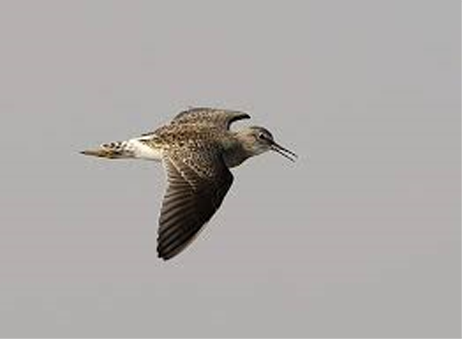
“Closer inspection reveals them to be Wood Sandpipers, two very decent birds indeed to see almost as an afterthought. Indeed, I can’t remember ever finding a completely wild Wood Sandpiper for myself before. All the others were plastic dummies carefully placed by the Warden out on the marshes at Cley-next-the-Sea to attract middle aged visitors.”
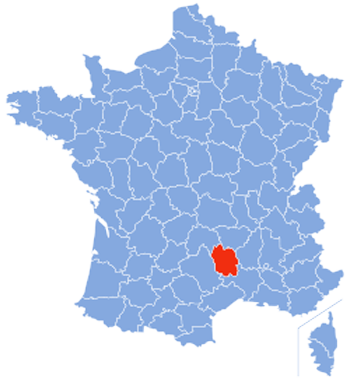
Last week I watched my heroes, the six Hillbilly Hunters, chase vainly after the Hell Hound of Pike County, Kentucky. As a European, though, I could not possibly be unaware of this fearsome creatures’s striking similarity to the so-called “Beast of Gévaudan”, or, in Occitan, the language spoken by the ordinary people in this area of France at the time, “La Bèstia de Gavaudan”.
Whichever language is used, this is the historical name given to the creature which ravaged an area of up to 300 square miles in the province of Gévaudan, in the Margeride Mountains in south central France. In those distant days, between May 1764 and June 1767, this entire area was completely agricultural, and it was common practice once winter ended, to send the herds of cattle or flocks of sheep up into the spring and summer pastures in the high mountains. In an era long before mass communication, news was slow to emerge from the region of an epidemic of killings by an unknown but huge creature. This animal preyed for the most part, usually in broad daylight, on the young boys and girls who were sent up into the mountains for months on end to look after their father’s animals. Sometimes its prey was the women who lived in lonely cottages and tiny villages, often as they tended their animals or gathered crops in open fields. These three categories constituted, of course, the easiest of targets. They were made even easier by years of failed harvests and famine during the period preceding the first appearance of La Bèstia. Indeed, during the many huge beats which were to be organised during the following months, a whole succession of high ranking officials from Paris were all astonished to see the peasants who were taking part, fainting and falling over, passing out from malnutrition and the physical effort involved in walking for any distance across fields or through woods.
The creature, for the most part, ignored men, and likewise cattle, sheep and goats. After the kill it would disappear into the dense patches of forest scattered across the granite plateaux and grass covered hills.
The number of victims differs according to sources. One study estimated there were 210 attacks, with 113 deaths and 49 injuries. Nearly a hundred of the victims killed were partly eaten. However, other sources put the number of fatalities at between sixty and a hundred, mostly defenceless children, or perhaps adult women, with more than thirty victims injured. Attempts have been made to compile full lists of his victims’ names. Click on “Attacks” on the left hand side of the webpage.
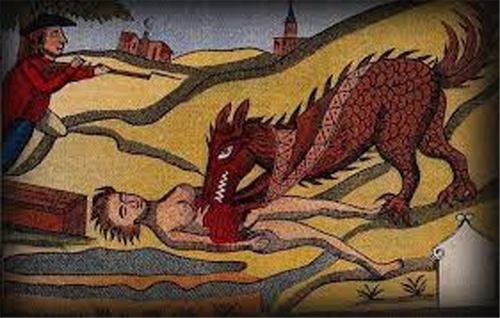
Here are some contemporary illustrations of the creature, nearly all of which depict girls or young women as the victims.
This slideshow requires JavaScript.
According to those who saw the attacks, the monster had formidable teeth and an immense tail. In general, La Bèstia resembled a wolf but it was huge, between a calf and a horse in size. Overall, its fur was said to be unusual in colouration, mostly red, but its back was streaked with black. It had a large doglike head, a snout like a wolf and a mouthful of large teeth. Its small straight ears lay close to its head, and it had a strong neck and a wide chest. The tail was immensely long, and somewhat like that of a panther. People who were struck by the tail said that it was a blow of considerable force. One or two witnesses said La Bèstia had cloven hooves, or that the end of its four limbs was tipped with a hoof. Others said the claws were so heavy that they merely resembled hooves.
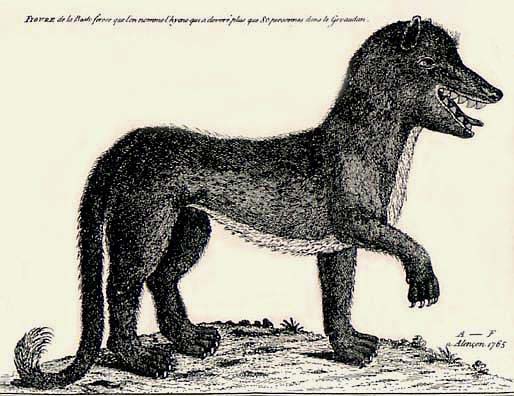
Here is one early depiction of the creature. The text at the top of the illustration below means…
“This is the figure of the Monster which is ravaging Gévaudan. This animal is of the size of a young bull. It attacks by preference women and children. It drinks their blood, cuts off their head, and takes it away. £2,700 is promised to whoever kills this animal.”
(My own translation)
This is an entry in an unknown parish record…
« L’an 1764 et le 1er juillet, a été enterrée, Jeane Boulet, sans sacremens, ayant été tuée par la bette féroce, présans Joseph Vigier et Jean Reboul. »
“In the Year 1764, on the first of July, was buried, Jeane Boulet, without the Last Sacraments, having been killed by the ferocious beast, present Joseph Vigier et Jean Reboul.”
(My own translation)
My knowledge of Old French is limited, and I do not know whether the spellings are correct for 1764, or whether the priest was writing the words as he would have said them. They would certainly not be correct by modern standards of orthography.
Here is a legal document taken from the parish records in the village of Rocles, with the graphic description of the death of a little girl called Magdeleine Mauras, a victim of the Beast of Gévaudan…
“On the 30th day of the month of September in the Year 1764, Magdeleine Mauras was buried, the daughter of the late Jean and Pagès from Pierrefiche. She was about 12 years old and staying with her uncle John Baptiste Mauras from a place called Thorts in this parish. Her body was found on the 29th day of the month, gnawed on the neck and the breast by the ferocious beast which has been ravaging through this diocese for five months. It ripped her throat out when she was coming back to herd her uncle’s cattle homeward at 4.30 in the evening.”
“The rest of her body, which was lacking an arm, ripped off and consumed by the said beast, was laid in the cemetery of this parish of Rocles in the tomb of the ancestors of her father. Present at this were Jean TF, Jean, Jean-Pierre Bouet and Pierre Martin, the son of the late Antoine, from the place called Thorts, all of them illiterate.
I made these enquiries, the Priest at Aubignac.”
(My own translation)
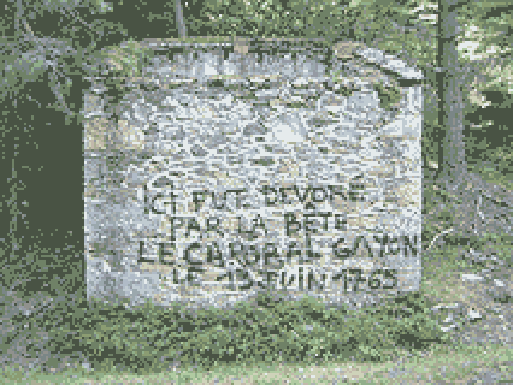
At least one grave of a victim remains…
The French means
“Here was devoured by the Beast Carobal Gayon, June 13th 1765”
He must have been one of the very few adult male victims.
The horrific method of killing victims by ripping their throats out was frequently used by the Beast. Not surprisingly, the government eventually undertook to rid the area of this ferocious creature.
One of the first to try his luck, in October 1764, was Captain Duhamel and his dragoons from Clermont. They did not have an enormous amount of success, and the dragoons themselves were extremely unpopular with the people of the region, as they frequently damaged their crops, and refused to pay for their lodging when billeted with local families. Duhamel was supposedly responsible for this picture of La Bèstia…
Duhamel’s written description said that the monster had the chest of a leopard, the legs and feet of a bear and the ears of a wolf. He thought the animal was some kind of hybrid, but considered that its father was a lion. He did not know what the mother had been. He, like d’Enneval and his son, who were to succeed him in March 1765, refused to believe that it was just an ordinary wolf.
It was January 12, 1765, when twelve year old Jacques Portefaix and his little group of seven friends were attacked by La Bèstia. After several assaults, they drove off the monster by staying grouped together. The encounter came to the attention of King Louis XV who gave rewards to all of these gallant young men. including Jacques Portefaix who was given enough for his education. The King then decreed that the French state would help find and kill the monster.
At this time, of course, the population of France believed that Louis was king by Divine Right. In other words, he was directly appointed by God. Clearly, if Louis could not protect his people from the ravages of an animal that was initially supposed to be merely a large wolf, then questions would certainly be asked about his suitability to rule the country in the face of what might easily be called a punishment sent from God.
Three weeks later, therefore, a concerned King sent two professional wolf-hunters, Jean Charles Marc Antoine Vaumesle d’Enneval and his son Jean-François, to Gévaudan. They arrived on February 17, 1765, bringing eight bloodhounds trained to hunt wolves. Over the next four months father and son hunted wolves believing that eventually they would surely kill the beast. The attacks, however, continued and they were eventually to lose their jobs. D’Enneval père had previously been considered “l’un des meilleurs chasseurs de loups qui ait jamais existé“, “one of the finest wolf hunters who had ever existed”. He had killed some 1,200 wolves in his lifetime, the majority of which, amazingly by today’s standards, were in the Normandy region. His final departing judgement, though, was that, whatever La Bèstia was, it was no wolf.
On June 22 1765, therefore, Monsieur Antoine de Beauterne, the king’s arquebus bearer and Lieutenant of the Hunt arrived. They began immediately to organise beats by the local people, and set about the same policy of killing as many wolves as they possibly could, in the hope that one of them would turn out to be La Bèstia.
On September 20, 1765, Monsieur Antoine, as he was universally now known, killed his third and largest wolf measuring 31 inches high at the shoulder, 5 feet 7 inches long, and weighing 130 pounds. The wolf was named Wolf of Chazes after the nearby Abbey of Chazes. Strangely, though, this shooting did not take place where the Beast had ever killed anybody, and indeed, it had never been seen there previously.
Monsieur Antoine stated officially:
“We never saw a big wolf that could be compared to this one. This could be the fearsome beast that has caused so much damage.”
The animal was identified as the culprit by attack survivors who recognised the scars on its body inflicted by victims defending themselves. The wolf was stuffed and sent to Paris where Monsieur Antoine was received as a hero, receiving a large sum of money as well as titles and awards.
And then, OH NO!! Very soon, and certainly from the month of November onwards, there were rumours of fresh attacks. They continued throughout the whole of 1766, and then twelve year old Marie Denty was attacked and devoured on May 16th 1767.
On June 19th, 1767, a hunt was organized by a well intentioned local nobleman, the Marquis d’Apcher,
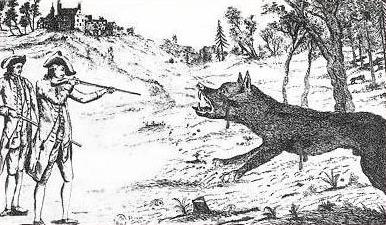
The supposed second beast was duly killed by a local hunter named Jean Chastel. The death of this creature seems finally to have marked the end of these appalling attacks in this benighted region of France.
Writers later introduced the idea that Chastel had shot the creature with blessed silver bullets of his own manufacture. This was probably so that it would fit in more exactly with the largely twentieth century tales told about werewolves, particularly in the cinema.
Upon being opened, the animal’s stomach was shown to contain human remains. Like the first creature, this second wolf was sent to Paris, but, because it had decomposed so badly and was extremely smelly, nobody was particularly interested. Even so, what seems a very thorough autopsy was carried out by the King’s Notary, Roch Étienne Marin.
One television programme, Australia’s “Animal X”, stated that this picture shows, according to Chastel himself, the animal that he shot.
Jean Chastel is nowadays commemorated as the saviour of the region. His signature is preserved, and so is his rifle…
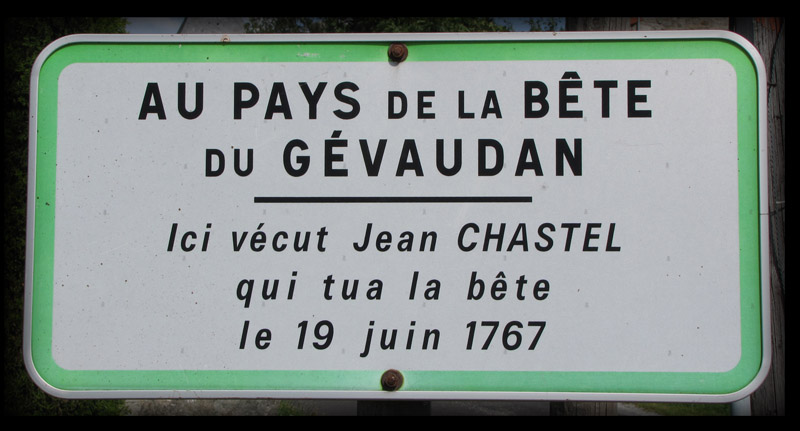
His house is prominently labelled…
The French means
“In the country of the Beast of Gévaudan Here lived Jean Chastel who killed the beast on June 19th 1767. ”
He has a statue…
There are, as you might expect, any number of explanations of the identity of the Beast of Gévaudan. I will look at as many of these as I can in another blogpost.
One thing, however, remains indisputably true: La Bête du Gévaudan was only too real, and terrified thousands of people for a good three years.
Nowadays, La Bèstia is much more in favour. He has numerous statues dedicated to him…
Yesterday we went to Westdale Lane in Nottingham to see the flypast by the Battle of Britain Memorial Flight’s Avro Lancaster.
This particular aircraft was completed at Hawarden Airfield, Chester on May 31 1945 and its serial number is PA474.
This sole remaining British Lancaster is currently painted as “Thumper Mk III“.
In a recent blogpost, I told the often harrowing tale of how what appeared to be a small army of men descended on our hitherto tranquil house, and after a period of some four days, managed to install both a new central heating system and a multi-fuel stove. Most interesting, though, was the tiling revealed in the back bedroom, when the old radiator was taken off.
There was no trace of a fireplace ever having been behind this tiling and we were told that it appeared to be a practice exercise, perhaps carried out by a young apprentice, and placed on the bedroom wall in 1932 to echo the fireplace in exactly the same position one floor below. In the 1960s, we think, the house was given its first dose of central heating and the young man’s work from thirty years before was covered over and lost. Being a sentimental and nosey old fool, I always wonder about the ordinary working men and women who laboured for such brief moments in endless time and whose work may, paradoxically, then sometimes go on to last for so many years, long after the deaths of the people who made them. Working men are born, live their lives for good or bad, and when they are gone, they leave little trace behind them. And once their grandchildren pass on, those men are then banished for eternity to “Trace your Ancestry” websites, as just names on forms, too far back in history to connect with. Did this apprentice tiler go on to fight in the Second World War? Did he survive? And the man who gave him the job to do – had he come back from the Somme a mental wreck of what he had previously been?
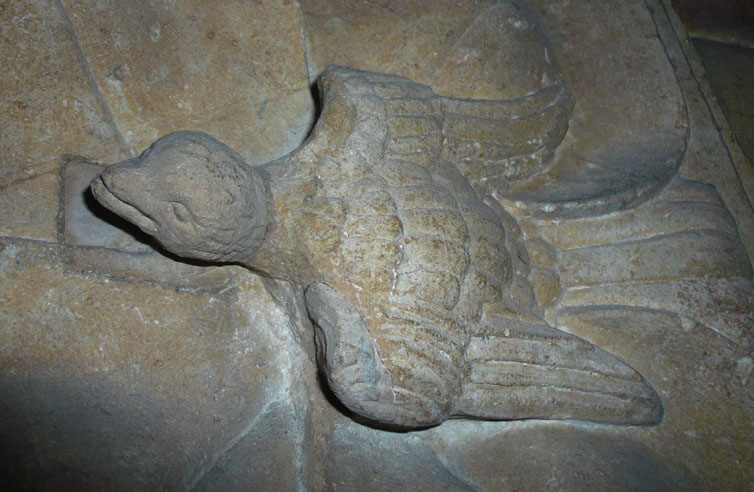
Nearly ten years ago, I went to visit Lincoln Cathedral, which has a fascinating parallel to the tiling exercise, except this one is getting on for being a thousand years older. This early medieval practice exercise is for carving lots of little squares with decorative flowers in the middle. Even twelfth century boys will be boys, though, and instead of a flower, one bright spark has carved a bird’s nest, complete with baby birds.
On the right, somebody has carved one of the adults, arriving with a worm in its mouth.
And on the left, there is the other parent flying away, its beak empty, in search of more food for their hungry offspring.
Those inventive young men of the twelfth century, however, were not to realise that one day, a tower in the very cathedral that they had had the privilege of helping construct, was to play host to its very own parent birds, a pair of Peregrines.
They are not easy to film!
This is “Lincoln’s Falcons” by Mark Taylor
Not everything always goes to plan! This is called “Peregrine falcon chick saved after fall” and comes from the local newspaper, the Lincolnshire Echo.
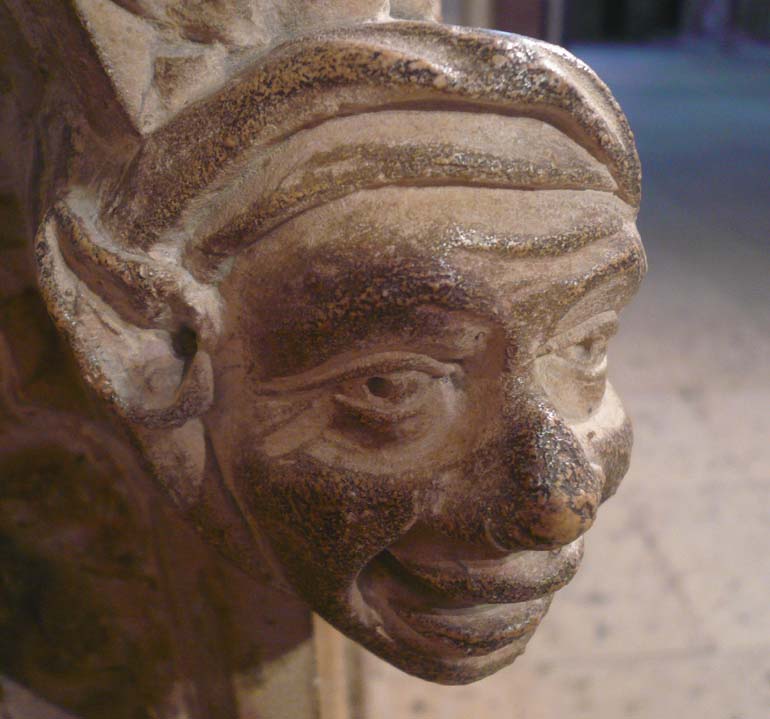
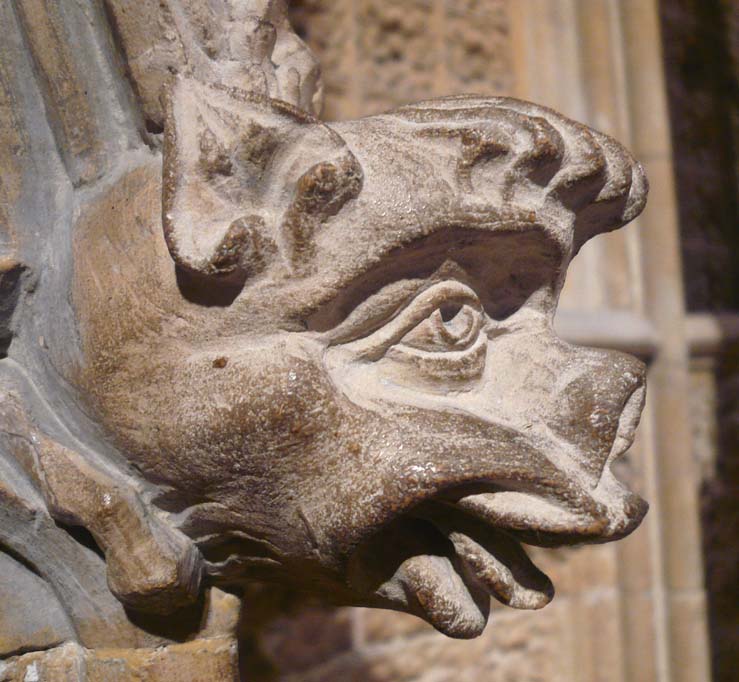
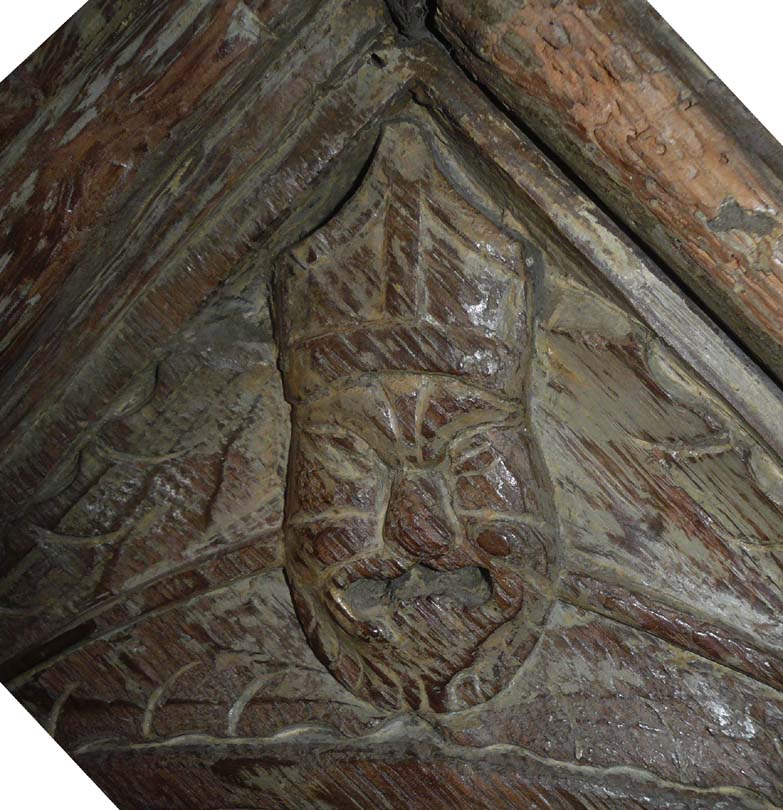
Even more interesting, though, are the medieval man’s opinions of his bosses. Asked to carve decorative heads onto the rood-screen, the stone carvers have obediently done so, but at the same time, they have taken a golden opportunity to transform important people, such as their foremen, into cartoon figures, with big noses and stupid expressions. I cannot believe that these carved faces were unrecognisable to the stone carvers’ contemporaries.
Martin, always over eager, with his big fleshy lips…
Will with his big nose…
Jack, what a chubby little chap!
Greedy Tom with his pig’s ears…
Stupid Henry with his donkey’s ears…
Harry, turning into a mouse…
Walter. metamorphosing slowly into Satan, complete with horns…..
The priest with his buck teeth and drooling tongue…
Even the bishop looks as if he is about to explode, with either anger or constipation…
In the ancient castle nearby is the religious graffiti carved by bored guards during a long forgotten night around 1350 or 1400, as they waited to take the condemned man out to be hanged the next day…
Most of all though at Lincoln, I love this old ring, set into one of the internal walls of the cathedral. This is where Oliver Cromwell’s troops tethered their horses, when the Roundhead cavalry was stabled inside this lovely old cathedral during the English Civil War.
What a magnificent building.
For a short period in the Middle Ages, when the towers had their spires, it was the tallest structure in the world.
To my shame, I did not appreciate that July 13th, the 121st anniversary of his birth, was “John Clare Day”. I found this out by googling retrospectively “John Clare”, and coming across an absolutely superb article by George Monbiot in the Guardian.
Furthermore, I must confess that I actually knew very little about John Clare other than the fact that he was a poet and that, unlike the vast majority of poets, he was of working class origin. His biographer Jonathan Bate described him as “the greatest labouring-class poet that England has ever produced. No one has ever written more powerfully of nature, of a rural childhood, and of the alienated and unstable self”.
The first port of call, therefore was Wikipedia.
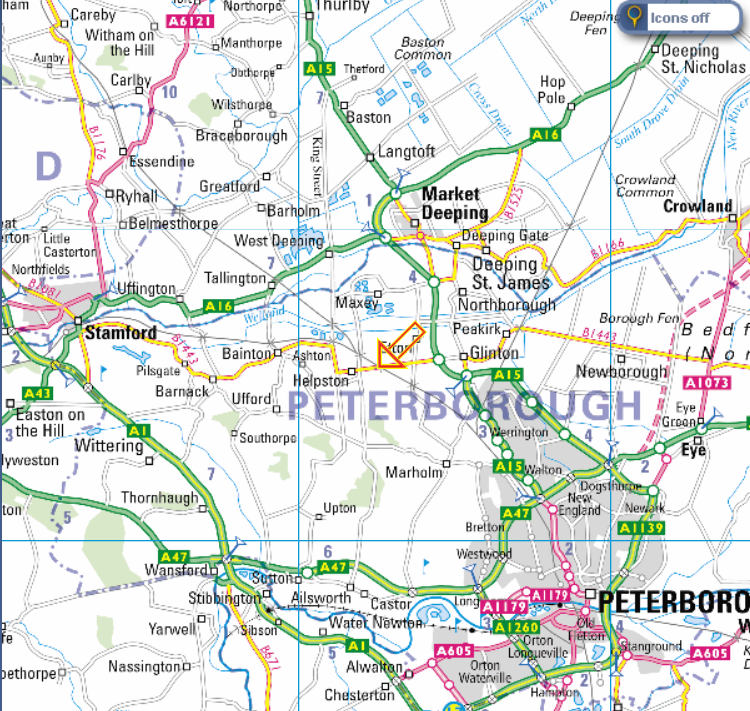
The bare bones of Clare’s life were that he was born into desperate agricultural poverty in the tiny village of Helpston, just to the north of Peterborough in Northamptonshire.
The area was amazingly rich in wildlife.
He would have seen and heard corncrakes everywhere.
Nightjars too, were as common in England then as they now are in this excellent film from Denmark…
There were ravens in the old, giant oak trees, wrynecks, which still bred in old woodpeckers’ holes, and the last few wildcats…
This slideshow requires JavaScript.
And glowworms…
“Tasteful illumination of the night,
Bright scattered, twinkling star of spangled earth.”
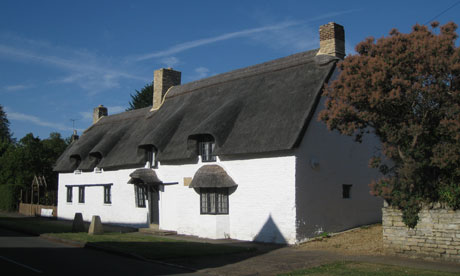
Clare’s cottage, where he spent his childhood, still remains…
Like all his fellows, Clare became an agricultural labourer while still a child, but he attended the school in Glinton church until he was twelve. He also began to write poetry, something which was to cause him great problems throughout the rest of his life among simple farm workers.
He wrote…
“I live here among the ignorant like a lost man in fact like one whom the rest seemes careless of having anything to do with—they hardly dare talk in my company for fear I should mention them in my writings and I find more pleasure in wandering the fields than in musing among my silent neighbours who are insensible to everything but toiling and talking of it and that to no purpose.”
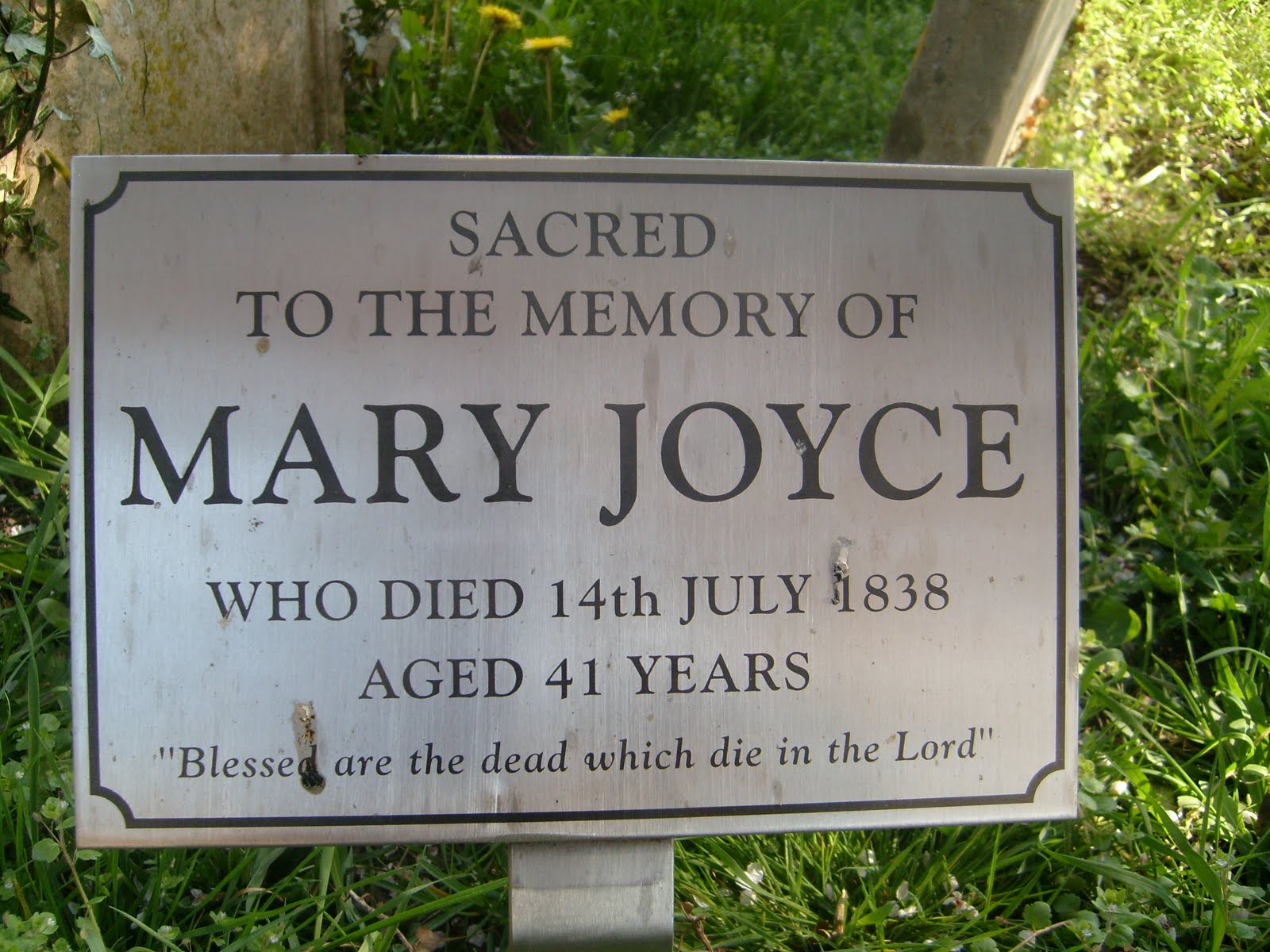
Clare’s first love was Mary Joyce, but alas, she was to die, by our standards at least, a premature death.
Clare was to marry Martha Turner in 1820. Her nickname was “Patty”.
“Courtship
Where are you going lovely maid
The morning fine & early
“I’m going to Walkerd”, Sir she said
&made across the barley
I asked her name she blushed away
The question seemed to burn her
A neighbour came & passed the day
&called her Patty Turner
I wrote my better poems there
To beautys praise I owe it
The muses they get all the praise
But woman makes the poet
A womans is the dearest love
Theres nought on earth sincerer
The leisure upon beautys breast
Can any thing be dearer
I saw her love in beauty’s face
I saw her in the rose
I saw her in the fairest flowers
In every weed that grows”
Clare, though, was to have many bouts of severe depression, which worsened as his family increased in size and his poetry sold less well.
Gradually over the years, his behaviour became progressively more and more erratic. In July 1837, he went of his own accord to Doctor Matthew Allen’s private asylum. In 1841, though, Clare absconded and walked all the way back home from Essex. He thought, in his madness, that he would be able to refind his first true love, Mary Joyce. He believed firmly that he was married not just to her, but to Martha as well, and had children by both women. He refused to believe Mary’s family that she had died accidentally three years previously in a house fire. He stayed a free man at home for a little while, but was back in the asylum by mid-1841, his wife having called for help from them between Christmas and the New Year of 1841.
Clare was sent to the Northampton General Lunatic Asylum, where he lived out the rest of his life. He was helped enormously by the kindness and humanity of Dr Thomas Octavius Prichard, who encouraged and helped him to continue writing his poetry. It was at the Northamptonshire County General Lunatic Asylum that Clare wrote possibly his most famous poem…..
“I am!
I AM! yet what I am none cares or knows,
My friends forsake me like a memory lost;
I am the self-consumer of my woes,
They rise and vanish, an oblivious host,
Like shades in love and death’s oblivion lost;
And yet I am! and live with shadows tost
Into the nothingness of scorn and noise,
Into the living sea of waking dreams,
Where there is neither sense of life nor joys,
But the vast shipwreck of my life’s esteems;
And e’en the dearest–that I loved the best–
Are strange–nay, rather stranger than the rest.
I long for scenes where man has never trod;
A place where woman never smil’d or wept;
There to abide with my creator, God,
And sleep as I in childhood sweetly slept:
Untroubling and untroubled where I lie;
The grass below–above the vaulted sky. “
Clare’s problems with depression had not been helped by having to watch his world disappear as, between 1809 and 1820, various Acts of Enclosure allowed the greedy, idle, useless rich to increase their already great wealth by putting fences across the previously open fields, heathland and woodlands., and declaring that everything now belonged to them.
This, of course, was the early nineteenth century equivalent of “Trespassers will be Prosecuted”, and, as it was designed to do, prevented anybody poor from enjoying what abruptly became the rich man’s landscape.
In due course, the idle rich realised that they could make even more money by destroying the ancient countryside, and farming it in an exclusively profit orientated way. There was no room for five hundred year old oak trees or sleepy marshes, no more meandering streams or cool copses to give shade on a hot summer’s day. Faced by the onslaught of Agribusiness, the wild animals, the birds, the insects and the butterflies all began to disappear.
In other words, it was pretty much the beginning of the country landscape we are asked to tolerate today.
This poem was finished by 1824, but was published only in 1935.
“The Mores
Far spread the moorey ground a level scene
Bespread with rush and one eternal green
That never felt the rage of blundering plough
Though centurys wreathed springs blossoms on its brow
Still meeting plains that stretched them far away
In uncheckt shadows of green brown and grey
Unbounded freedom ruled the wandering scene
Nor fence of ownership crept in between
To hide the prospect of the following eye
Its only bondage was the circling sky
One mighty flat undwarfed by bush and tree
Spread its faint shadow of immensity
And lost itself which seemed to eke its bounds
In the blue mist the orisons edge surrounds
Now this sweet vision of my boyish hours
Free as spring clouds and wild as summer flowers
Is faded all–a hope that blossomed free
And hath been once no more shall ever be
Inclosure came and trampled on the grave
Of labours rights and left the poor a slave
And memorys pride ere want to wealth did bow
Is both the shadow and the substance now
The sheep and cows were free to range as then
Where change might prompt nor felt the bonds of men
Cows went and came with evening morn and night
To the wild pasture as their common right
And sheep unfolded with the rising sun
Heard the swains shout and felt their freedom won
Tracked the red fallow field and heath and plain
Then met the brook and drank and roamed again
The brook that dribbled on as clear as glass
Beneath the roots they hid among the grass
While the glad shepherd traced their tracks along
Free as the lark and happy as her song
But now alls fled and flats of many a dye
That seemed to lengthen with the following eye
Moors loosing from the sight far smooth and blea
Where swopt the plover in its pleasure free
Are vanished now with commons wild and gay”
For me, Clare’s best work is his nature poetry. Because he was a poor labourer, he saw far more details as he walked along than the rich poets who thundered past in their coaches. John Clare’s nightingale actually was a real nightingale, not another species misidentified.
George Monbiot in his wonderful article urges us to read the poem…
“…Everything he sees flares into life…his ability to pour his mingled thoughts and observations on to the page as they occur, allowing you, as perhaps no other poet has done, to watch the world from inside his head.”
“The Nightingale’s Nest” is indeed a fabulous poem, and is just like going for a stroll into the woods with John Clare himself, to view a bird whose nest he has previously staked out at some point during his working day. The reader becomes a fellow birdwatcher, who can follow John Clare’s instructions about where to look…
“The Nightingale’s Nest
Up this green woodland-ride let’s softly rove,
And list the nightingale – she dwells just here.
Hush ! let the wood-gate softly clap, for fear
The noise might drive her from her home of love ;
For here I’ve heard her many a merry year –
At morn, at eve, nay, all the live-long day,
As though she lived on song. This very spot,
Just where that old-man’s-beard all wildly trails
Rude arbours o’er the road, and stops the way –
And where that child its blue-bell flowers hath got,
Laughing and creeping through the mossy rails –
There have I hunted like a very boy,
Creeping on hands and knees through matted thorn
To find her nest, and see her feed her young.
And vainly did I many hours employ :
All seemed as hidden as a thought unborn.
And where those crimping fern-leaves ramp among
The hazel’s under boughs, I’ve nestled down,
And watched her while she sung ; and her renown
Hath made me marvel that so famed a bird
Should have no better dress than russet brown.
Her wings would tremble in her ecstasy,
And feathers stand on end, as ’twere with joy,
And mouth wide open to release her heart
Of its out-sobbing songs. The happiest part
Of summer’s fame she shared, for so to me
Did happy fancies shapen her employ ;
But if I touched a bush, or scarcely stirred,
All in a moment stopt. I watched in vain :
The timid bird had left the hazel bush,
And at a distance hid to sing again.
Lost in a wilderness of listening leaves,
Rich Ecstasy would pour its luscious strain,
Till envy spurred the emulating thrush
To start less wild and scarce inferior songs ;
For while of half the year Care him bereaves,
To damp the ardour of his speckled breast ;
The nightingale to summer’s life belongs,
And naked trees, and winter’s nipping wrongs,
Are strangers to her music and her rest.
Her joys are evergreen, her world is wide –
Hark! there she is as usual – let’s be hush –
For in this black-thorn clump, if rightly guest,
Her curious house is hidden. Part aside
These hazel branches in a gentle way,
And stoop right cautious ’neath the rustling boughs,
For we will have another search to day,
And hunt this fern-strewn thorn-clump round and round ;
And where this reeded wood-grass idly bows,
We’ll wade right through, it is a likely nook :
In such like spots, and often on the ground,
They’ll build, where rude boys never think to look –
Aye, as I live ! her secret nest is here,
Upon this white-thorn stump ! I’ve searched about
For hours in vain. There! put that bramble by –
Nay, trample on its branches and get near.
How subtle is the bird! she started out,
And raised a plaintive note of danger nigh,
Ere we were past the brambles ; and now, near
Her nest, she sudden stops – as choking fear,
That might betray her home. So even now
We’ll leave it as we found it: safety’s guard
Of pathless solitudes shall keep it still.
See there! she’s sitting on the old oak bough,
Mute in her fears ; our presence doth retard
Her joys, and doubt turns every rapture chill.”
I have not quoted some of Clare’s poems in full. They are extremely accessible on the Internet, and will fully repay your efforts.
The vast majority of his poetry can be found very easily.
Just find “Poets by Name” on the left of the screen, and click on “J” for “John Clare”.
The poet’s grave is at Helpston….
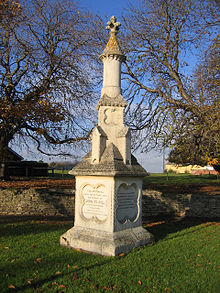
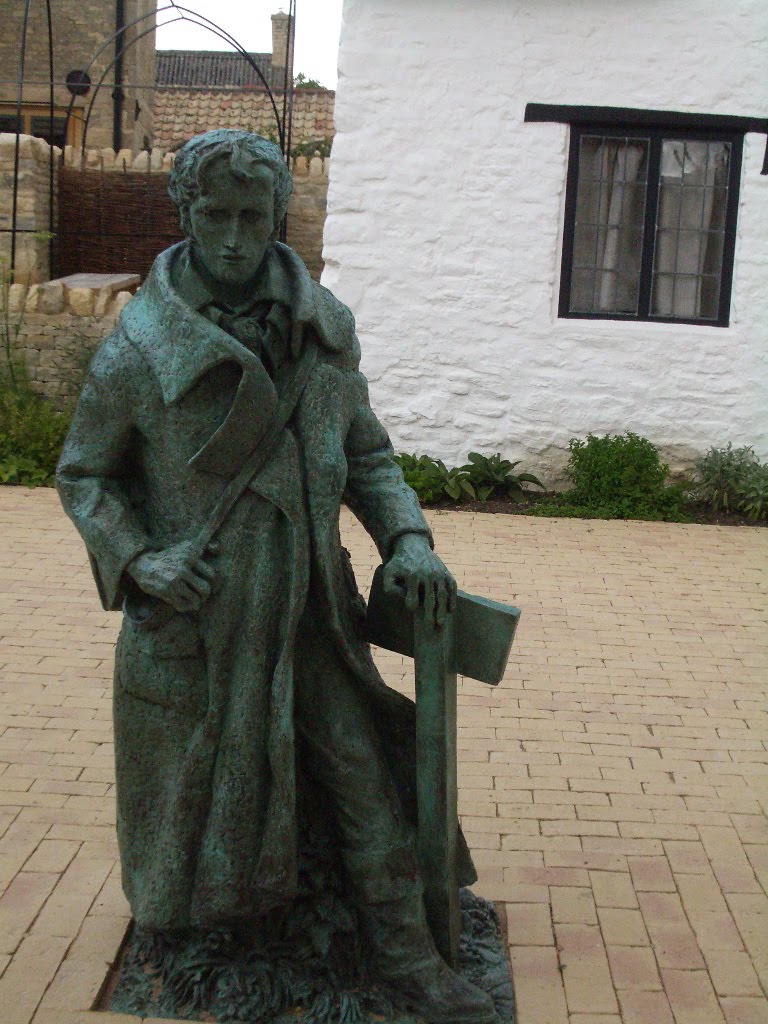
And, as one of England’s greatest poets, he has a memorial…
This is my first attempt at being creative in a blogpost. Given the subject matter I have chosen, World War I, or the Great War as it was called until 1939, it would be easy to offend people. That is not at all my intention. Indeed, I am trying to draw the attention of the living to just how much those 888,246 young casualties were asked to give up….all the rest of their young lives, the wives and husbands they never had, the children, the careers, their quiet old age. Everything.
Cue the first section of this well-known song, written by John Lennon…
“I read the news today, oh boy
About a lucky man…..”
“And though the news was rather sad
Well, I just had to laugh”
Well, I felt closer to crying actually. So many young men were slaughtered, so many young lives came crashing to a halt, and above all, the unknown potential of so many young minds was snuffed out.
What might some of those 888,246 young people have discovered for the benefit of the rest of Mankind? And how would all of them have spent another fifty or sixty years of family life, if they had been lucky enough to have had one?
The war started more or less, by pure chance.
“On Sunday, 28 June 1914, Franz Ferdinand and his wife were killed in Sarajevo by Gavrilo Princip, a member of a group of assassins organized by the Black Hand. Earlier in the day, the couple had been attacked by Nedeljko Čabrinović, who had thrown a grenade at their car. However, the bomb detonated behind them, hurting the occupants in the following car. On arriving at the Governor’s residence, Franz angrily shouted, “So this is how you welcome your guests — with bombs?!”
After a short rest at the Governor’s residence, the royal couple insisted on seeing all those who had been injured by the bomb. However, no one told the drivers that the route had been changed. When the error was discovered, the drivers had to turn around. As the cars backed down the street and onto a side street, the line of cars stalled. At this same time, Princip was sitting at a cafe across the street. He instantly seized his opportunity and walked across the street and shot the royal couple.”
This slideshow requires JavaScript.
“I saw the photograph.
They blew his life out in a car.
He didn’t notice that the route had changed.
A crowd of people stood and stared
They’d seen his face before
Nobody was really sure if he was from the House of Lords”
What a pointless reason for the deaths of millions and millions of people, not just from this country and the British Empire, but from our fellow members of the present day European Community: Belgium, France, Italy, and of course, our good friends in Germany and the USA.
The total number of deaths worldwide, was between 15,163,603 and 17,989,782.
This slideshow requires JavaScript.
“I saw a film today, oh boy
The English army had just won the war”
“A crowd of people turned away”
Perhaps they were disgusted when they were told that the paperwork for the Armistice had been signed at 5.00 a.m. but that 11,000 more men were to be killed over the course of the next six hours. And of course, there were lots of excuses at hand for this heartless bungling by people to whom the ordinary soldiers’ lives were, ultimately, of little or no consequence.
Worse than that, in many places on the front line, well after that 11.00 a.m. deadline, combat continued, and men died pointlessly.
There is no record of who looked after and loved those 40 million horses, dogs, pigeons and other animals which perished.
Nobody will ever know what the world could have done with the £109,000,000,000 that was spent on the conflict.
And just in case you didn’t know, here is how a very large proportion of those desperately young men were to end their lives….
And while the ordinary working man came to understood the real truths of international brotherhood and comradeship…
Last week we had the builders and plumbers around to our house to put in a new central heating system. At first it felt exactly as if the whole building had been hit by a tsunami. Not quite as dramatic or as destructive though as this one…
The problem was that every one of the six men was armed with his very own Mjölnir, his very own Hammer of Thor, with which he was capable of sending thunder echoing round the house whenever he felt like it.
In actual fact, it was more that the jobs they had to do in the first couple of hours were by far the noisiest of the entire four days. Believe me, a dining room is no is no place for a pneumatic drill.
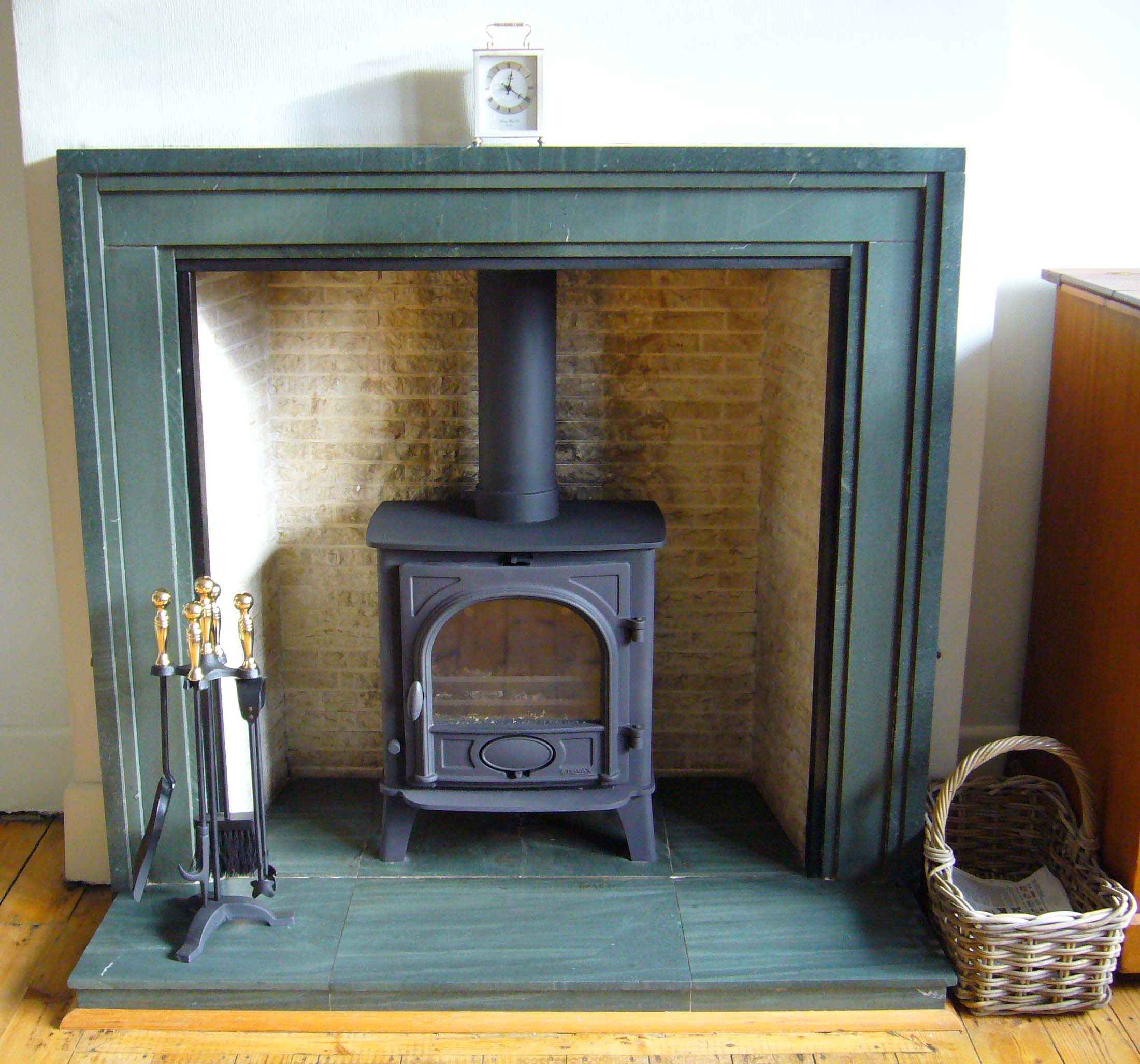
In 2013 we had the same company come round and put a multi-fuel stove in our living room. We were sick and tired of the money guzzling gas fire, to which the only other solution was to switch on the central heating for the entire house. Here is our first stove which was put in last September.
Over the course of the winter therefore, we lit our new multi-fuel stove in the late afternoon, and after feeding it sparingly with coal for the evening, we then discovered that it would then keep the room pleasantly warm for the whole night and for much of the next day. In addition, it also kept the bedroom above equally lovely and warm. Only very infrequently were we using the central heating.
We soon realised that having a second stove fitted in the dining room at the back of the house might have the same effect and save a great deal more money. So, as well as having our central heating revamped, we were having a second stove put in.
In the dining room, we had a ten or fifteen year old gas fire. It always seemed to remind me of somebody, perhaps a character out of Wallace and Gromit.
First of all they removed the gas fire. Here is just a small selection of the rubble that the builders created. Notice though, that it is neatly put into special plastic buckets, so that nothing whatsoever remained at the end of the day.
Here is the old gas fire, and the old radiators, gone for ever…
The majority of the old radiators had to go. They had been there since probably the mid-1960s. Here, plans are being laid to put the new boiler in the bathroom where an old cabinet had been.
In the loft, the old boiler had come to the end of the road. The fat lady really had sung for the last time.
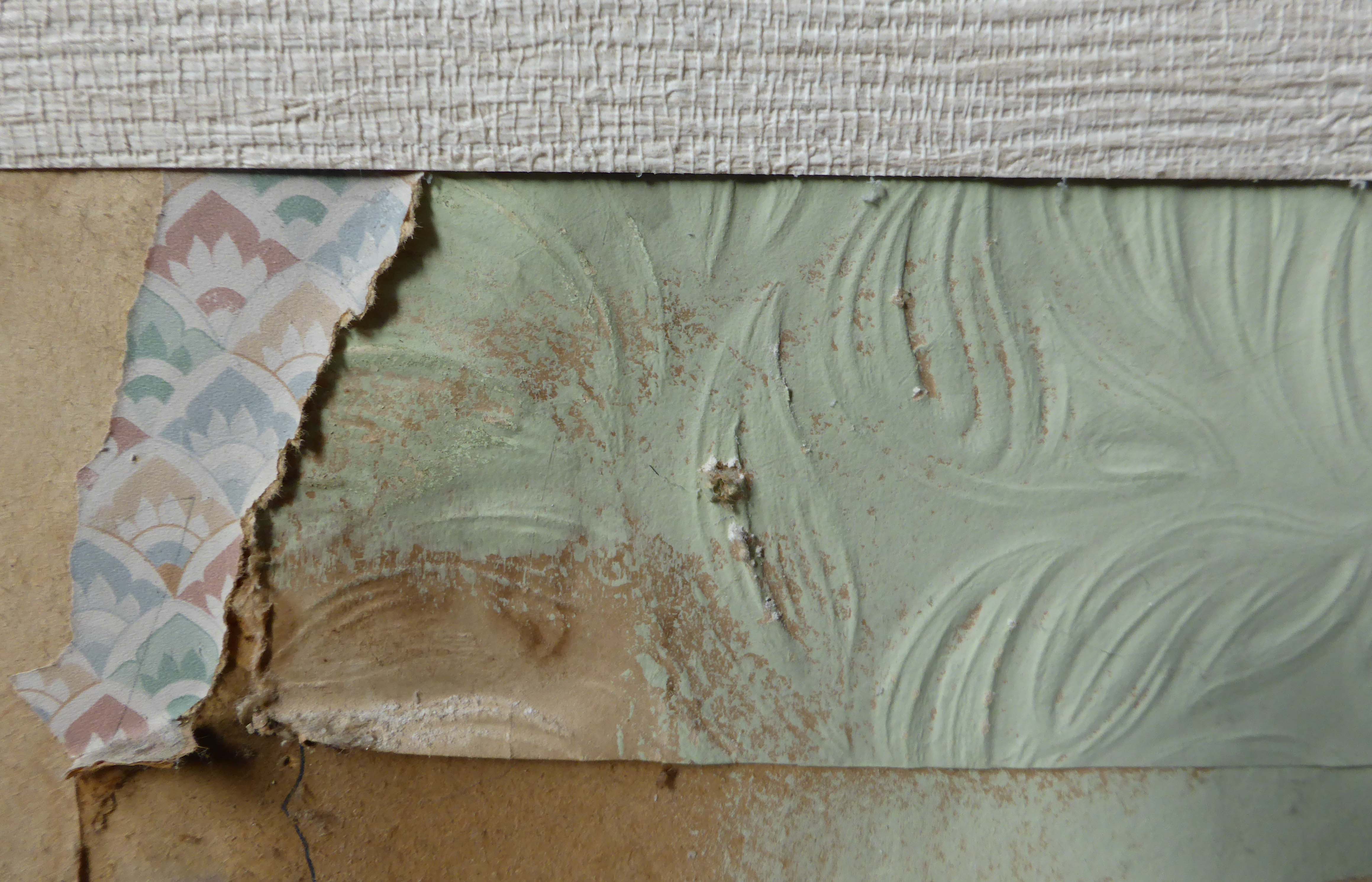
Unfortunately, here and there, the wallpaper will need repair, but there are very few things that a Pritt stick will not be able to remedy. In actual fact, in some places, a number of different layers of wallpaper were revealed.
The top pale green one, I think, was our responsibility but the green leafy pattern looks to me to be either 1940s or 1950s, and the relatively bright coloured wallpaper to its left dates from the more optimistic days of the 1980s.
Here you can see not only Mjölnir, the hammer of Thor, but also the pneumatic drill which caused all the scariest noise for the first half hour or so.
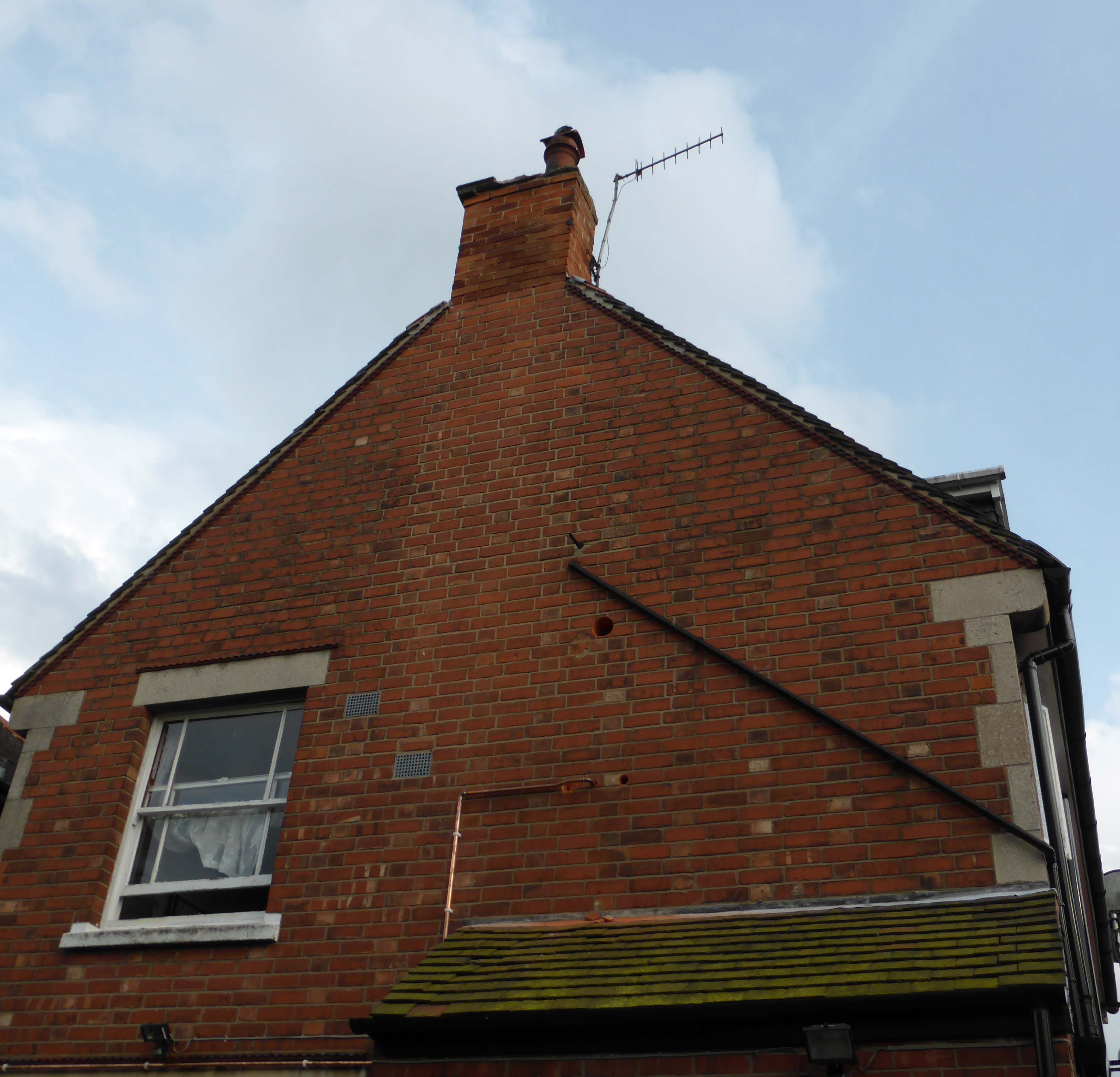
The chimney had to be inspected. Would an eighty year-old chimney be up to the job, or would it require extensive and expensive repairs? Well, what do you think?
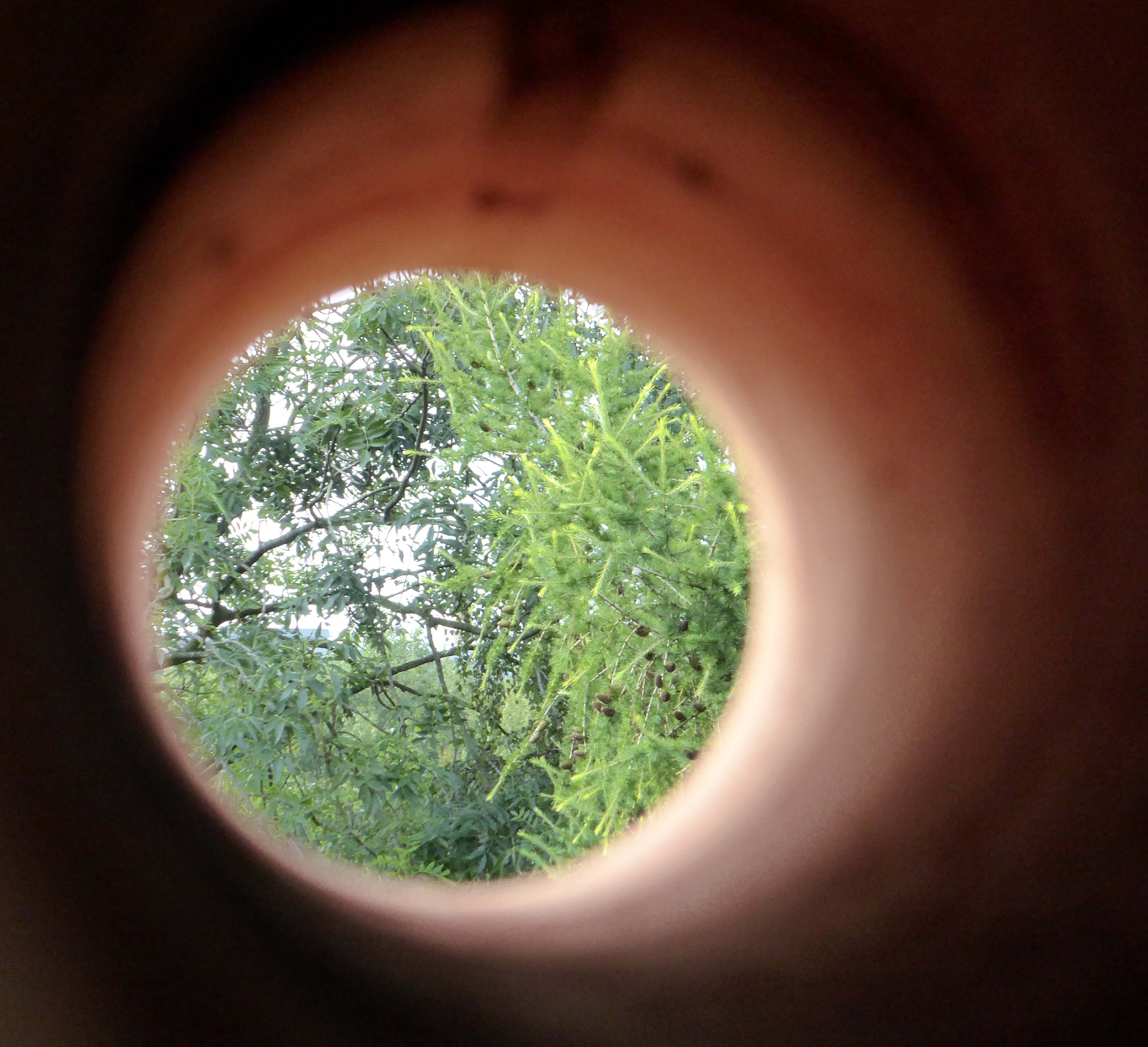
This hole, drilled in the bathroom wall for the new slimline boiler, gave a view over the garden which could be enjoyed for only twelve or so hours in nearly eighty years.
The princess of boilers is now in place.
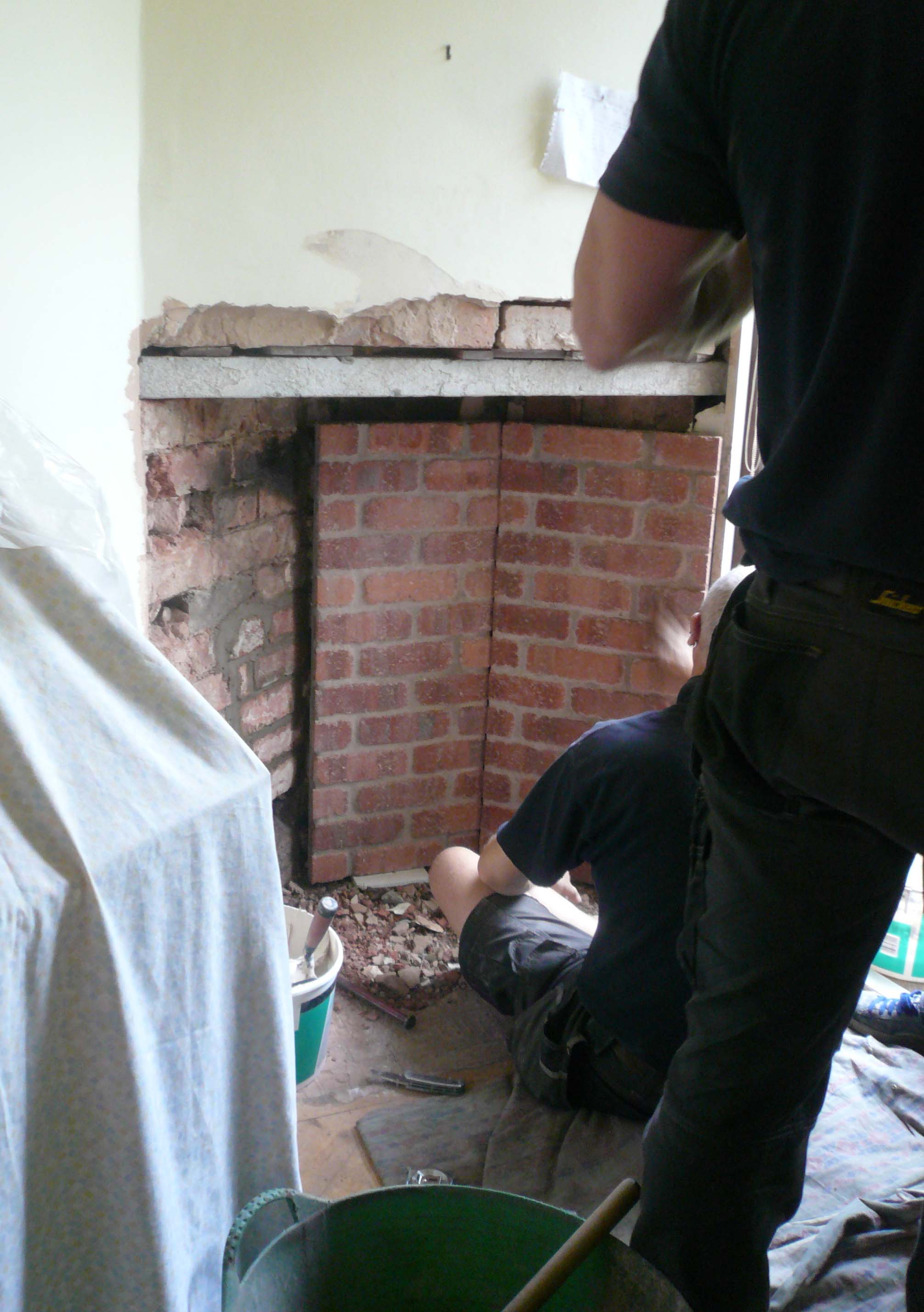
Meanwhile the new fireplace will need some imitation bricks. The builder works so fast his trowel is just a blur. Behind him is the Safety Superintendent.
At last everything is ready. The stove is connected up. And then, the all important test firing.
All those lovely warm happy flames. I do so love flames and lovely warm fire. Flames and fire. Fire and flames.
With two radiators now though, there will be no repetition of that unfortunate business with the polar bear.
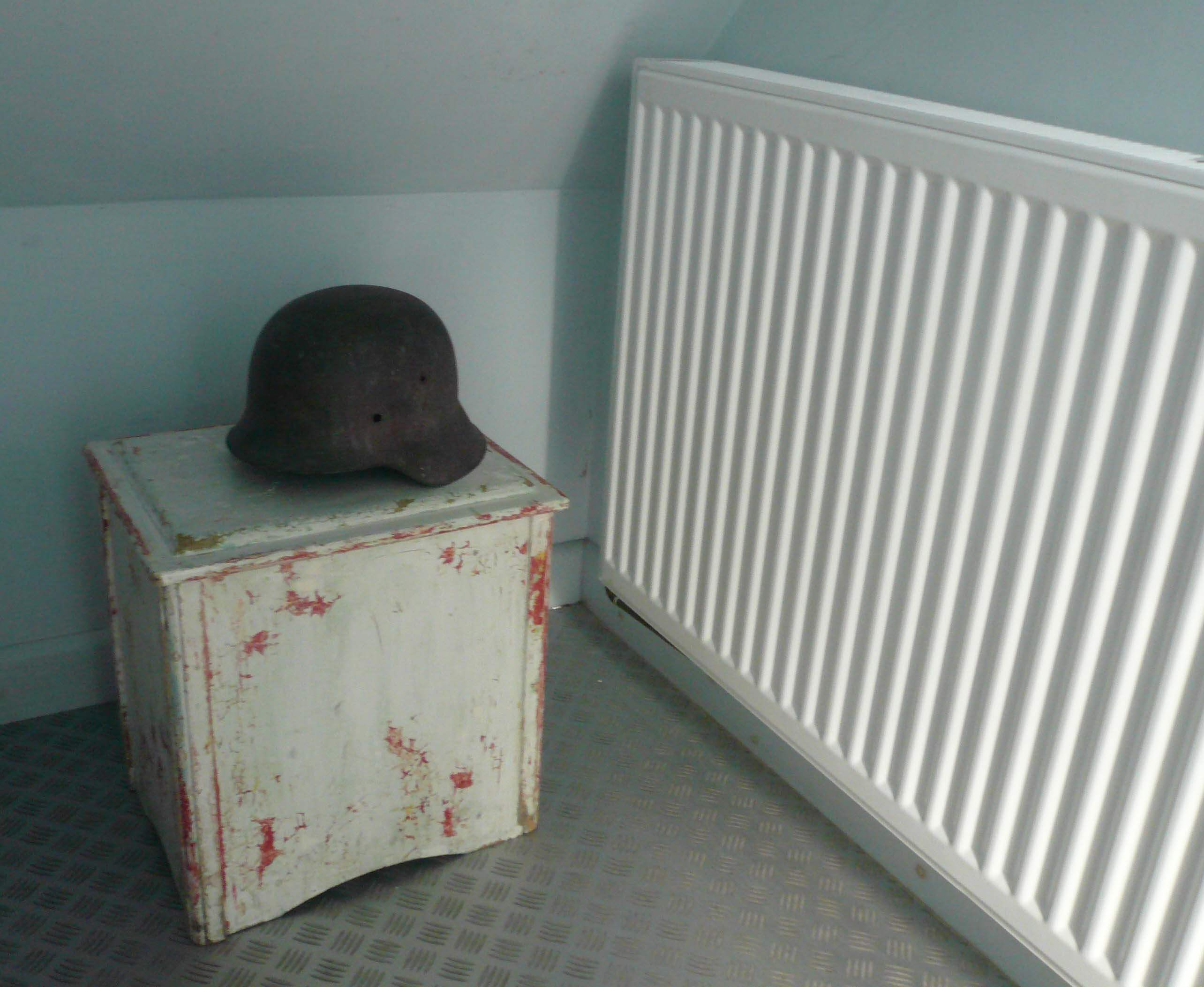
In the bathroom, there is yet another radiator. It will now be impossible for me to put my Stahlhelm on and re-enact “Showering Facilities on the Eastern Front”.
Best of all though, is the fact that I took advantage of all this building work to have a new, much more powerful shower installed. No more problems now with having to wash like this…
Every single morning now, I’m in the new shower just like this.











































 John Knifton