Category Archives: Science

Jer Falcon. one shot at Park Hall by Mr Shelton. Now in my collection.

In his own vastly expanded version of “Notes on the Birds of Nottinghamshire”, published in 1907, and now housed in the local collection of Mansfield Library, author Joseph Whitaker has added, for the most part in pencil, his own notes and additions. In some cases, he has pasted newspaper clippingts onto the pages. At one particular point, towards the end of the book, he has added the following handwritten note, misspellings and all:

“Jer Falcon. one shot at Park Hall by Mr Shelton. We were beating a plantation on Clipstone Road near the Red House Farm it was misty + this falcon flew low over the trees + was shot by him.
I missed this bird out when this book was written. Now in my collection”.

Sceptics might say, of course, that Joseph Whitaker was mistaken in his identification of the bird and that it was, quite simply, not a definite Gyrfalcon. This is, however, a rather unlikely scenario. Joseph Whitaker was familiar with many, many different kinds of raptor. If anything, he had probably seen more species within the county than the majority of present-day birdwatchers. And don’t forget. Mr Shelton shot it. They were identifying a corpse, not a distant dot disappearing into a dismal sky:

Gyrfalcon_e0 zzzzzzzzzzzzzzzzz
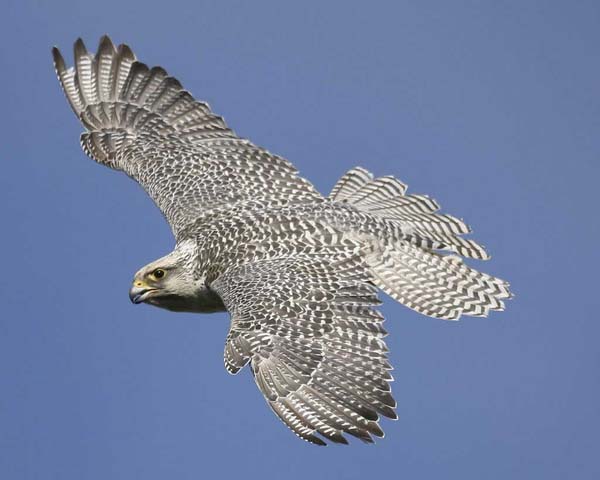
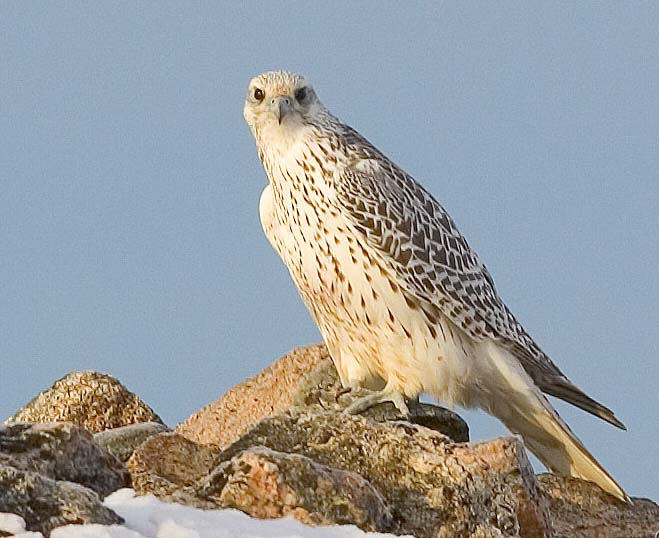
In any case a Gyrfalcon would have been easily identifiable on size alone. It is a falcon as big as a Common Buzzard And if Whitaker’s bird was a white phase individual, it would have been totally unmistakeable:

faucon-gerfaut-vol-tm3 zzzzzzz

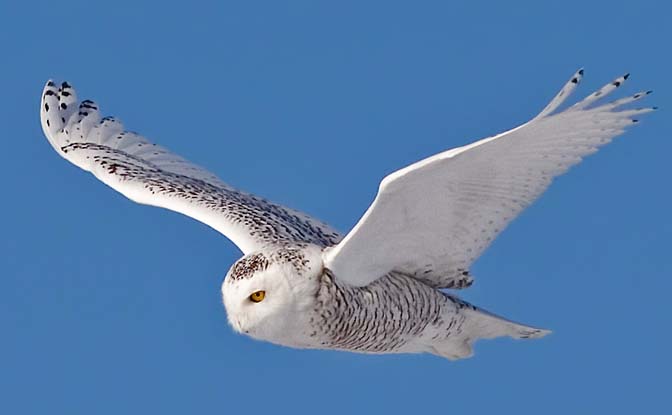
There are only two birds of this size which are completely white, namely Gyrfalcon and Snowy Owl. The latter is not exactly difficult to identify:

speciexxxxxxxxxxxxxxxxxxxxxxxxxxxxxxxxxxxxxxxx

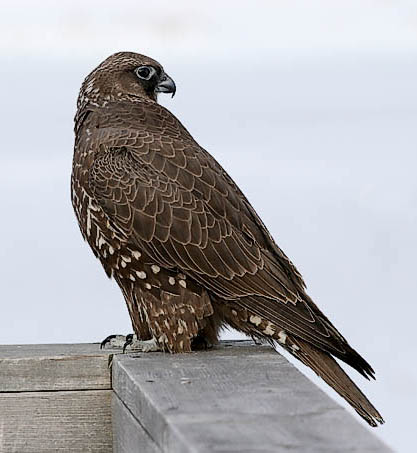
Gyrfalcons exist in two different colour morphs and it would, admittedly, have been more difficult to identify a dark morph bird:

dark

The issue of size would still have been there, of course. Gyrfalcons of both white and dark morphs are huge birds. Furthermore, even dark phase Gyrfalcons are very distinctive birds, especially when viewed as dead specimens.

Dark morph birds may just be an academic problem anyway. According to at least one ornithological authority, namely Fisher in 1967, the vast majority of Gyrfalcons seen in England during the Victorian era were, in actual fact, white phase birds, with apparently only one dark morph individual recorded nationally during the last third of the 19th century.

And in Whitaker’s day, of course, there was no need to worry about the presence of escaped foreign falcons from Australia, or exotic, artificially inseminated hybrids produced by Baron Frankenstein the Falconer. It would have been very difficult to misidentify one of these charismatic killers:

32_GYRFALCON stuffed zzzzzz

Indeed, it is difficult to imagine what Mr Shelton shot, if it were not a Gyrfalcon. We also know that the bird went into Joseph Whitaker’s collection. This fact in itself would have served as some kind of checking mechanism, since the specimen would have been mounted and then inspected by the continuous parade of visitors to Whitaker’s house in Rainworth. These would have included a large number of nationally reputable ornithologists and it would have been impossible for a man like Joseph Whitaker to have shown them such an important county specimen without their quickly mentioning the fact had the bird be misidentified.

gyrr zzzzzzzzzzzzzzzz

Why then do we not have the Gyrfalcon now? Again, answers are not difficult to find. The bird may have been sold privately, either before or after Whitaker’s death. Equally it was common practice, when the owner of a great collection died, for selected individual birds to be passed onto close friends, before the collection as a whole was sold, usually at a public auction. It is also conceivable that the specimen may have been stolen after Whitaker’s death.

On the death of a great collector, it was a frequent occurrence that the beneficiaries of the estate had little or no expert knowledge of the worth or importance of certain individual stuffed birds. These vulnerable specimens were then liable to disappear between the death of the collector and the public disposal of the collection. This has certainly happened to a number of other birds which are known to have been in Whitaker’s possession but have now disappeared, presumably between his death and the acquisition of his collection on behalf of the Mansfield Museum.
In any case, why should we automatically cast doubt on Whitaker’s handwritten note? What clearer message can the great man have hurled forward into the future, than the one we now have? He offers us the word of an honest man.

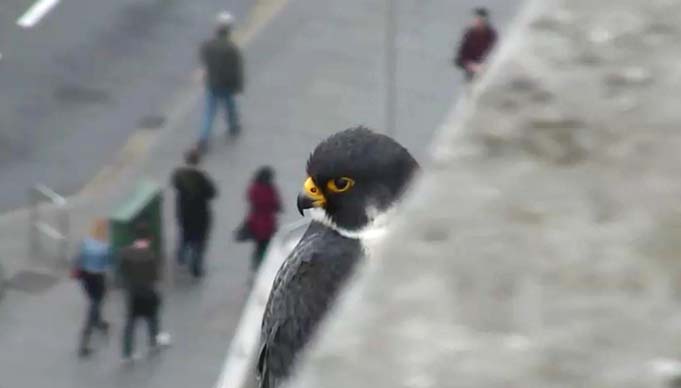
You might be lucky enough one day to see a Gyrfalcon in this country. I never have. But I console myself by watching the Peregrine Falcons which have nested for years in the middle of the City of Nottingham:

the urban peregrine zzzzzzzzzzzzzzzzzzz

They can be seen on the Newton and Arkwright Building of Nottingham Trent University on South Sherwood Street, Nottingham.

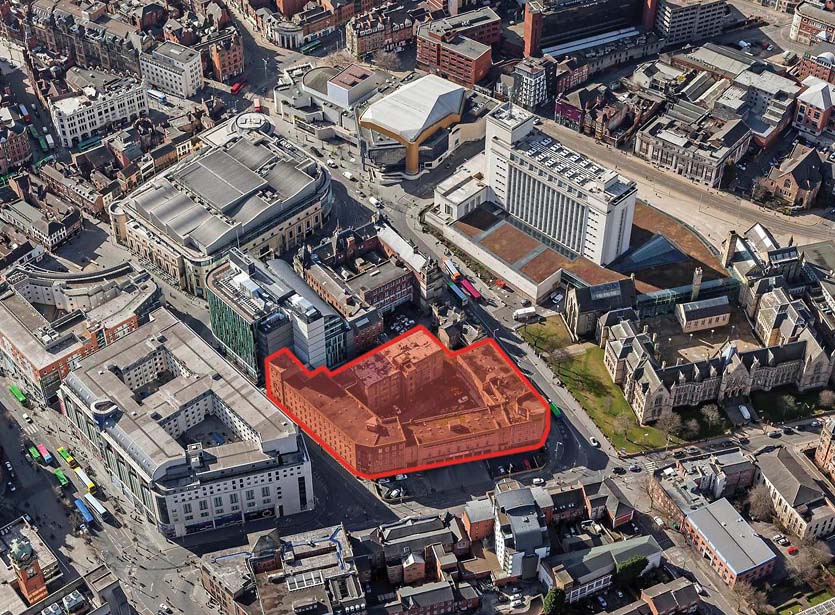
In this aerial view, the Fire Station is coloured orange as it is the most well known building in this part of the city for the majority of people. (No, it’s not on fire):

fire station zzzzzzzzz

Look at the street to the right of the Fire Station and follow it towards the top of the photo. The Newton and Arkwright Building is the enormous white building on the right as you walk up the slight slope towards the Theatre Royal. It is a very distinctive Third Reich type of 1930s architecture.

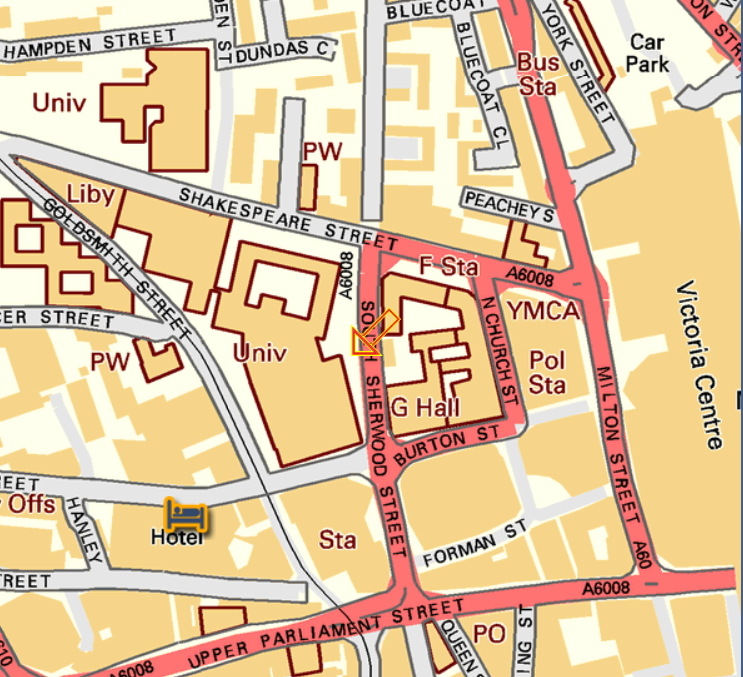
If you go there, take some binoculars if you have any. Look at the right side of the building. The nest is on a wide lip that runs the whole length of the building, just below a row of largish windows. This street map might help. Look for the orange arrow:

map of south shwood st

If you wish, you can watch them on a live webcam. The birds are present pretty much all they year round. Theoretically, they should not be here in the winter, but somehow they seem quite frequently drawn back, a little bit like teenagers returning to the Bank of Dad. At the moment, they should be feeding their young. In the past, there have been catastrophes with this, as is always the case with Mother Nature, but if all goes well, it can be a wonderfully blood spattered spectacle.

But back to Gyrfalcons.
Here are a pair of them, filmed by “thegowser1” at 78 degrees north between Svalbard and Greenland:


More typical for a twitcher in north west Europe would be these two films of a bird which had strayed to  Champtocé-sur-Loire, in Maine-et-Loire, France. The two films come from Alain Fossé, and show a raptor doing what they spend most of their time doing…absolutely nothing!. High calorie meals of meat mean you only need move around infrequently (or so I tell my wife).

These are much more typical  of a March day near Mansfield than an icebreaker near the North Pole!

14 Comments

Filed under History, Nottingham, Science, Twitching, Wildlife and Nature

The Great Storm of 1703. Get your kite!

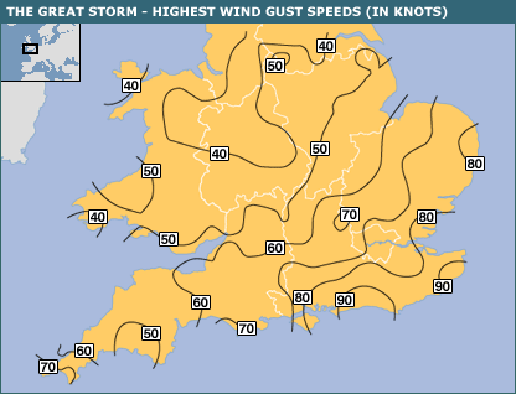
The Great Storm of November 1703 was reckoned to be the most severe storm ever recorded. The hurricane that struck the English Channel and the south of England was beyond anything in living memory:

_44175913_wind_patterns

Unlike today’s storms, when we have advanced warning and can prepare for the worst, the poor souls of 1703 had very little idea about what was about to hit them, other than the fact that the country had been buffeted by a persistent south westerly wind for quite a few weeks. Sailing ships could not sail against it and had therefore been confined in great numbers to whichever port they happened to find themselves near. Inland though, people were largely innocent of the catastrophe they were about to experience. Furthermore, the Great Storm persisted not just for a few shocking hours, but for nine terrible days. How could anything, buildings, ships, farm animals or men stand up against well over a week of wind speeds like those recorded in the eastern part of the English Channel or East Anglia? They would have approached 100 mph for long periods.

It has been variously estimated that between 8,000 and 15,000 people were to perish. John Evelyn, the seventeenth century diarist, described it in his diary as:

“not to be paralleled with anything happening in our age or in any history … every moment Job’s messengers brings the sad tidings of this universal judgement.”

The inhabitants of London felt the first strong breezes during the morning of Wednesday, November 24th 1703, (December 5th 1703 in our current calendar). By four o’clock in the afternoon the winds had noticeably increased. In London, recently out of prison, Daniel Defoe, the journalist, pamphleteer, spy, trader, writer and author, of course, of “Robinson Crusoe”, had a narrow escape in the street when part of a nearby house fell down and luckily missed him. On Friday the 26th, the wind began to blow with even greater ferocity and when the Great Man checked his barometer, he found the mercury had sunk lower than he had ever seen it. After midnight the gale increased to such strength that it was almost impossible to sleep. The noise of the chimneys of surrounding houses crashing into the street made the whole family afraid that their own solid brick townhouse might collapse on their heads. When they opened their back door to escape into the garden, they saw roof tiles scything through the air, some landing thirty or forty yards away, embedding themselves eight inches or more into the ground. The Defoe family decided to stay in their house and trust in the Lord.

That night of November 26th-27th was catastrophic for the Royal Navy which lost 13 major warships, which were, for the most part, moored along the south coast.  HMS Resolution was driven onto the shore at Pevensey but the ship’s company was lucky and all 221 sailors were saved:

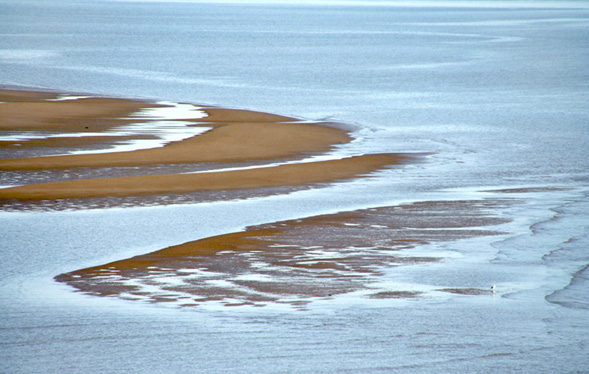
HMS%20ResolutionNot so fortunate were the men on board HMS Restoration, HMS Mary, HMS Northumberland, HMS Stirling Castle and the quaintly named HMS Mortar-bomb, who were all shipwrecked on the Goodwin Sands off the Kent coast:

Sandbanks_Credit_Ben_Salter

In the aftermath, when the tide fell, the sailors of the wrecked vessels who were able to find a foothold on the huge sandbar, were all wandering around knowing that when the tide rose they were certain to be drowned. It was said that a man called Thomas Powell, a shopkeeper in Deal, organised the rescue of some two hundred of them. Supposedly Powell was so appalled by his neighbours’ reluctance to help that he gave them five shillings each for their support. Certainly, the greedy citizens of Deal were widely accused of being more interested in plunder from the unfortunate ships than in helping to rescue the crew members. Indeed, some sources say that only three fortunate individuals survived the Goodwin Sands catastrophe. Supposedly, about 1,500 sailors in total were left to die.
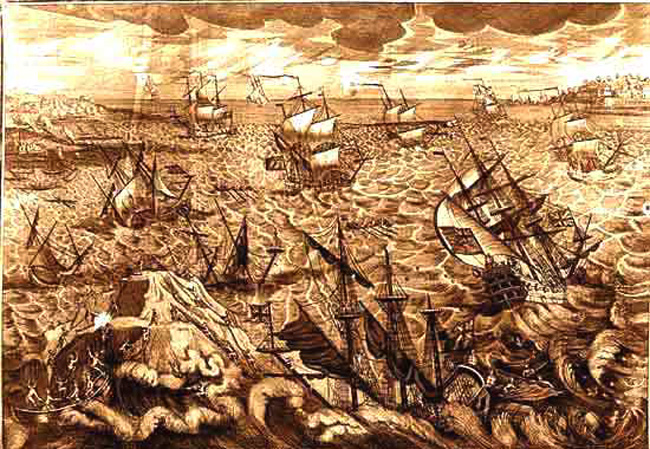
Lots of other naval ships were driven through the Straits of Dover and out into the storm tossed expanses of the North Sea where some survived to return days later but many others were lost without trace:

stormb_1703

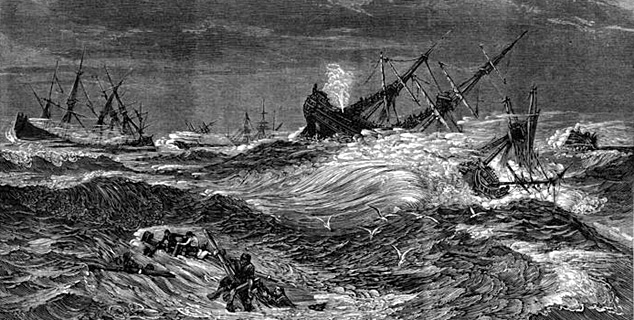
Ships were so driven by the wind that not only did sails have to be lowered but the masts had be cut off level with the deck. Well in excess of a hundred merchant ships were sunk in the North Sea, many of which were colliers from the fleet which at the time was used to transport cargoes of coal down the east coast from Newcastle to London. Some of these ships would have been empty, moored or at anchor when the incredible tempest struck, casting them out into the open sea. Most were ill-prepared and foundered, and their crews perished to a man:

141126-great-storm-b

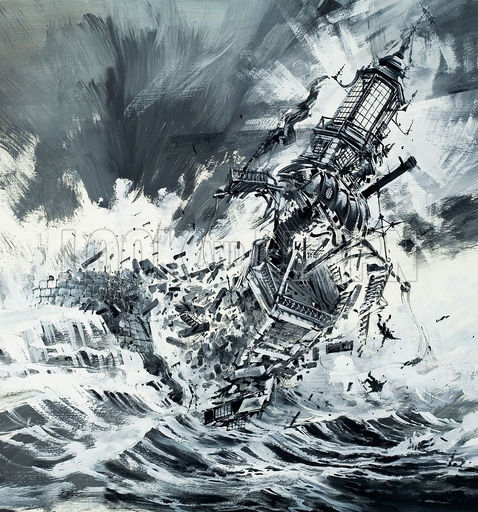
The storm caught a convoy of 130 merchant ships and the six Men O’ War escorting them as they sheltered at Milford Haven. The warships included HMS Dolphin, HMS Cumberland, HMS Coventry, HMS Looe, HMS Hastings and HMS Hector. By the middle of the following afternoon the losses amounted to thirty vessels. Overall it was estimated that more than 8,000 sailors perished as the storm annihilated the Royal Navy. Around 20% of its sailors were drowned. The first Eddystone Lighthouse was completely destroyed:

Destruction of the Eddystone Lighthouse, 1703

Its erection had been started a mere seven years before, and  its light had been lit for the first time only on November 14th 1698.  Now all six of its occupants were killed, including the brave builder Henry Winstanley.

This slideshow requires JavaScript.

This lighthouse was of inestimable importance and stood 120 feet tall,  some twelve miles to the south of Plymouth, one of England’s most important naval harbours. Even the French valued it, when during the period of construction, a French ship took Winstanley and his men prisoner. King Louis XIV, “le Roi-Soleil” ordered their release, explaining that “France is at war with England, not with humanity”, « La France est en guerre contre l’Angleterre, non contre l’humanité! »:

Louis_XIV_of_France

The Great Storm reached its appalling apogee, its catastrophic climax, during the following night, that of November 28th-29th (December 9th-10th 1703). Between the south coast and the Midlands, entire villages from Northamptonshire in the north to Suffolk in East Anglia were devastated  as the winds of the Great Storm rampaged across the country, striking hardest in the south and east of England, sending house roofs flying, flattening barns, razing everything in its path. Both men and animals were lifted off their feet and carried for long distances through the air. Roofs were ripped from more than a hundred churches, the lead was rolled up like a sheet of paper and dumped hundreds of yards away.
Millions of trees were blown over or uprooted; knocked flat in their tens of thousands, they lay prostrate in rows like soldiers mown down in battle. It was said that more than 4,000 oak trees crashed down in the New Forest.  An attempt was made to count the flattened trees in Kent but the count was abandoned at 17,000. The diarist John Evelyn lost in excess of 2,000 trees on his own Surrey estate.
Every kind of building was totally demolished and salt spray was driven almost as far inland as Tunbridge Wells. Animals refused to eat the resultant salty grass.
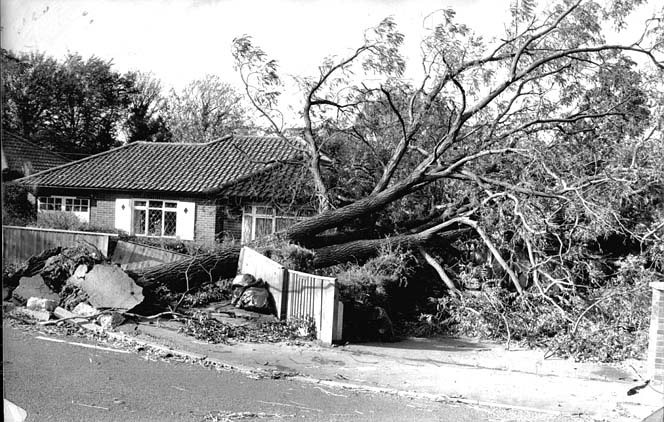
The maximum wind speeds were similar to those of the Great Storm of 1987 but the bad  weather lasted for much, much longer, well over a week, and thereby increased the enormous loss of life. Here is one of the enduring images of 1987:

1987

People could not decide whether it was safer to stay in their house and risk its collapse or to go into the street where flying tiles killed large numbers.
In East Anglia the wind reached over 80m.p.h. and killed well over a hundred people.  More than four hundred windmills were blown down. Many of them  burst into flames because the friction of their sails spinning round at high speed caused their wooden machinery to catch fire. In Cambridge, part of St Mary’s Church fell down and the falling stones completely flattened the organ. It had only recently been installed at a cost of £1,500. Kings College Chapel was equally badly damaged with stone pinnacles toppled and many of the wonderful stained glass windows destroyed.
In the capital, around 2,000 massive chimneys were blown over. The roof was blown off Westminster Abbey and the Queen, Queen Anne, had to take shelter in a cellar at St James’s Palace to avoid falling chimneys and tiles whizzing off the roof. Daniel Defoe told how the Reverend James King of London wrote him a letter about a chimney which crashed down and buried a maid. She was thought to be literally dead and buried, but she came out the following day from a small cavity in the rubble.

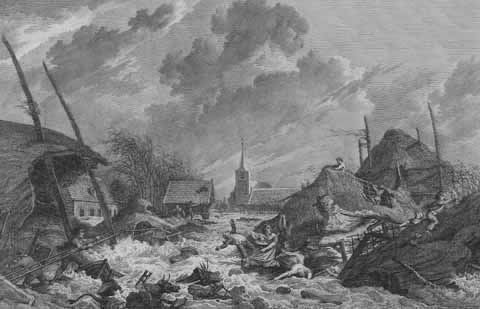
Watersnood_1809

Floods devastated the whole country, especially in the east of England and along the Severn Estuary. In the West Country in general, flooding was extensive and prolonged, particularly around Bristol where just under a thousand houses were totally destroyed. Hundreds of people were drowned on the Somerset Levels, where uncounted tens of thousands of farm animals, mainly sheep and cattle, perished. One lost ship was found fifteen miles inland. At Wells, Bishop Richard Kidder was crushed when two chimneys in the palace collapsed onto him and his wife, both peacefully asleep in their bed. Part of the Great West Window in Wells Cathedral was blown in and smashed to smithereens. At Fairford the church’s west window, facing the raging anger of the oncoming wind, bulged inward and crashed into the nave. In Wales, major damage occurred to the southwest tower of Llandaff Cathedral at Cardiff.
The storm began to die down around December 2nd, and on December 3rd,  Daniel Defoe visited the Pool of London, where, in the section downstream from London Bridge, he saw more than 700 sailing ships all piled up into heaps one on top of another:

vvvvvv Daniel_Defoe_Kneller_Style

Daniel Defoe told the tale of the captain of a leaking ship who tried to escape what seemed to him at the time to be an inevitable death by drowning, and instead committed suicide—only for his ship to survive. One possibly taller tale related how a sailing ship at Whitstable in Kent was blown out of the foaming sea and then deposited more than a quarter of a mile inland.
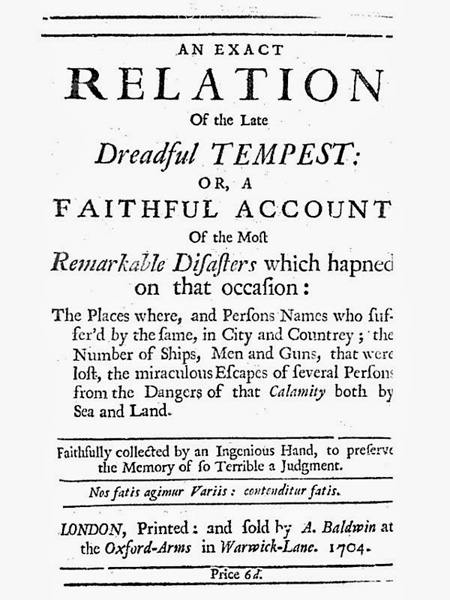
Unsurprisingly, in the aftermath of the Great Storm many special newspapers and publications appeared with information and eyewitness accounts:

the_dreadful_tempest_01b

Conceivably this disaster became “national news” in a way that had seldom, if ever, happened before. It was just like a modern “big story”.
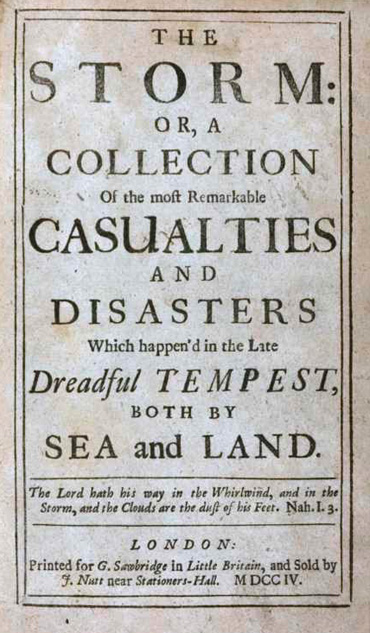
Daniel Defoe himself sought out testimony from as many witnesses as he could find.  When the weather ameliorated, he the whole country assessing the damage. He then produced what was subsequently described as “the first substantial work of modern journalism”, a book of more than 75,000 words, which was called “The Storm”.  It was the first proper book of Defoe’s career.

The_Storm_by_Daniel_Defoe_cover_page
*****************************************

http://historicaltrinkets.blogspot.co.uk/2013/10/the-great-storm-of-1703-eyewitness.html

http://en.wikipedia.org/wiki/Great_Storm_of_1703

http://www.historytoday.com/richard-cavendish/great-storm

12 Comments

Filed under France, History, Science, Wildlife and Nature

As promised, a beautiful bird in the garden

In a previous blogpost I extolled at great length the many ways in which a fascinating plant called the teasel was extremely beneficial to wildlife. In the summer therefore, our garden played host to a number of lovely butterflies:

This slideshow requires JavaScript.

The teasel also kept us human beings interested by drowning passing insects and slowly absorbing the chemicals from their bodies. Here is the teasel in flower:

Teaselxxxxxxxxxxxxxxxxxxxx

I hope you have not forgotten though, how I made a solemn promise that, when the seeds had matured, the seed heads would play host to one of our most beautiful birds, the Goldfinch.
They should have been here in autumn, but now, at last, they have finally made their long awaited appearance. I, of course, missed them on their first visit, but my daughter and fellow blogger saw them and took a few photographs. Here are some of them.

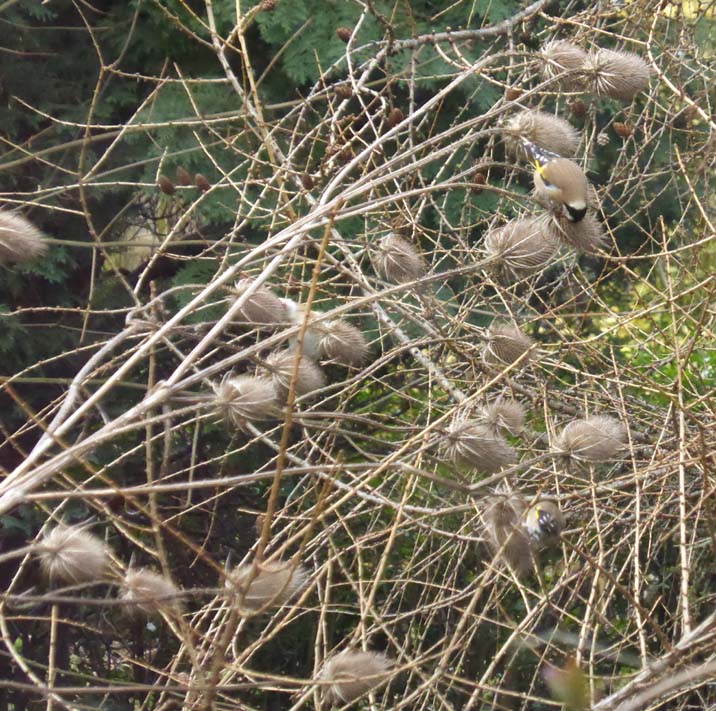
Firstly, it may actually be a case of “Spot the bird”:

P1010677xxxxxxxx

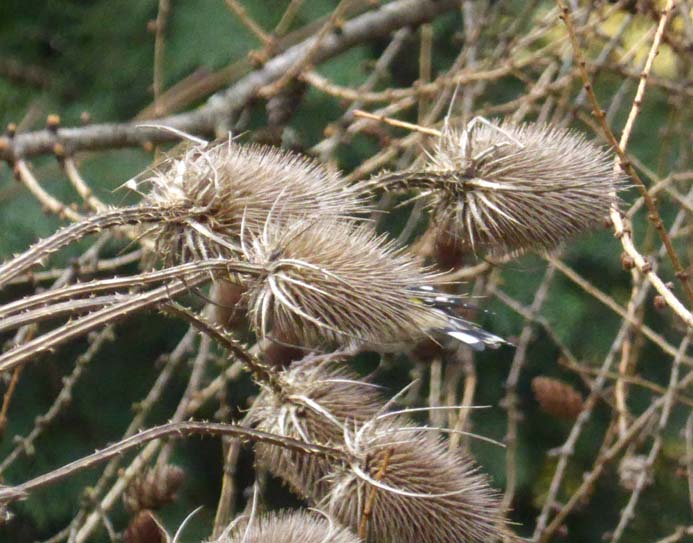
Not always an easy decision to make:

P1010651xxxxxxxxx

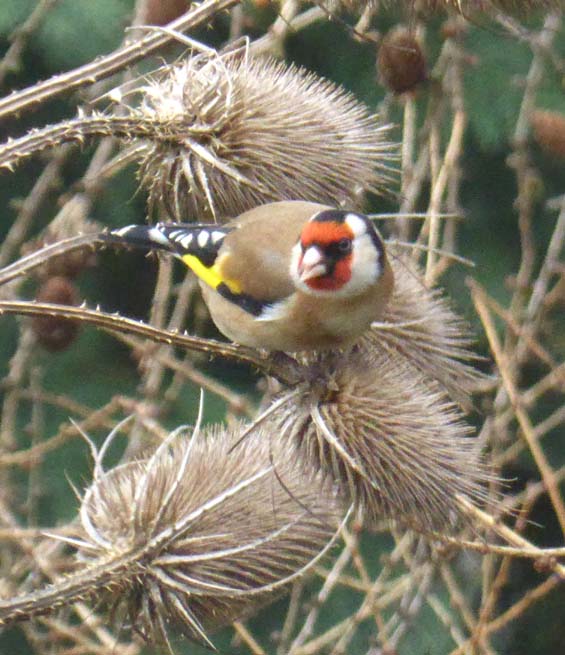
Yes, at last, a Goldfinch:

P1010673xxxxxxxx

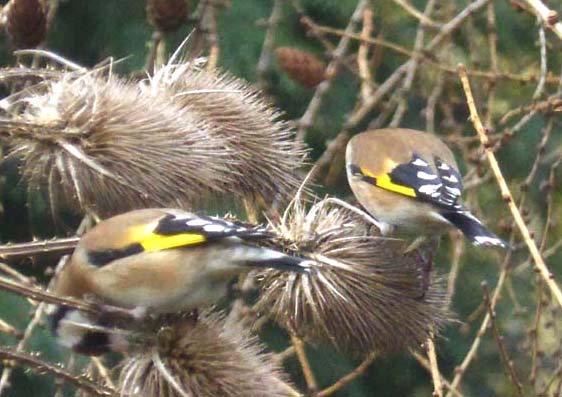
As far as I know, the males and females are the same:

P1010640xxxxxxxxxxxx

At least, they look it:

P1010692xxxxxxxxxxx


3 Comments

Filed under My Garden, My House, Nottingham, Science, Wildlife and Nature

“Where are the snows of yesteryear?”

Over the centuries, the weather can often be extreme, and some amazingly strange things have happened. In 1110, nearly a thousand years ago, Nottingham experienced a terrifying earthquake. Bizarrely, the River Trent dried up for several hours, presumably as it drained into, and then eventually filled up, a huge new crack in the ground that it had created somewhere upstream.

In the Nottingham of 1682, extremely low temperatures lasted from September until February of the next year. Shortages of coal, wood and food were caused by difficulties in the transport system, and  the fields, roads and rivers were all frozen up. The Trent, for example, was completely impossible to navigate throughout the entire period of the freeze.

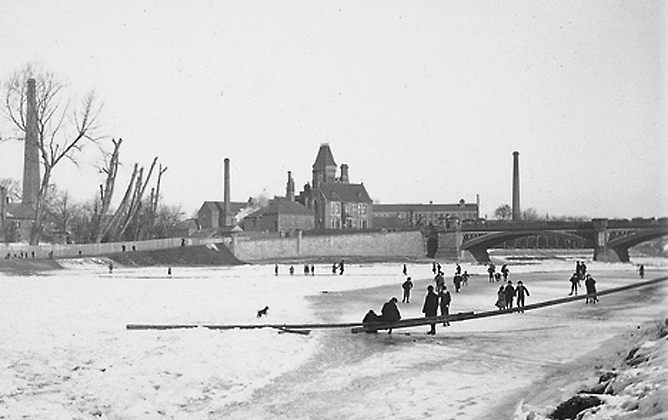
It was equally cold in 1855 when a cricket match was played on the frozen River Trent. The victors roasted, and ate, the greater part of a whole sheep without the ice either melting or giving way. When the thaw set in, an iceberg weighing many tons was unleashed in the river and it destroyed a bridge downstream when it crashed into it.

6419523017_ebf7e7e31c

A local solicitor, William Parsons, recorded the weather’s outrages in his diary:

“In 1814, we had so severe a frost as to freeze the Trent over, the first time I believe. It continued 16 weeks. The Trent was then so frozen that a fair was held and oxen, sheep and pigs were roasted.”

In 1838, the River Trent froze over at the beginning of the year. William’s entry for January 20th reads:

“The frost has now continued about twelve days but with greater severity than is remembered. Many thousands from Nottingham went to see the Trent today. The frost continues extremely severe. The Trent this afternoon is now frozen completely over and I was sliding upon it just above Trent Bridge.  I shall visit it tomorrow again it being of rare occurrence to be frozen. The snow continues upon the ground about six inches deep. My hands are very severely chapped that I am now writing in kid gloves”.

He described the river as:

“in that state frozen it appeared like a frothy, foaming river of snow. Many people were crossing on the ice. I walked down to the bridge and crossed the river just above it where numbers were also winding their way through projecting masses of snow covered in ice. The river was more rough and picturesque in this part than in any other.”

The most charming thing about William’s diary is his great honesty. As regards the consumption of alcohol in very large quantities, he was a man many years before his time:

“Time worse than wasted, money spent, health injured, myself debased! Let these days of drunken, senseless riot be remembered only as incitements to become a rigid teetotaller”.

We’ve all been there.

6419523525_986f696990

The River Trent was a very different river in those days and that is why it used to freeze fairly regularly during exceptionally cold weather. There were, of course, no power stations releasing huge quantities of warm water which might increase the natural temperature of the river, but that is not the most fundamental reason for the change. Nowadays, the waters of the Trent have been for the most part  tamed and confined firmly in great ramparts of concrete. Because of the way in which the river has been turned into a giant canal, it is now much deeper and fast flowing than it used to be. The edges of the river do not extend outwards in leisurely fashion into marshes or shallow ponds with very little flow. The modern Trent no longer stretches, as it did in primeval times, from the sandstone cliffs south of St Mary’s Church for many, many hundreds of yards into present day West Bridgford. And the old wide river, of course, was a shallow, more slow flowing river, the kind of waterway that was much more likely to freeze in severe weather.

St Mary’s Church is in the top left of the map, near to the word “Museum”. It is represented by a cross and a square joined together. Trent Bridge is indicated by the orange arrow, and the southern edge of the waters centuries ago would have been well to the south of the present day B679 (bottom left of the map) or the Trent Valley Way (top middle right of the map).

old trent bridge

In those ancient of days, when the river was so very much wider, the only safe crossing, either on  foot or on horseback, was across the band of harder rock where Trent Bridge now stands.

images8WR58W3V

On January 16th 1892, on a “piercingly cold” Saturday, Nottingham Forest played Newcastle East End at the City Ground. When the crowd arrived at Trent Bridge, they were surprised to see “skating in progress on the old course of the River Trent.”  Because of the recent introduction of the penalty kick, the frozen football pitch had some new markings, which in this case were made of broad strips of black soot. Newcastle changed from their normal crimson shirts into black and white stripes. Hopefully, before the game, Old Nottinghamian Tinsley Lindley, Forest’s centre forward, was able to walk across the Trent to the game, just like Brian Clough used to do.

NTGM006720

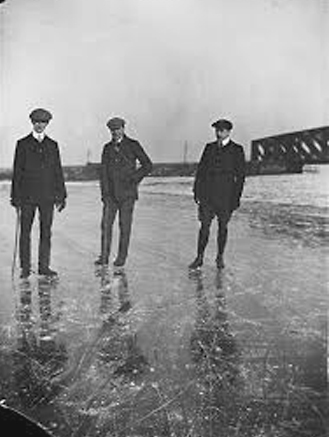
Three years later, in 1895, the river froze for the last time. Again, the region’s economy suffered. Numerous tributary rivers smaller than the Trent were also frozen, and many jetties and warehouses became unusable. This caused huge job losses in local industry.

MS 258/3

The river was caught in this devastating frost for almost a fortnight.  Skaters were able to venture onto the safe and solid ice over many miles of the Trent’s length. The ice was thick enough to allow a hockey game between teams from Newark and Burton-on-Trent to take place on a pitch somewhere upstream from Averham Weirs.

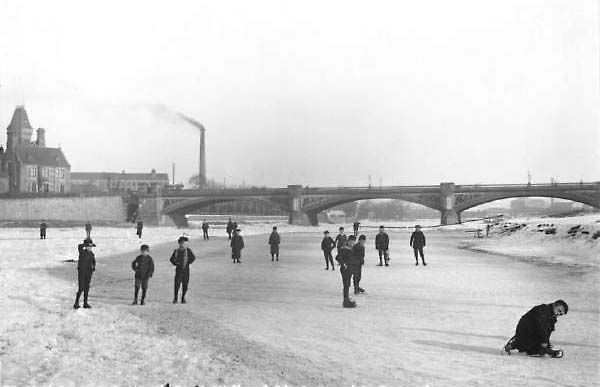
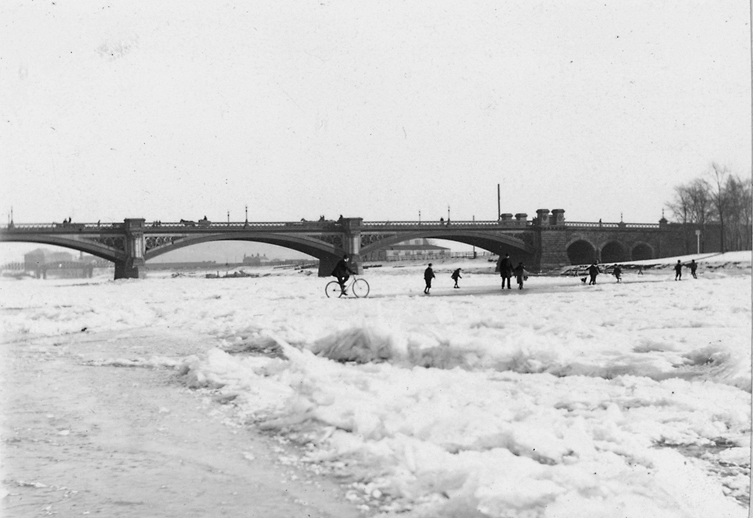
Here a huge crowd of boys are standing on the thick ice. Everybody looks very happy, but there were several fatalities, as people contrived to find excessively thin ice to stand on. Lady Bay Bridge can just be seen through the arches of Trent Bridge.

freezes caption 1

And not a scarf or a pair of gloves in sight. Kids were tough, and Health and Safety hadn’t even been thought of yet.

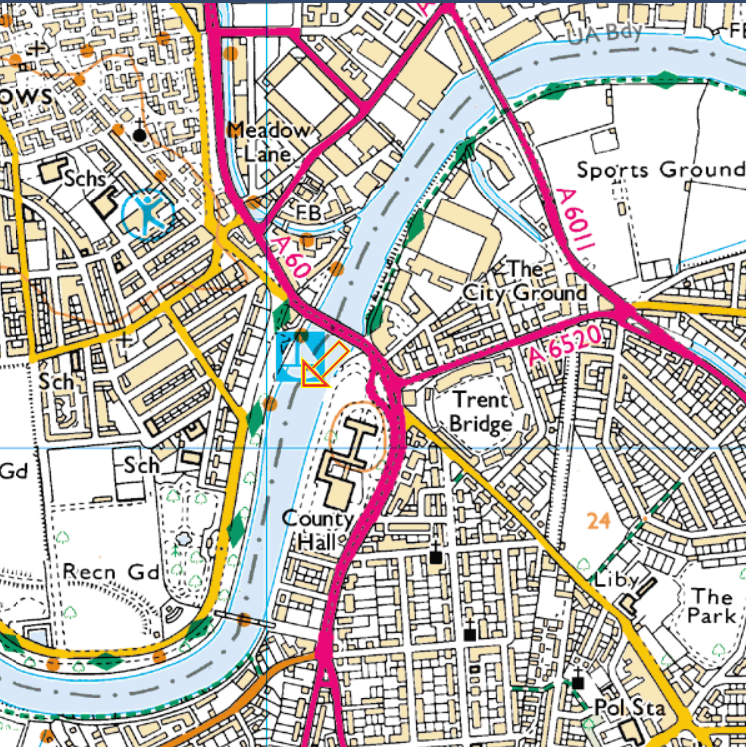
The photograph above was taken from opposite the West Bridgford embankment, to the south of Trent Bridge, near to the present day County Hall. Look for the orange arrow:

county hall

In places the extreme frost, the most severe in living memory, penetrated into the ground so deeply that it froze the tap water in the mains. Ordinary people suffered greatly and many had no water supply whatsoever, a parlous situation which was to last for several weeks. To overcome this most basic of problems, stand-pipes fitted with taps were set up at various places in the streets, and buckets could be filled up there. January and February of 1895 was a time of difficulty and danger for ordinary people and those who survived it were to remember it for the rest of their lives.
caption 2

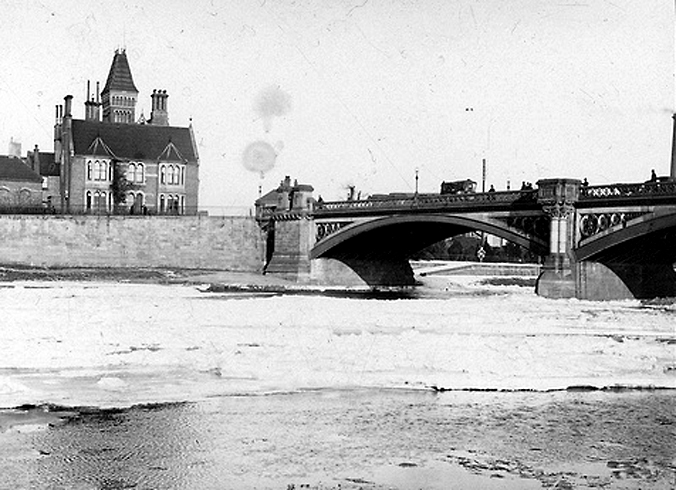
In the photograph above, a fire can be seen burning against the bridge, one of the many which blazed happily on the surface of the ice. The river’s rate of flow is reduced by the ice floes so much that it is almost reminiscent of a river during a drought.

During these bitterly cold winters at the turn of the twentieth century, my grandfather, Will, who had emigrated to Canada around 1905, saw Niagara Falls, for the large part frozen, on at least one occasion, this postcard dating most probably from 1911.

naiagara

2 Comments

Filed under History, Nottingham, Science, Wildlife and Nature

Black Shuck on the world stage

As I have said in two previous blogposts, Old Shuck, Black Shuck, or simply Shuck is the name of the huge, phantom black dog which roams, allegedly, the fields and fens of Norfolk and Suffolk. There are, of course, many places other than East Anglia where completely credible reports occur. We have already looked at three in Nottinghamshire, but almost every county in England has its own version of the creature, whether that be the “Bogey Beast” in Lancashire, the Lincolnshire “Hairy Jack”, the “Gallytrot” in Suffolk or the “Bargheust” in Yorkshire and the North.

hellhound zzzzz

They are often associated with electrical storms, such as Black Shuck’s appearance at first Bungay and then Blythburgh in Suffolk. More often, though, they are linked to places rather than meteorological conditions. Churchyards and graveyards at midnight are a favourite, as well as crossroads. Equally, if not more, favoured are dark lanes, ancient pathways and lonely footpaths in the countryside. Occasionally, there is a connection with water, such as a river, a lake or even a beach. Sometimes, such as at Launceston in Cornwall, it may be an ancient tumulus, as is the case with the….

“graves and prehistoric burials whose attendant hounds proliferate densely in Wiltshire and West Somerset on the grounds that they can be seen as passages downwards to the World of the Dead, and so also suicide graves and scenes of execution…”

(Theo Brown: ‘The Black Dog’, in Porter and Russell (ed.) ‘Animals in Folklore’ (1978).”

Likewise, the Black Dog is seen as the “guardian of the threshold, escorting souls into the afterlife”. According to Jennifer Westwood in her book “Albion” (1985) :

“Black Dogs commonly haunt lanes, footpaths, bridges, crossroads and graves – all points of transition, …..held to be weak spots in the fabric dividing the mortal world from the supernatural.”

And :

“If a count be made of the kind of places favoured by these apparitions one thing becomes plain. Quite half the localities are places associated with movement from one locality to another: roads, lanes, footpaths, ancient trackways, bridges, crossroads.”

Let’s now leave Nottinghamshire’s Shuck eating his Pedigree Chum for just a moment, and skip thousands of miles to the north east of the United States. In her most excellent book, “Real Wolfmen True Encounters in Modern America” the author Linda S Godfrey explains her idea that…

“One common factor seems to emerge from every collection of strange creature accounts: there is an unmistakable connection between anomalous beings and certain features of the land. Unexplainable creatures and events tend to occur near freshwater; on hills; at boundary areas such as roads; and on or near burial grounds, and military zones, and all types of sacred areas around the world.
This geographic predictability supports the premise of many contemporary investigators like Rosemary Ellen Guiley, Nick Redfern, and the late John Keel, who suspect that anomalous creatures are not natural animals; they are entities that belong to a completely non-human realm and are attracted to certain energies of the Earth and all living creatures.”

The researchers listed above, and many others, believe that werewolves, Bigfoot, alien big cats, grey aliens, UFOs and sea monsters as well as more traditional entities such as fairies, dragons and ogres are all part of a planet-wide “spirit” population that manifests “in some sort of concert with the human mind, intent on  its own enigmatic purposes.”

.
And of course, this theory does go quite a long way to explaining a very large question, namely, “Why do so many apparently reliable witnesses continue to report the same, impossible things?”

.
If we just think of Great Britain, how many UFOs, Black Dogs, ghosts and even sea serpents have been reported over the years?

Linda S Godfrey, who specialises in the more exotic of the world’s canids and possible canids writes about the Wolfmen who are regularly seen in her native Wisconsin.

portrait xxxxxxx

Wolfmen in form are rather like Bigfoot, except that they have a wolf’s head.  They are thinner than Bigfoot, and consequently, can move very quickly if required. The most famous of the American Wolfmen is the “Beast of Bray Road”.

This slideshow requires JavaScript.


Witnesses have sketched what they saw on this most famous of cryptozoological highways…

This slideshow requires JavaScript.

Linda S Godfrey first became interested in the Beast when she was a journalist and had the opportunity to speak to one of the first witnesses….
WisconsinWolfnespaper ccccccc

Fairly frequently, the Wolfman’s favourite food is roadkill. These were originally witness sketches…

This slideshow requires JavaScript.

There are at least two photographs…

This slideshow requires JavaScript.

One of the very earliest known sightings of a Wolfman occurred not in Bray Road, but at the St Coletta School for Exceptional Children, where Mark Shackelman worked as a security guard. Linda S Godfrey tells the story….

“The nightwatchman’s main duty was to make quiet surveillance of the 174 acre grounds…The land was dotted with ancient Native American burial mounds.
One evening, movement on the mound behind the main building drew the sharp nightwatchman’s attention as he observed what appeared to be a large animal digging furiously atop the raised earth. The creature was roughly man-size, covered in dark fur, and knelt in a way that should have been physically impossible for a four-footed beast And it fled on two feet rather than four as soon as it noticed Shackelman’s presence.
The flummoxed Watchman examined the mound next day and saw that the Earth had been torn by what looked like big claw marks, with raking slashes in sets of three. That night, he made sure to arm himself with a big, club-like flashlight before making his rounds. Sure enough, the creature was there again, digging in the mound near midnight. This time, however, it rose upon its hind legs and faced Shackelman. It stood about six feet tall and reeked of rotten meat.
Shackelman bravely shined his light at the creature so that he could get a good, long look at it. Although it was covered in fur, he could make out powerful arms that ended in hands with thumbs and little fingers that were much smaller than the middle three digits, explaining the triple slashes in the dirt. It had a muscular torso and a canid head with a muzzle and pointed ears. Perhaps most surprisingly of all, the creature made a growling vocalisation that Shackelman later described as a “neo-human voice” and that sounded to him like three syllables, “ga- dar-rah”. The creature continued to make fearless eye contact with Shackelman, who felt he was in imminent and mortal danger.”

If you want to read what happens to Mr. Shackelman, or the Wolfman, then you will have to buy the book! You will not be disappointed! It is a marvellous book which opens a whole world of strangeness that takes a lot to explain away. This report of a wolfman was just the first of the many. According to Linda S Godfrey…

“Was the St Coletta creature just a sign of things to come? The Shackelman sighting was only the first of over one hundred reports nationwide of a human sized canine that could run upright or crouch with a chunk of bloody carrion clutched in its paws. In that incident and most sightings since, the creature is described with a head that appears wolf-like but a body that often – except for its fur, dog shaped limbs, and elongated pause – looks somewhat humanoid because of its powerfully muscular torso and shoulders.”

Here are some more modern colour photos, in some cases taken by trailcams.

This slideshow requires JavaScript.

If you look at Youtube, a search for the “Beast of Bray Road” will reveal scores of films of varying quality. This lasts an interesting three minutes…

and this is a more thorough full length programme

If, however, you find yourself being tempted towards the “Gable Film”, please be aware that its maker has already acknowledged, several years ago, that the film is (a very accomplished) fake .

7 Comments

Filed under Cryptozoology, Science, Wildlife and Nature

The Beast of Sarlat

The « Bête féroce de Sarlat » was famous in Périgord in central France from 1766 onwards. Its peculiarity was not to attack women but exclusively to kill men.

This slideshow requires JavaScript.

According to that font of all knowledge, Wikipedia….

“The « Bête de Sarlat » was a man-eating animal behind a series of attacks against human beings in the Périgord province of France. During the spring of 1766, a dozen or so fatal attacks were been recorded in the villages around Sarlat. The inhabitants of the region were filled with genuine panic, beginning to talk of a gigantic beast thirsting for human blood or even a werewolf. The creature managed around fifteen victims more, before in August 1766 the peasants and noblemen organised a beat together with more than a hundred rifles. During the course of this, the animal was flushed and killed. It was a wolf infected with rabies but the people did not readily accept this explanation and continued to talk of a werewolf.”

One website devoted primarily to the « Bête du Gévaudan » has a little to say about the « Bête de Sarlat » :
11111xxxxxxx

After all, the two areas are not a million miles apart in distance, although the two time periods clash, with the more famous Gévaudan monster killing its victims between the early summer of 1764 and June 19th, 1767 when a local man named Jean Chastel supposedly killed it during a hunt organized by a local nobleman.

“The Bête de Sarlat terrorised the Périgord province of France in the XVIIIth century. Its first appearance came in March 1766, when it carried out around ten killings in the surrounding area. The fear that the Beast caused can be imagined. It was from this time onwards that the myth of an enormous monster thirsting for human blood arose.
But in the month of August 1766, it was finally identified as a wolf suffering from rabies. The people did not really believe this explanation and it must be said that in the intervening time at least another eighteen more people were killed. The monster was seen absolutely everywhere, even in the dark backstreets of Sarlat. When the people’s fear and exasperation was at its height, the legend of the beast grew to such a point that the good people of the area no longer dared go out as soon as it got dark.

From this time onwards, both peasants and nobility came together with more than a hundred rifles and began a beat. The creature was found, pursued and shot. This death was confirmed by an assembly of a large number of happy eye-witnesses and seems to have taken away once and for all the justified fears of the local people. We know very well that the wolf with rabies and the man with rabies seem equally overcome with madness: frothing at the mouth, slavering and biting. They are terrifying to see and dangerous to approach. But this killing only stopped the spread of the rumour. Nothing really changed either in Sarlat or in the surrounding region, where they still spoke of the beast as a werewolf.”

perigord noir rocamadour cccccc

A further account tells broadly the same tale….

“The first time that this creature came to people’s attention was in the spring of 1766 when it had already committed a dozen murders in the villages around Sarlat. From then on, absolute terror reigned in the province of Périgord. They spoke of a gigantic beast, thirsting for human blood, and soon the legend grew to such a point that the people no longer dared to go out as night was falling, because it was claimed that the monster had even been seen in the very streets of Sarlat itself. The creature killed another good fifteen or so people before both the peasants and the aristocrats, driven to it by fear, organised a beat with more than a hundred rifles. The animal was flushed and killed, and it was stated to be a rabid wolf. Even if this particular animal was killed, its legend remained alive and well throughout the whole region, where they spoke for a good many more years of a bloodthirsty werewolf.”

On his own website, Mikerynos writes

“The Beast of Sarlat terrorised Périgord in the XVIIIth century. Its first appearance dates back to March 1766 when it had already committed around a dozen murders in the neighbouring areas. It is easy to imagine the terror that it provoked. It was from this time that there began the myth of an enormous monster thirsting for human blood. In the month of August 1766, however, the animal was finally identified as a wolf carrying rabies. The ordinary people found it difficult to accept this explanation, and it must be said that in the meantime it had killed at least eighteen more people.
People would see the creature absolutely everywhere, even in the dark alleyways of Sarlat. With fear and anger both reaching their peak, the tales told about  the beast grew to such a level that the good people of the region no longer dared to go out as night fell. From that moment both peasants and aristocrats came together with more than a hundred rifles and organised a beat. The animal was found, tracked and shot. This death was witnessed by so many ecstatic eyes and seemed to have rid the local people for ever of the object of their well justified fears.
We know very well that a wolf or a man with rabies both seem equally overcome with madness, slavering at the mouth, frothing and biting. They are terrifying to see and dangerous to approach. But this only stopped the rumours from spreading, nothing had changed and both in Sarlat and the surrounding area, they still talk of the beast even now as a werewolf.”

At the time in 1766, a broadsheet about the beast was published locally in the province.

broadsheetcccccc

Here is the bottom half with the text. Hopefully, the words are a little clearer….broadsheet   bottom  cccccc Here is a translation of the words you can see, but unfortunately, this is, literally, only half the story. And it seems supremely ironic that on the scan of the front page, you can see some of the print from the back page in reverse, but I cannot find it anywhere on the Internet…

“The curious, remarkable and true tale of the deaths and disorder caused by the ferocious beast, in the area around Sarlat in the Périgord region (of France).
Recently there has been seen in the area around Sarlat in the Périgord region, a ferocious beast, that was considered to be a rabid wolf, but one of an extraordinary size. This ferocious beast roamed, at an incredible speed, over the parishes of Saint-Julien and Grossejac. In vain did a number of the inhabitants of one or the other parish try to put a stop to the depredations of this cruel animal. Between eighteen and twenty people were the sad victims of its fury.
This animal was in complete contrast to the Beast of Gévaudan of which so much has been said; for it seems that the former hated only men whereas the Beast of Gévaudan preferred to attack women. When ready to seize its prey, it put up its hackles, and its eyes became flaming red. It raised itself up on its back legs and tried to seize the victim, sometimes by the face, sometimes by other parts of the head. To stop the ravages of this formidable enemy, whose terrible deeds were already beginning to weigh only too heavily on people, the nobleman Descamps and the gentleman Saint Julien……

Raising itself up on its hind legs, of course, is not normal behaviour for a wolf, animals which nowadays seem to stick firmly to a four legged approach. Flaming red eyes, of course, are not a feature of any known wild animal.

The on-line edition of the newspaper « Sud-Ouest » reports…

“In the XVIIIth century a monster terrorised the south eastern part of the province of Périgord for several weeks. The creature appeared in March 1766 and around a dozen people were killed in the villages around Sarlat. Then was born the myth of an enormous beast thirsting for human blood, like some kind of werewolf.
In the month of August in the same year certain people identified it as a very large wolf infected with rabies. But the population were not reassured by this, especially as in the meantime eighteen other people had been killed. People glimpsed the beast everywhere, even in the dark little lanes of Sarlat. The “population of the village shut themselves away in their houses. Around a hundred people armed with rifles, both peasants and nobles then organised a beat. A rabid wolf was killed. The attacks stopped but the legend lived on, that of a werewolf.”

Its report continues with a device that is known, probably, to newspapers the whole world over. Indeed « Sud-Ouest » could not consider itself a real newspaper if it did not  have that desire to thrill, to terrify and then to sell more newspapers…

« Un loup a-t-il été aperçu en Dordogne ? »
“Has a Wolf been seen in the Dordogne?


la-bete-a-ete-prise-en-photo-par-quentin-sarlat-dans-un_1535215_480x300

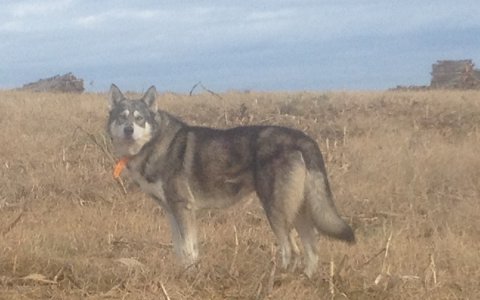
«This animal was photographed at Saint-Amand-de-Coly. Other people in the immediate area have been seeing it for the last two weeks. According to government sources, the theory of a wolf, however, is not particularly credible and some doubt may be expressed. Quentin Sarlat, aged 20, was coming back from Montignac last Friday and came across this animal in a field at Saint-Amand-de-Coly.

1415216_loup-2409062-1200_800x600p

He took a photograph of it, unlike one of his friends who had already seen it two weeks previously. «At first, the animal was much more distant and then it began to run across the field in my direction only to stop about ten metres away from me. He looked at me for at least thirty seconds, and I did not dare get out of my car. Then the animal went off round the back of the car, without ever taking his eyes off me »

As for Aurélien Viau, the regional head of the Office National de la Chasse et de la Faune Sauvage (The Ministry of Hunting and Wildlife) said that there was little chance that this was a wolf.

«Looking at this photograph, I would say that it’s a dog because the animal is too fat, it’s wearing an orange collar and it does not fear man. But nevertheless we will be going over there to have a look round. »

The collar that the animal is wearing could well be an identification collar, as some method of tagging wolves. On the other hand, it is certainly a wolf which seems to have eaten all the pies.

After this, of course, widescale panic seems to break out and the questions below are suddenly all asked in the newspaper. Nobody seems to notice it is that old strategy….”thrill, terrify, sell”……

Et si le loup revenait dans les forêts de Dordogne ?
“What if wolves came back to the forests of Dordogne?”
Le loup peut très bien recoloniser entièrement le territoire
“The wolf might very well recolonise the entire area”
Environnement : les sentinelles guettent toujours le loup
“Environmental news: a network of guards await the wolf”

And then, AH NON !!!!….

Dordogne : le loup était un husky

“Report from the Dordogne: the wolf was just a husky.”

Most significant of all perhaps is the verdict of the historian Jean-Marc Moriceau who in a newspaper article entirely worthy of our Daily Mail will:

“retrace the blood soaked career of the wolf in France. 8000 dead people in 250 years, and perhaps it isn’t all over yet….”

Perhaps the writer who argued in one of my previous blogposts that the entire French nation was too often guilty of collective hysteria in the face of these much maligned and gentle animals was correct. This website makes « Sud-Ouest » appear almost conservative in its ideas….

LE DIABLE A-T-IL CRÉÉ LE LOUP ?

DID THE DEVIL CREATE THE WOLF  ????

Bonne nuit et dormez bien!


7 Comments

Filed under Cryptozoology, France, History, Humour, Science, Wildlife and Nature

Hallowe’en Nights (3) Black Shuck in Notts

In my first blog post about the cryptic canid, it becomes perfectly obvious that for hundreds of years Black Shuck has been seen fairly frequently throughout all of East Anglia. Not only that, but he can still be seen there right up to the present day. Well known folklorist Ivan Bunn continues even now to find regular examples of Black Shuck’s appearances in our 21st-century world.

And so too, Black Shuck has been seen throughout the whole of the country. One website details 329 different places in the British Isles where spectral dogs of various size, shape, colour and attitude have cropped up over the centuries.
But has this famous dog ever been seen in our own county of Nottinghamshire? By careful searching on the Internet, I have managed to find just three examples. Read them through very carefully and make sure that you follow all the directions on the maps provided. There will be a test at the end!
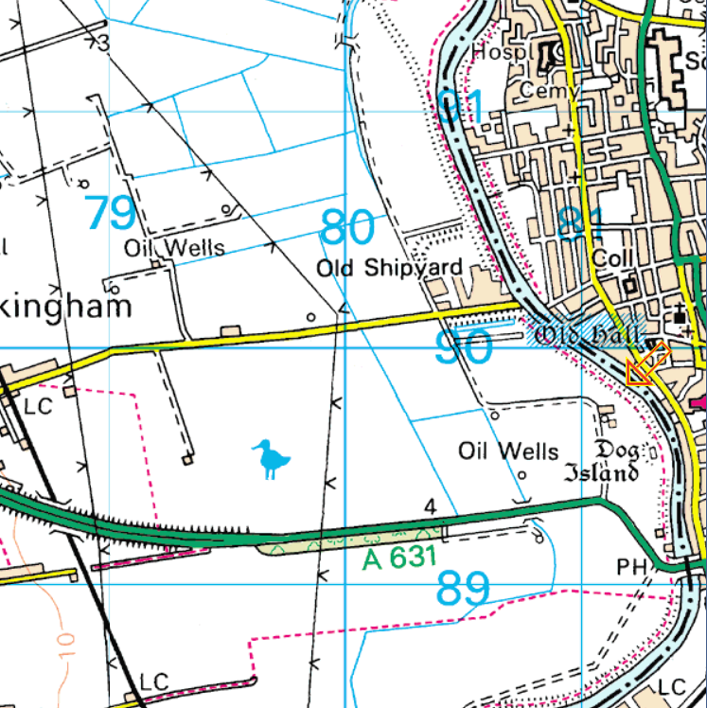
The first tale is of a little village which now has the high-speed A631 dual carriageway constructed around it to the south west, allowing the peaceful, quiet community to preserve its rural tranquillity. Centuries ago, though, the main road from Sheffield to Gainsborough went right through the very middle of the village, which, with the frequent passage of mail coaches, it may well have been livelier than it is now….

bigger scale

Perhaps this is why Beckingham’s most famous phantom, a colossal Black Dog, always keeps faithfully to his old tried and trusted route. The animal is reputed to be up to five feet tall and has dull red eyes that burn with an inner fire like the glowing embers on a coal fire
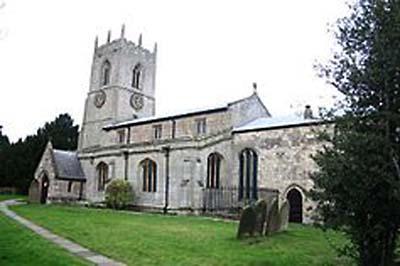
black_shuck_by_mearcu-d3lgpnd ccccccThe Black Dog invariably leaves from the churchyard of Beckingham’s parish church of “All Saints” which dates mostly from the thirteenth century, although the exterior is apparently fifteenth century.

church beck

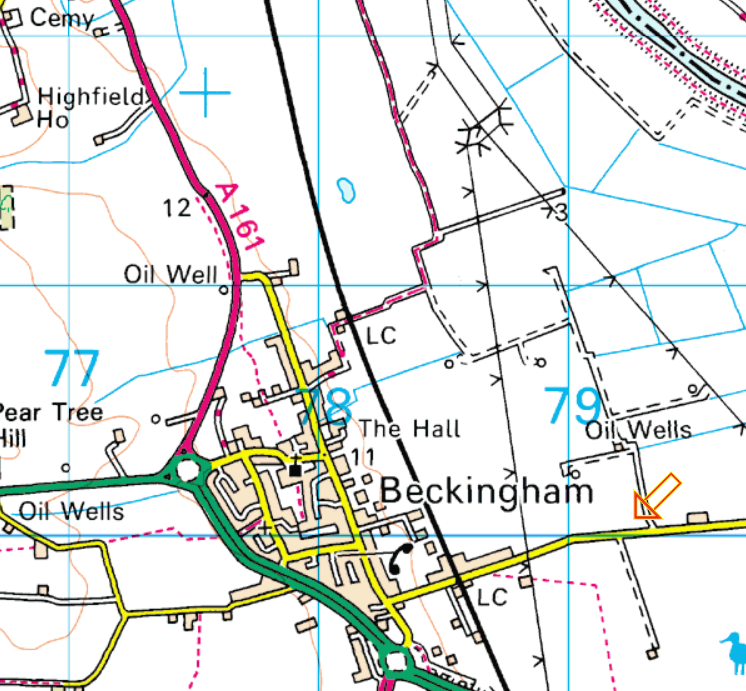
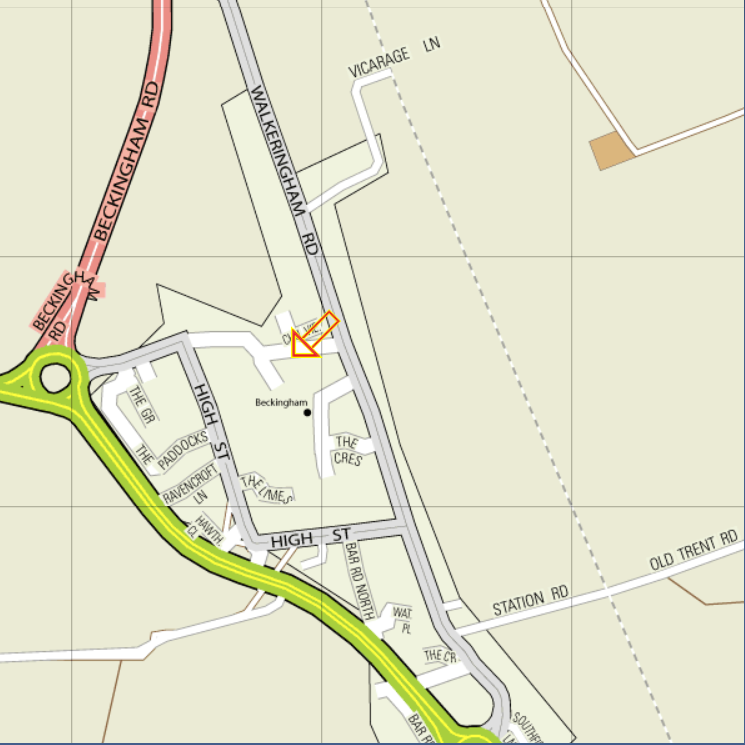
The Cryptic Canid leaves the little church with its square tower and makes his way, presumably down Walkeringham Road and then Station Street, before finally leaving the village along the Old Trent Road, walking purposefully out towards the marshy water meadows.
This map shows the church with its square tower and the red arrow points to the Old Trent Road.
better backingham
Some of the streets are indicated on this larger scale map. The red arrow points to the church…

at long last

The Black Dog always leaves the Old Trent Road (yellow on the map) near the Old Shipyard and then sets off along the old path to the south, alongside the old River Trent. The red arrow points to the riverside route he invariably uses.

red varrow

Black Shuck though, for it is no less than he, is not a dog to mess with.  Anybody who tries to get in his way or to prevent his progress from church to river does so very much at their own risk. A good many years ago a man from Gainsborough attempted to stop Black Shuck by refusing to stand aside and allegedly asking it what it was doing. The dog looked with great anger at this foolish person, who was later found unconscious in the middle of the road. He was paralysed down one side of his body for the rest of his life and never recovered the feelings in his arm or leg.

A second Black Shuck has occurred not too far from Newark-on-Trent. In the Nottingham County Library there is a manuscript dating back to as recently as 1952 which records the words of a Mrs Smalley, who was then about seventy five years old.
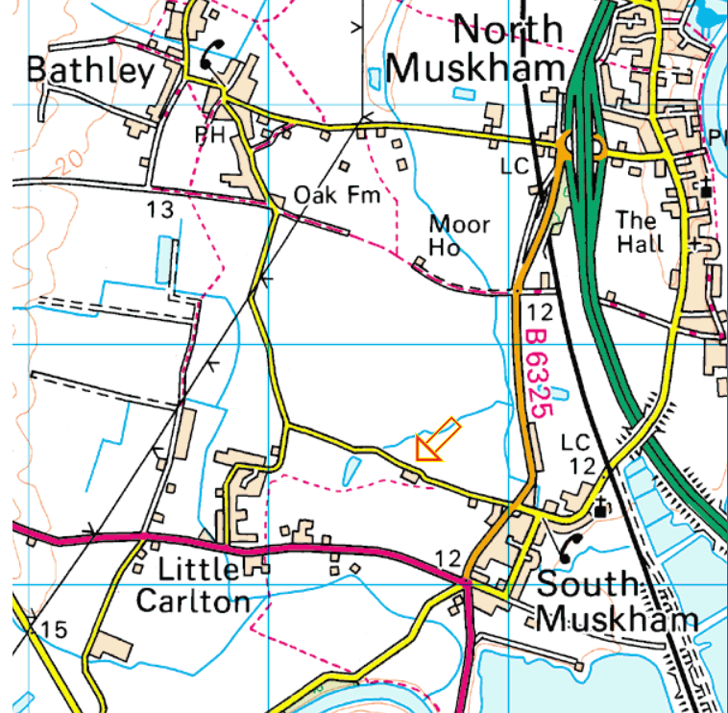
Her grandfather, who was born in 1804 and died in 1888, used to have occasion to drive from Southwell to Bathley, a village near North and South Muskham, in a pony and trap. This involved going along Crow Lane, which leaves South Muskham opposite the school and goes to Bathley. Along that lane he frequently, used to see a large Black Dog trotting alongside his trap.
Here is a map of South Muskham, with all the landmarks in the story visible.

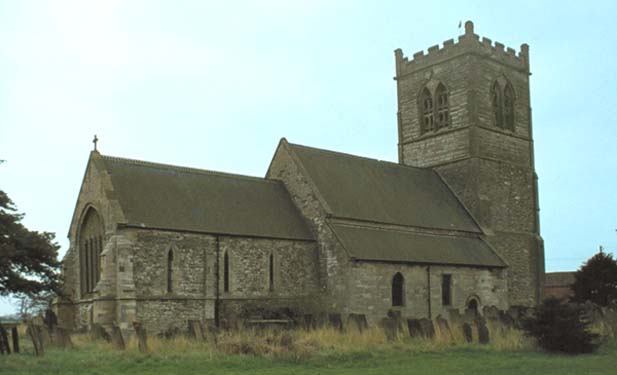
better map soujkth muskbhanmThe red arrow points towards Crow Lane, which goes westward  to Bathley. In the other direction, to the east, it runs, typically, past a church with a square tower.

pextne xxxxxxxxxxxxxxxxxxxxxxxxxxx

St. Wilfrid’s Church in South Muskham is medieval but seems to have taken a long time to construct. The square tower, therefore, has its lowest section of thirteenth century construction, the middle section is fourteenth century and the top is fifteenth century. One of the more interesting features are the carved ends of the wooden benches in the chancel, which include a number of “hideous monsters” and one crab.

“Round about 1915, Mrs Smalley’s son Sidney, used to ride out from Newark on a motorcycle to their home at Bathley. He went into Newark to dances and frequently returned at about 11 o’clock at night. He too often saw a black dog in Crow Lane; he sometimes tried to run over it but was never able to. One night Sidney took his father on the back of the motorcycle especially to see the dog, and both of them saw it.”

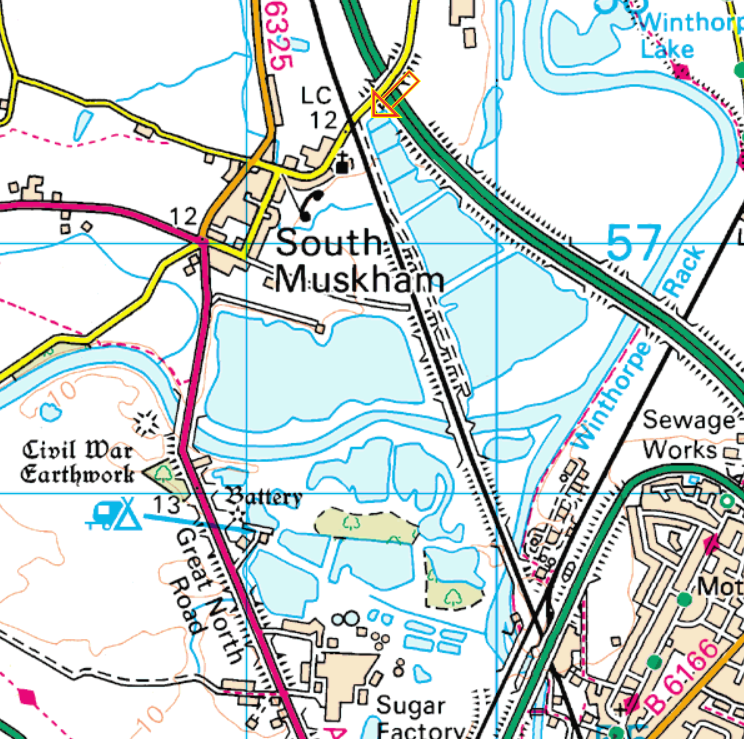
Overall, South Muskham is an area with a good deal of water in the landscape.

south musk is wetzzzzz

The third story is considerably more modern. It was 2.14 a.m. on May 11th 1991 and….

“Victoria Rice-Heaps had been visiting her boyfriend in Worksop, and was on her way home when she had her unusual experience. It was a journey she had made “thousands of times”. She wasn’t particularly tired, having slept earlier in the evening. Making her way out along the Blythe Road, she soon left the comforting glow of the streetlights for the dark country roads beyond.
After a mile or so, near to Hodsock Priory, Victoria saw illuminated in the beam of her headlights about 150 yards ahead “two red dots.”

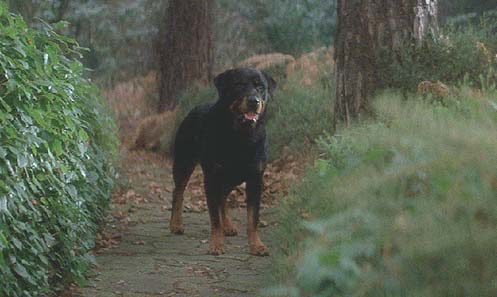
beast_main ccccccc

“I slowed right down to a crawl as I saw a huge black dog. It looks like something from hell! It had very shiny fur and a short coat; the nearest thing I’ve seen to it in size was a Great Dane, but it had a good 18 inches over a dog of that breed. Its ears were erect and it appeared to be dragging something quite large across the road.”

Victoria had lived with dogs all her life, but had seen nothing like this creature.
As she waited for the dog to get out of the way of her Fiat Panda, the headlights of another vehicle announced its approach from the opposite direction. The driver of the red Montego estate, evidently seeing her at a standstill, pulled up and wound down his window to ask if anything was wrong. Victoria, having wound down her own window, asked the man if he could see the dog in front of her car.

“At this moment he shouted “Oh Jesus!” and sped off into the night. I looked in front of me again and to my joy and amazement the creature had vanished. I drove home as fast as I could. I did a little research later and found a tumulus nearby, a river and an old boundary as well as the priory”.

There is a lot less exact geographical detail for this particular story and I have therefore made one or two “best guesses”.
Victoria was driving north out of Worksop along the B6045 in the direction of Blyth. This road is fairly straight and leads quickly to the Hodsock area. The very narrow yellow road to the west of the B6045 is the turn off to Hodsock Priory, which is a big country house, rather than anything of particularly religious significance. In Nottinghamshire, it is very famous for its magnificent displays of snowdrops in the very first days of Spring.
B6045

My contention, though, is that Victoria only saw a single snapshot moment of Black Shuck’s usual journey. I believe that the huge dog would have started his journey in the northern section of the B6045.  Here is a map with the middle of Blyth and the old unnamed northern section of the B6045 (see arrow). It leads past a church with the square tower, St Mary and St Martin.
wet blyth

Shuck’s exact point of departure would surely have been the churchyard of this ancient church which dates from as early as 1088, when it was a part of a Benedictine monastery. Clearly, if you are driving down the B6045 in a saloon car at 40-50 m.p.h. in the darkness of the night, you will see Black Shuck for a lot less time than if you are on foot, or in a pony and trap, or even on a slow motorbike back in 1915.

The one thing I would really like to know, though, is what “quite large something”  Black Shuck was dragging across the road. And the driver of the red Montego, how had he not seen the ghostly dog when he first stopped? He was going in the opposite direction to Victoria, and Black Shuck was right in front of her car. The driver of the red Montego must have been parked almost directly next to the “Hound from Hell”. Indeed, she actually asked him if he could see the dog in front of her car.

When he apparently and finally saw this enormous beast, he shouted out in terror and drove off into the night. Why? He left a defenceless young woman behind on her own. Did he see what Black Shuck was dragging? Given the Hell Hound’s connection with the imminent death of those who see it, did the man see his own ghostly corpse?
If you have followed the directions and maps carefully, you will not find my next question a particularly difficult one!

“What is the connection between all three of the Black Dogs seen in Nottinghamshire?”

Well, if you have paid attention, you will have realised the elements which occur and recur throughout all three stories.

There is always a church, and the Ordnance Survey map shows that it is always a church with a square tower. That church of course, will have a graveyard around it. Black Shuck then follows a route which is always a very ancient one, rather than opting for the new bypass or the new dual carriageway. It is always a road which has been there for centuries, almost as if he has been following that path for that same amount of time. And as the road continues away from the church, it will gradually become more and more lonely and isolated. At the same time it will lead through a landscape which contains enormous amounts of water, either in the form of lakes, rivers or streams. In one case, namely that of Beckingham, the road leads to the wettest place of all. This is an area of riverside water meadows, which have now been taken by the RSPB to form an official wetland nature reserve.

rspb reservezzzz

Black Shuck makes his departure from this route not only at an old shipyard, but he also sets off southwards alongside the River Trent itself. As if to prove that this is the strongest manifestation of Black Shuck in the county, the phantom animal will pass an ancient hill which is called “Black Island”. This may have been a tumulus in the dim and distant past. Somewhere as flat and wet as this area is certainly a strange place for a completely natural hill.

Victoria Rice-Heaps mentions a tumulus near the B6045, but I have been unable to trace it, although I have not visited the area personally. This does not mean that it is not there, of course. But there is a “Hodsock Red Bridge”, red with the colour of Black Shuck’s eyes, perhaps? And what is “Black Screed”? Nowadays, a screed is “a levelled layer of material (e.g. cement) applied to a floor or other surface.” Earlier than this, it was “a fragment cut from a main piece”, and then “a torn strip”. Was it called “Black Screed” because it was connected with Black Shuck and being “torn to shreds”?
I was delighted to find all these various connections, because they fit in perfectly with the book “Real Wolfmen: True Encounters in Modern America” by Linda S Godfrey. She provides a key quotation about the appearance of spectral canids. And this quotation applies not only to North East Nottinghamshire, but also to the state of Wisconsin in the north eastern part of the United States.

I will be looking at all these various connections and trying to explain why they are so important in another blog post in the future.

6 Comments

Filed under Cryptozoology, History, Nottingham, Science, Wildlife and Nature

Hallowe’en Nights (2) The Beast of Auxerre

After researching “The Beast of Gévaudan”, I was amazed to find that over the centuries, a large number of different areas of France have been ravaged by man-eating creatures, such as the monsters in the countryside around Auxerre, Lyon,  Orléans or the Vosges Mountains. On a number of occasions what was probably one single animal might even be called by several different names as it wandered widely around various places. «La Bête des Cévennes », « La Bête du Vivarais » or « La Bête du Gard », for example, were all one and the same monster.
The majority have always been considered wolves, although of course, in our time the wolf no longer seems to behave in this aggressive way. Strangely enough, for a substantial number of these less widely known beasts, the witnesses were often keen to say that it was a wolf but not an ordinary wolf like the ones which they saw virtually every single day. It may have had a wider muzzle, or a belly that dragged on the ground. It may have had pale or even white underparts. Ironically, this latter identification feature on its own actually excludes the wolf as a possibility.
All three of these details, of course, the muzzle, the belly and the underparts were  features of the “Beast of all Beasts” in Gévaudan.  The peasants, shepherds and shepherdesses were armed only with a stick, or a pole with a knife attached to it, because the lower classes were forbidden to carry firearms, which was the exclusive right of the nobility.  Agricultural workers, though, were all highly experienced  at identifying wolves. And lightly armed as they were, the population of the average administrative area in rural France in the eighteenth century might still kill a hundred wolves a year between them.
Nowadays, the wolf seems a much calmer animal. They have become extremely rare in Western Europe, and even in Eastern Europe they seem to be less dangerous than old oral traditions would have us believe. Furthermore, it is certainly a fact that only one person has ever been killed by wolves in North America, and even then the wolves involved had become over-habituated to Man through frequent feeding on a landfill site.
The process by which wolves are believed to have become man killers in France is described in a French Wikipedia article, entitled “Le Loup dans la culture européenne”…“The Wolf in European Culture”

….Thanks to the improvements made in the field of agriculture, Man ceaselessly extended his cultivated land and increased the area for his livestock at the expense of woods and forests. The Feudal System and hunting as a leisure pursuit constantly reduced the number of animals to hunt, and attacks by wolves became therefore increasingly frequent. Flocks of sheep were an easy prey item during a period when food was short.
In normal times the wolf does not attack Man and indeed, even when he is hungry he fears human beings, above all when he is forced to confront an upright enemy. Faced by a man, the wolf always backs down or just runs away. Nevertheless wolves in the Middle Ages used to follow men around when they were out at night walking between villages. The wolves always remained a certain distance away from them. Without doubt they were doing this to get food, thinking that the man must be hunting and that they could grab any unwanted food that was left behind. These stories of wolves which followed men at a distance, sometimes over dozens of kilometres, accentuated the phenomenon of fear of the wolf.
However, attacks by wolves on men were reported for the first time towards the end of the Middle Ages, from the time of the Hundred Years War onwards. These attacks also correlate with epidemics of rabies which can change a wolf’s behaviour completely.
At this time of famine the wolf might have started devouring the corpses left behind by the warring armies. Not rabid wolves, but wolves used to the taste of human flesh would have committed acts of predation towards weak human targets. These cases of predation disappeared around 1820 because of the disappearance of open air mass graves from this period onwards. There will always remain nevertheless a small number of isolated attacks linked to epidemics of rabies, but in this case the cause of the illness is easily identifiable.”

(My own translation)

Further ideas come from « Mikerynos » writing on his own excellent website. He sees the entire French population as having within them a deep seated fear of the wolf, much as other nations might have traditional fears of people of a different race or cultural background from themselves.

“Nowadays beasts still appear in the French countryside but they only kill sheep or other animals. The most famous of all was the Bête des Vosges in 1977.
Feral dogs, escaped zoo animals, animals trained by malicious pranksters and sometimes wolves are used to explain these episodes.
But the Old Demons are not yet ready to fade away. The arrival of Italian wolves in the Parc National du Mercantour has brought about the raising of a protective shield wall on the part of livestock farmers and hunters, who have not been at all afraid of introducing the question of the danger to human life, for in the collective subconscious of the whole French nation, some monstrous beast can still be seen lurking dimly behind these innocent wolves, which have absolutely no connection whatsoever with it.
Over the course of the centuries in France there have been many other episodes similar to the Beast of Gévaudan, even if they were less blood soaked. And the explanations are always exactly the same. Wolves are the guilty ones.

Biche-second blogpost cccc

Nowadays all zoologists are in complete agreement with each other that the wolf practically never attacks Man. Indeed on the contrary, the Wolf always flees from Man. The idea that a Wolf is a man eater is essentially a French one which has led some people to deduce that the wolves in France must be the only ones to exhibit such behaviour! In the same way the theme of the werewolf, a man who can change into a wolf, is above all a French one.  And The Beast who brings together both of these two themes is, in exactly the same way, as we already said, a very French concept.
In a word, though, it is the fear of untamed nature which shines through these themes, a fear which has become particularly focussed on certain species such as the wolf. Every animal attack which seems beyond rational explanation very quickly leads to gossip and rumours. The Beast of Gévaudan is not the only animal to have spread terror across France. There was “la Bête d’Evreux”  (1632-1633), “la Bête de Brives” (1783) and “la Bête du Cézailler” (1946-1951).
The most ferocious seem to have been “la Bête de l’Auxerrois” and “la Bête du Vivarais”.
The former appeared in 1731 and killed 28 victims. It was described as a tiger or a wolf. The “Bête féroce de Sarlat” was famous in Périgord from 1766 onwards. Its peculiarity was not to attack women but to kill exclusively men. In 1814 it was the turn of the « Bête féroce d’Orléans » to achieve a certain success. It ripped to pieces and devoured the poor inhabitants of the countryside, massacred entire families, destroyed and devastated everything which appeared in its path and carried out the most appalling carnage, if one is to believe the caption explaining an etching of the period. A lament was even written about it; the style is not too clever but we can imagine the fear of the audience who were listening to such verses. The official disappearance of the wolf from France came in 1937 when the very last one was killed in Limousin. Or more precisely, the Wolf was presumed extinct insofar as the breeding population was diminishing between 1930 and 1939.
From 1818 to 1829, more than 14,000 wolves were killed in France every year. That was the era of the appearance of the single shot rifle (1830) then there were repeating rifles and the double barrel shotgun. Firearms became henceforth extremely accessible and extremely effective. Wolves could be killed at a range of more than 100 metres. The number of hunting permits awarded just grew and grew. In parallel, the use of poison spread among wolf hunters: monkshood the wolf killer, added to ground glass, meadow saffron, a concoction with tamarack, water hemlock and nux vomica.”

(My own translation)

I have found it a fascinating idea that only two hundred or so years ago a highly developed European country like France could have been repeatedly ravaged by man-eating animals, whether they were wolves or, just plain, simple monsters of the type the Hillbilly Hunters chase after on a weekly basis in the TV show “Mountain Monsters”.
I intend therefore to bring these unknown creatures back into the public eye. Had they been active in an English speaking country, I am sure that they would be a lot more famous than they are now, although, of course, they do appear in a good many French websites on “la cryptologie”. The first one to feature, on a purely alphabetical basis, is the “Bête de l’Auxerrois ou la Bête de Trucy”….

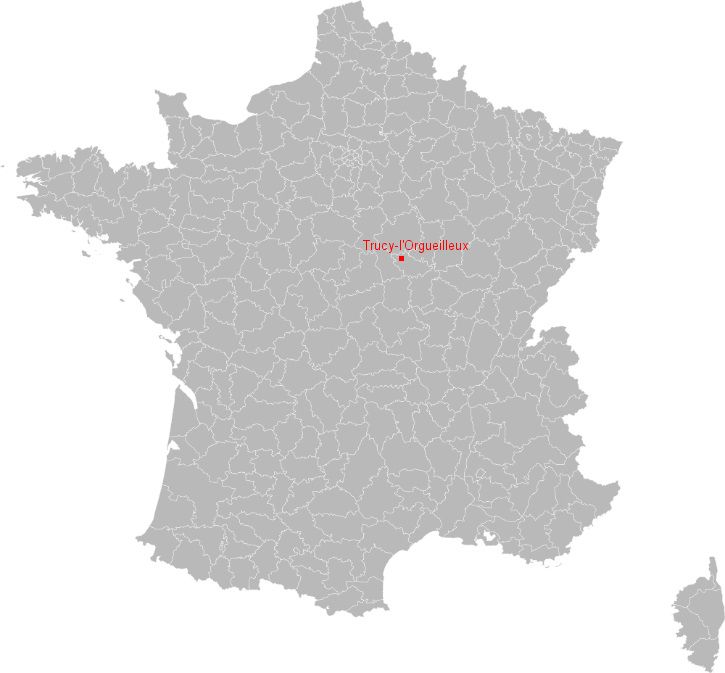
Called by two alternative names, the “Beast of Auxerre” or the “Beast of Trucy” was either one or several man-eating animals which were behind an extensive series of attacks on humans. Nowadays, the tiny village is called “Trucy-L’Orgueilleux”.

carte-Administrative-Trucy SECOND BLOGPOST

The first incident came in November 1731 when a young boy of 12 years old was working close to the wood of Trucy-sur-Yonne to the south of Auxerre with his mother. She managed to snatch him back from the carnivorous animal which was trying to devour him, but he died in her arms as they made their way back home.

SECOND BLOGPOST ccccc

Attacks then succeeded each other in such quick succession that King Louis XV offered a reward of £200 to whoever could kill the beast. Beats were organised and numerous wolves were killed. The poisoned carcasses of sheep were left out in the fields but the attacks continued, with young children the principal victims. The beast even ventured into the village of Mailly-la-ville and carried off a young child who was playing in front of his house. Trying to snatch him back from the beast’s fangs, his nurse was only able to recover one of his feet (or just one of his arms according to other witnesses).

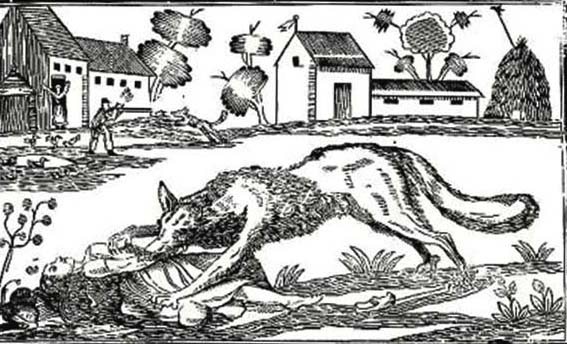
Illustrations of the “Beast of Auxerre” or the “Beast of Trucy” seem pretty well non-existent on the Internet. The engraving below appears on one website, but it is also featured elsewhere as being the  “Beast of Orléans”…

2653xxxxxxxxxxxxxxxxxxxxxxxx_small_1

In five months the local priest of Val-de-Mercy recorded 14 deaths due to the attacks of this carnivorous animal. By the end of the year 1734 a grand total of 28 victims had been listed. The animal supposedly killed a total of nine children, nine women and ten men according to the death certificates which have so far been located. In 1734 two wolves were killed in the course of a hunt and the attacks stopped shortly afterwards. There was however, no irrefutable concrete indication that either of these two animals was behind the attacks which had lasted for three desperate years. Contrary to the Beast of Gévaudan, these killings seem to have concerned as many men as women
In 1817 a second carnivorous beast ravaged the forest around Trucy for a few months, strangely, at the very same place as the animal from eighty years previously. One child was devoured close to Charentenay, another at Fouronnes and numerous people were injured. Poisoned sheep were placed close to the woods and the beast duly disappeared without leaving any trace whatsoever. No carcass was ever found but mercifully the attacks stopped.

This picture allegedly shows the “Beast of Auxerre” or the “Beast of Trucy” but it had previously been used in pamphlets about the Beast of Gévaudan.

bete-du-gevaudanzzzzzzz
For the attacks of 1731–1734, contemporary rumours talked of a werewolf, of several wolves and even of demons. The witnesses spoke of either a huge wolf or a tiger. Following the usual pattern, the witnesses’ descriptions indicated an animal that was “like a wolf” but which nobody thought was just an ordinary wolf. According to the experts nowadays the monster was probably some exotic wild animal which had escaped from its owner, but given the descriptions, it was most probably not a common-or-garden wolf.

Unlike the countryside though, in the towns, certainly, the majority of the people had little idea at all of what a wolf was like. Here is a contemporary picture of a wolf….

concept of wolf xxxxxx

For the second series of attacks in 1817, local talk was of a hyena although one statement described a mastiff dog with pointed ears.
It is always worth looking at a second account of what are clearly the same events

“In 1731 there appeared in the woods around Trucy, to the south of Auxerre, a beast which terrorised the region. The first attack was on a boy of twelve in November 1731, very close to the tiny village of Trucy-l’Orgueilleux. The number of victims quickly increased, with 17 in three years, of whom the majority were children. The king offered a reward of £200 to whoever could kill the beast but without result. The creature then continued its carnage until 1734 when it quite simply disappeared without anyone having been able to kill it despite numerous beats being organised. Overall it killed approximately 30 people, the majority of them children.
In 1817 it was a different beast which ravaged again the very same area of Mailly-la-ville and the Forest of Trucy. Described as a tiger or an enormous wolf, people finally concluded that it was a wolf of enormous size and particular ferocity. It killed 28 people (nine children, nine women and ten men) and was never killed despite numerous beats being organised and the poisoned carcasses of sheep being placed randomly in the surrounding area. Like its predecessor this animal just disappeared “back into Nature” so to speak.”

Clearly there has been some confusion between the two websites over victim totals, but it is always best to see at least two variations of the same story. If you want to see more than just these two then go to the French Google and search for either “La Bête de Trucy” or “la Bête de l’Auxerrois”.

Another website…..

 “…a mother grabbed her twelve year old son from the jaws of an enormous beast without managing, alas, to save him… After this they killed a number of wolves, but the beast continued to attack young children, women and men…… 28 victims were eventually listed. Then they killed a couple of wolves, and the attacks ceased. People talked of werewolves, of wolves gone mad, and even of Demons. Witnesses spoke of the “Beast like a Wolf” but actually “Not a Wolf”. The experts nowadays tend to speak of a wild animal, but seldom of a mere wolf.”

At least one other website which lists “The Monsters That Ravaged France” clearly places “La Bête de Trucy ou la Bête de l’Auxerrois” not in the category of the wolf but in that of the “bête mystérieuse”.
These same details are given by that great expert, « Mikerynos » in the very first article on the page….

“(Elle) est apparue en 1731 et a fait 28 victimes. Elle est décrite comme un tigre ou comme un loup.”

What is most striking about “La Bête de Trucy ou la Bête de l’Auxerrois”, though, is the sheer number of victims consumed. In English we say “as hungry as a wolf”. I don’t know if the French have an equivalent but if they do, it should probably relate to Trucy or Auxerre!

4 Comments

Filed under Cryptozoology, France, History, Science, Wildlife and Nature

A twitch to Dorset and the Beautiful South

(An extract from my old birdwatching diary “Crippling Views”)

I used to be a very keen twitcher, driving hundreds of miles to see a rare bird. It sounds really stupid now, but it wasn’t. It was exciting…

Saturday, July 23, 1988
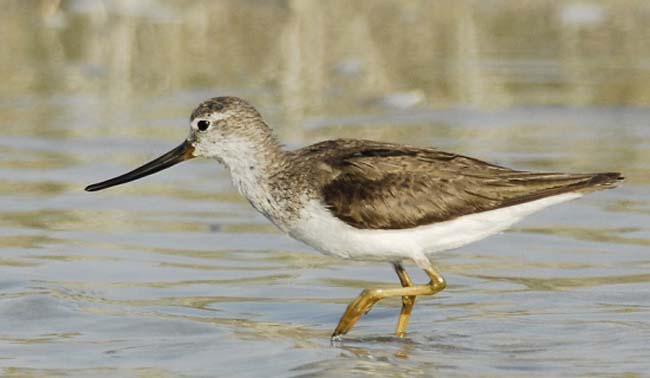
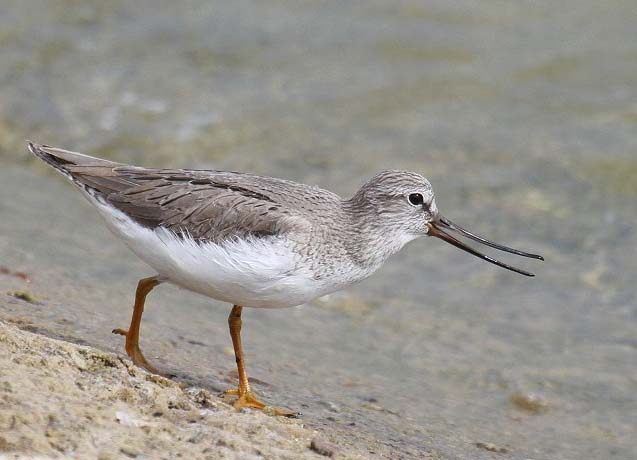
A late-night phone call and by 10:30 p.m., I’m being picked up to drive overnight in an attempt to see a Terek Sandpiper, one of the very few birds to have an upturned beak.

550px-Terek_Sandpiper zzzzzzzzzzzz

At the time, this wader was extremely rare in this country, and for reasons best known to itself, this particular individual was a very long way indeed from where it should have been. Yellow is summer, and blue is winter…

rangeccccccc

Our target bird is a good drive from Nottingham, at Stanpit Marshes, near Christchurch, far down in deepest Dorset…

We go past all sorts of romantic dual carriageway turnoff signs, Oxford, Salisbury, all places I wouldn’t mind seeing one day, but not tonight, or rather today, for as we arrive at Stanpit, Rosy fingered Dawn is just beginning to lighten the eastern sky.

MARSH  vvvvvvvvvvvvvvvvvvv

I feel terrible, truly awful. We all sleep for the best part of half an hour, slumped in the car. When we emerge the light is really quite good, but the drawback is that it is pelting down with heavy drenching rain, which is the worst possible thing for glasses and valuable optics. We walk out onto the marsh, where there is the normal selection of shelducks and black headed gulls, sitting out on a shingle bank, but anything more subtle is going to be difficult in this appalling weather. Cleaning off my glasses has already soaked my one and only handkerchief, and I am very loathe  to get either my binoculars or my telescope out from under my old waxed jacket. I hate the rain.
In the hour before we left, I did a little bit of research on the Terek Sandpiper. The literature that I read said that they were not amazingly different from Common Sandpipers, especially when seen badly or from a distance. One particularly good point, though, is that they feed at a much quicker rate than the Common Sandpipers with which they often associate. Bearing this in mind, I take a closer look at three Common Sandpipers feeding in a creek….

common sand.jpg zzzzzzzzzzzzzzz

One individual is pecking away a lot quicker rate than the other two, and seems rather dumpy and portly to me. Whether its beak is upturned or not, I just cannot see, the rain is coming down too hard. I call Paul, but he can’t penetrate the gloom either. The other two birdwatchers I’m with are a lot more experienced than I am, so I just meekly point out the birds to them, say that I think that they are worth looking at, but don’t labour the point. Neither of them seems to be particularly impressed, because they stalk off into the middle distance, without even a backward glance. Unabashed, I try to get closer to the three birds, but succeed only in flushing them, and they all fly off along the edge of the creek. I presume that that is the end of it.
It isn’t though, because we soon come across a group of birdwatchers, all intently watching a Terek Sandpiper.

another terekxxxxxxxxxxxxxxxx

It has just flown in with two Common Sandpipers apparently (LOL, you would say nowadays). It is visible at the edge of the main creek. We watch it for a good while. It’s a rather delicate, if pot-bellied bird, as it feeds rapidly in the shallows. It even bathes briefly, preening itself with what in the telescope is obviously a wonderfully upturned bill.
Our next port of call is a little village called Corfe Mullen, a really posh place, compared to our pathetic Northern Hovels. All great big mansion houses, with huge country gardens, all filled with exquisitely trimmed conifers. Here is a beautiful Southern Hovel…housesxxxxxxxxxxxxxxxxxxxxxxxx

There’s a small triangle of grass in the middle of the village, surrounded by lots of lovely telegraph wires, all eager to support the delicate weight of a Red-rumped Swallow.

Red-rumped-Swallow WIRE xxxxxxxx

Not today, though. We stroll along the surrounding lanes, turning up a few swallows and housemartins. It’s not a great day for hirundines, because it’s a bit drizzly still, and somewhat cold. There cannot be many insects up there for them to catch. After a couple of hours searching, we suddenly hear a cry. I look up and see the bird, completely distinctive with its dark rear end, and nobody is any doubt as it disappears over a distant line of trees.

RED RUMP FLYING zzzzzzzzzzzzzzzzz

After this, we return to the M3, M25 and M1, all equally delightful in their own way. By the time I get to the services at Leicester Forest East, I feel like one of the extras in “Return of the Zombie Twitchers”. Still, you forget the distance covered, and the discomfort, when you look at your life list. Soon be two hundred.

2 Comments

Filed under Science, Twitching, Wildlife and Nature

Just what WAS the Beast of Gévaudan?

There is no shortage of theories as to the identity of the murderous beast I described recently,  la Bèstia de Gévaudan,which terrorised a whole province of France from 1764-1767, and claimed upwards of a hundred victims, mostly women and young girls. From what I have read, but above all, from what I have watched on “Youtube”,  basically, you will have to make your own  choice.

The creature was, therefore, perhaps a single enormous wolf, or maybe a number of wolves in a single pack, or even a large number of wolves in a number of separate packs.

Less fancifully, it could have been some type of enormous domestic dog, or perhaps even a wolf dog hybrid, perhaps with a red coloured mastiff involved. Its supposed invulnerability to bullets was because it wore the armoured hide of young boar.

It may have been a hyena although this species is thought to have been long extinct in Europe at this time. It has even been suggested that it was not a real animal, but a sex-crazed serial killer who dressed in a fur costume, pretending to be a wolf. In the same vein, it was perhaps a werewolf with a penchant for hunting women and young girls.

An initial, perhaps simplistic approach, is quite simply to look at pictures of the beast, and to compare it with photographs of the most likely candidates, and then to make up your own mind.

Firstly, here are some pictures of the beast itself. You need to bear in mind that they are unlikely to have been drawn directly from a witness descriptions, and that many of them may have been mere copies of the work of other artists. Furthermore, at this time, it was accepted practice to draw animals in a very stylised fashion, rather than in the more accurate zoological one. Because of this, therefore, the head and limbs are often out of proportion, and the body is frequently too large for a small head and legs. In many pictures, the artist sought to portray an unknown animal by reaching into his knowledge of Heraldry…


This slideshow requires JavaScript.

Here are some photographs of wolves. I have deliberately picked what I consider to be the largest individuals, and to provide illustrations of animals in poses which are hopefully similar to those in the engravings of the beast.

This slideshow requires JavaScript.

Here are some photographs of what are usually called wolf dog hybrids. Having looked at a much larger number of them on the Internet, I do feel that most can be dismissed immediately because an ordinary person would think that they were pure bred wolves. They are only noticeably different when crossed with a very distinctive breed of dog.

This slideshow requires JavaScript.

Many cryptozoologists favour the hyena. Certainly, a number of the original drawings from the eighteenth century are titled as being “la Bèstia de Gévaudan, the hyena”.  Many of them, even the most wolf-like, have their flanks covered with either stripes or spots.
This picture was allegedly drawn by the killer of the second beast, Jean Chastel.

drawn chastel

Here are some pictures of the striped hyena.

This slideshow requires JavaScript.

And here are some pictures of the spotted hyena.

This slideshow requires JavaScript.

Basically, you pay your euros, and you take your choice.
As blogposts cannot be of infinite length, let me summarise the fors and againsts of all the possibilities as I see them.

A wolf or wolves?

This is the mot acceptable of a very large number of  explanations. Certainly, the prints found were deemed to be those of a wolf. Monsieur Antoine de Beauterne who was to kill the first animal, the Wolf of Chazes, said that there was « aucune différence avec le pied d’un grand loup » “no difference with the pawprint of a large wolf”

BUT…

Wolves do not normally attack Man. The locals used to kill around 700 wolves every year, so they all knew what a wolf looked like and could defend themselves against them. All the witnesses were adamant that the animal was not a wolf, but an animal that they did not know. That is why it was immediately christened “la bèstia”. Neither can wolves have a white breast and underparts, as a large number of witnesses said in their descriptions and, indeed, as is portrayed in many of the contemporary illustrations. Only a hybrid animal could exhibit this pattern of coloration.

Wolves do not strip the clothes off their victims, neither do they decapitate their prey.

After the Wolf of Chazes was killed, the deaths did not stop.

A rabid wolf?

An animal  diseased in this way would not have been afraid of Man, but it would certainly have died well before the three year period was  up. A number of rabid wolves? Isn’t that possibly stretching the argument a little?

A hyena?

The animal would certainly have been unknown to the inhabitants of the area. Members of the French nobility, however, frequently indulged themselves by importing exotic animals such as lions and tigers into the country, and we know that hyenas were brought into France at this time. So too, hyenas are supposedly relatively easy to train, or at least, easier than you might expect! Whether this would extend to converting them into fearless and ferocious attack animals is a different matter, however.
Hyenas are certainly capable of decapitating their prey. I have been unable to ascertain if they take the clothes off their victims, although I would have thought that they might have needed opposable thumbs for any particularly intricate garments.

BUT…

the second beast to be killed, the Bête de Chastel, did not have enough teeth to be a hyena. This creature was, without doubt, a canid of some description, according to the King’s Notary, Roch Étienne Marin, the man who carried out what appears to be an extraordinarily thorough autopsy. On the other hand, the creature was also examined by the famous Comte de Buffon, an extremely famous scientist and naturalist of the day, whose ideas were to have a great influence on Charles Darwin. Buffon pronounced it to be a very large wolf.

skulls ccccccc

The Striped Hyena, which resembles most closely perhaps, la Bèstia, does not hunt but scavenges. The Spotted Hyena does  hunt for itself, but nobody has ever really mentioned spots as a feature of la Bèstia.
In one of his blogposts, C.R. Rookwood suggests another exotic solution. He suggests that la Bèstia was a  mesonychid, a prehistoric mammal related to present day whales. They were very large predators with huge heads, long tails, and hooves instead of feet. The largest was Andrewsarchus mongoliensis, known only from its skull, minus the jawbone: for this reason, illustrations of its colour are, for the most part, just well informed guesswork. The structure of the animal is based on the other members of the family, whose skeletal structure is better known.

This slideshow requires JavaScript.

This animal does fit quite closely the description given by many of the peasants who saw la Bèstia. A few of the reports did mention hooves instead of feet, although the creature may well have been described as having hooves to emphasise its connection with the Devil.

BUT…

How could a gigantic, fierce, flesh eating mammal have survived from a prehistoric era until the eighteenth century, without anybody noticing it?

A human serial killer?

Humans can remove dead people’s clothes. Humans can decapitate their victims. Some bizarre serial killers would enjoy the chance to mask their activities behind the depredations of a very large trained carnivore.

BUT…

All the reports by eye witnesses say that only an animal was involved. This idea of a human serial killer can only be maintained  if mutilated bodies were found and there were no eye witnesses who saw an animal attacking them. Only in the Cantal area, apparently, were these circumstances fulfilled.
Of late, many people have  become increasingly concerned by the involvement of Jean Chastel in this marvellous enigma. Jean, a farmer and inn-keeper in the province of Gévaudan, and his son Jean-Antoine, have come under suspicion because when both of them were imprisoned for a period  because of their aggressive attitude to two of Francois Antoine’s gamekeepers, the number of attacks by the monster diminished noticeably.

chastel 2 ccccccc
It has therefore been put forward that la Bèstia was the result of Jean’s crossing either his own or his son’s red-coloured mastiff with a wolf, and then subsequently training it to kill. Almost all the evidence is perforce circumstantial, but much of it is quite compelling.
The creature may have been, therefore, a particularly  aggressive hybrid, which Jean-Antoine Chastel trained to have no fear of human beings, but instead to attack and to kill them. Witnesses have said that if its attacks were met with strong resistance, la Bèstia would retreat fifty yards or so, then sit and wait, as if sizing up the situation, before finally returning to the fray. This has been  taken to be the behaviour of a trained animal, unafraid of its opponent, rather than a wild one, whose natural instinct in an equal contest would have been to save itself by fleeing. Furthermore, witnesses thought that la Bèstia was driven not by hunger but by its own fury and an innate aggressiveness. It could also be more agile and jump much higher than a normal dog.
According to hunters in the eighteenth and nineteenth centuries, crosses between dogs and wolves were invariably very varied in appearance with dark or light tinges, sometimes marked with yellow or white or striped a little like a zebra. This, of course, agrees with many of the eye witness descriptions of la Bèstia.
Here are some pictures of mastiffs, although it is very difficult to know exactly what they looked like two and a half centuries ago. Nowadays, they simply don’t look particularly fierce….


Here is an English Mastiff around 1700.
mastiff 1700 ccccccc

If we are going down the road of wolf-dog hybrids, then I was quite attracted to a long extinct breed of German bulldog, or Bullenbeisser…
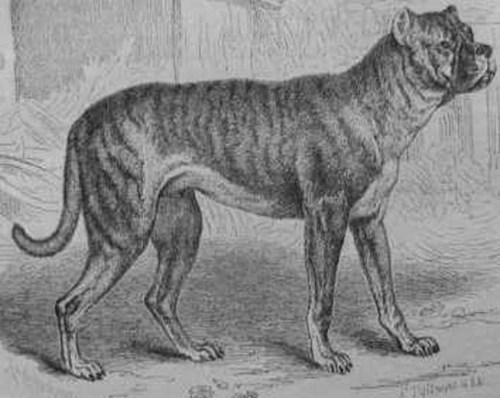
Bullenbeisser extinct ccccccccc

On the other hand, others have said that no successful interbreeding of a Mastiff, or Mastiff type dog, has ever been successfully carried out with a wolf, even though such a hybrid might explain the colours noted by many witnesses.
From the summer 1764 to its death in 1767, la Bèstia wandered over vast distances in almost no time whatsoever. Perhaps the two Chastel were conveying their creature around the province by some artificial means…an explanation of the high frequency of attacks spread over a not inconsiderable area.
On many occasions, people reported the apparent invulnerability of the creature when either stabbed or shot at. It has been suggested that it was wearing some kind of body armour made from the skin of a wild boar. Many witnesses told of the creature being shot several times by experienced hunters, and not being affected by it. Other witnesses spoke of its entrails hanging down after it was stabbed. Could this have been the strapping for some kind of home made armour?
When it was killed, la Bèstia died in the parish of La Besseyre Saint Mary, where Jean Chastel and his son lived. Perhaps they felt that they were about to be discovered, so they shot the creature and then manufactured a tale of heroism and religious devotion to snatch a glorious propaganda victory from the jaws of ignominious discovery and defeat.
As to why the two Chastel would want to kill so many of the people in the area where they lived, that remains a matter of pure guesswork. Certainly, Jean Chastel was supposed to have been an unpopular loner, and given his previous record of various episodes of fairly serious criminal behaviour, he may well have been a man who the locals disliked and feared in equal measure.
Perhaps les Chastel, père et fils were rejected and hated by local women and children, and then took their massive revenge on them, like those American teenagers who return to their High School and kill everybody they can. Perhaps they were sexual psychopaths who enjoyed killing and eating women and little girls.

One further detail which may be of significance is that the loud, belligerent and generally anti-social behaviour of the father, Jean Chastel, seems to have changed profoundly from May 16th 1767 onwards. On this date, in the village of Septols, Marie Denty was attacked in a little lane near her house, right under the eyes of her parents, and killed, just before her twelfth birthday. Supposedly, she and Jean Chastel were very close friends and he doted on her like the grand-daughter he never had. Now he was “fou de douleur”, “mad with grief”, and seemed about to lose his sanity. Perhaps, les Chastel and their appalling pet had killed by mistake. Certainly, his ne’er-do-well son, Antoine, seemed suddenly to be released from an evil spell, and he turned straightway to God. Jean spent his time in pure pursuits such as prayer, confession and penitence. For his redemption to be complete, he and he alone had to be the man who finally killed la Bèstia. According to which sources you believe, in best werewolf killer tradition, he made some silver bullets. Or perhaps, he made them from molten lead which had had a statue of the Virgin Mary dipped into it. Or perhaps he made them from the medals of the Virgin Mary which he wore on his hat. Whatever the case, he certainly had them blessed at a religious ceremony.

The manner in which he killed the creature is extremely suspicious, and could very easily be interpreted as a tale told merely to satisfy contemporary religious feelings, and to exonerate a man who is not bravely hunting down a ferocious killer beast, but who is, instead, shooting it through the head in its kennel before the locals find out it is actually his beloved pet, and then string him up from the nearest tree. The following account I have translated from the French Wikipédia

“On June 19th, the Marquis d’Apcher decides to organise a beat around Mont Mouchet in the wood of la Ténazeire. He is accompanied by a few neighbours as volunteers including Jean Chastel reputed to be an excellent hunter. The latter finds himself at a place called la Sogne d’Auvers,  a crossroads where he sees the animal go past. Chastel fires at it, and manages to wound on the shoulder. Quickly the marquis’ dogs arrive to finish off the beast.”
“As regards this rifle shot, Legend has preserved the romanticised words of the priest Pierre Pourcher which he used to say came from tale told by his family, “When the beast came along, Chastel was saying prayers to the Holy Virgin. He recognised it straightaway, but through a feeling of piety and confidence in the Mother of God, he wanted to finish his prayers. Afterwards, he closes his prayerbook, folds his glasses up, puts them in his pocket and takes his rifle. In an instant he kills the beast which had been waiting for him.”

“A week after the destruction of the beast by Jean Chastel,on June 25th, a female wolf which according to several witness accounts used to accompany the beast itself was killed by Sir Jean Terrisse, one of the hunters His Grace de la Tour d’Auvergne.  He received £78 as a reward.”

Perhaps they were acting on behalf of somebody else. The usual favourite is Jean-François-Charles de La Molette, the Count of Morangiès. He may have wanted to destabilise the area, so that he could take over when the revolution inevitably came.  There were others. The Church wanted to teach the King and the members of the  intelligentsia of the time that free thinking is frowned uon by God….

“Return to the Ways of the Lord or face the Hound of Hell”

As I said before, basically, you pay your euros, and you take your choice.

I had just finished my investigations about la Bèstia de Gévaudan, and had made up my own mind that all the devastation could be attributed, without necessarily knowing the real motivation behind it, to Jean Chastel and his son Antoine.
And then I bought “Real Wolfmen: True Encounters in Modern America” by Linda S. Godfrey. I was enjoying reading this interesting and innovative book, when I stumbled upon page 93 which was about the Wampus Cat of Ariton in Alabama.

“The man who wrote me was disturbed by unidentifiable animal sounds while camping on his ten acres on the Pea River near Ariton, which lies about half an hour’s drive south of the picturesquely named town of Smut Eye. His normally rambunctious standard poodle refused to leave the safety of his trailer that afternoon, and the man was having a cup of tea at about 5.00 p.m. when he heard loud rustling sounds coming from outside the camper.”
“As he peered out the camper window he noticed a large black furred animal with a doglike face surveying his campsite on all fours. It was bigger than his standard poodle and, he said, “Looks like a cross between an ugly collie and an even uglier lab.” Weirdly, it sported a white chest.”
“The creature ambled nonchalantly through the camp and when it jumped over a fallen tree, the man saw that it had a long, sinuous tail like that of a cougar. He reported the creature to the area game warden who said that while she didn’t know what it was, others have reported seeing it, too!”

You can pursue this interesting hunt for truth a lot further if you have any knowledge of French. There are three exceptionally good videos about la Bèstia which can be found on a tourist website for the Auvergne region. They are well worth your time, and seem to portray this most baffling of stories in a fairly reasonable and sensible way. Un, deux et trois.
If you want to see even more videos about la Bèstia, then go to this website which is the French equivalent of “Youtube”. If you search for “la Bête du Gévaudan”, you will find a huge number of films, varying from 15 or 20 seconds long to an hour or more. On the first page, there are eighteen different videos, a further eighteen on the second page, and any number of pages after that.

Bonne chance! And don’t be put off by having to practice your French!

55 Comments

Filed under Criminology, Cryptozoology, France, History, Science, Wildlife and Nature